Winter isn’t summer gone wrong.
Winter isn’t summer gone wrong. Rest doesn’t mean you’ve failed to work, and a quiet season in your life doesn’t mean something is broken. The same goes for painting: a season of making less doesn’t mean you’ve stopped being an artist. You don’t have to keep everything in balance all the time. You have to recognise the season you’re in, and stop farming against the weather.
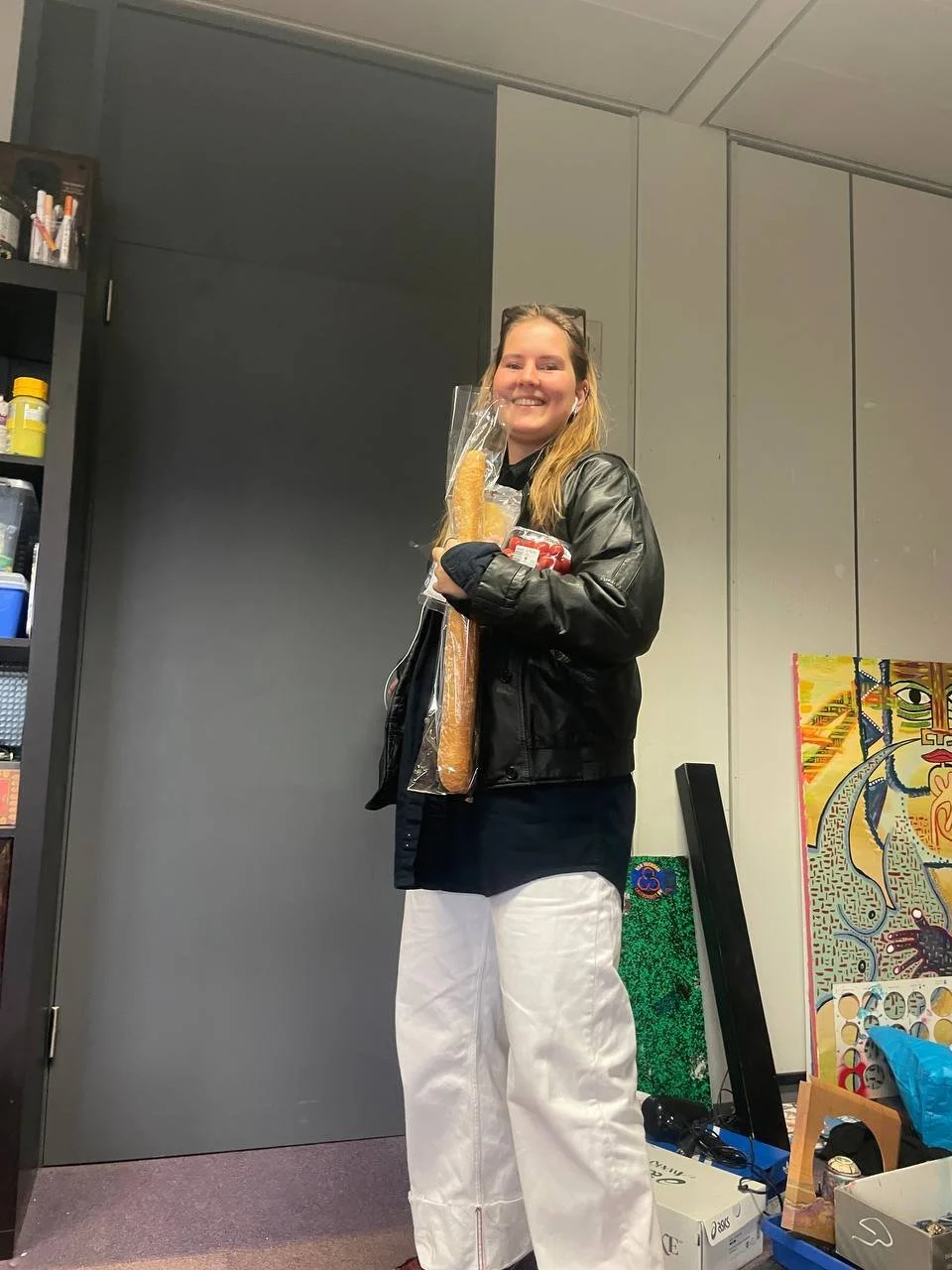
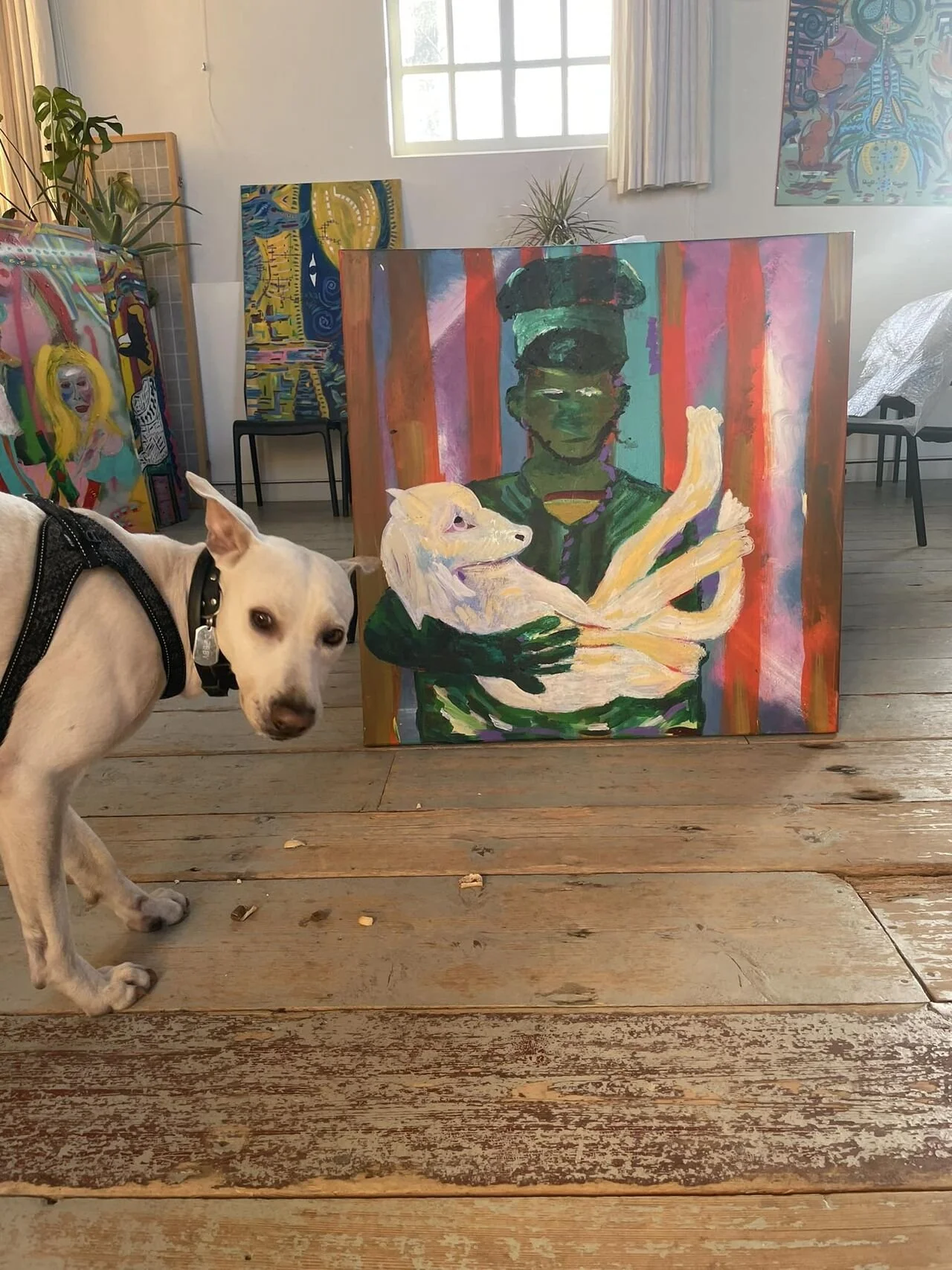
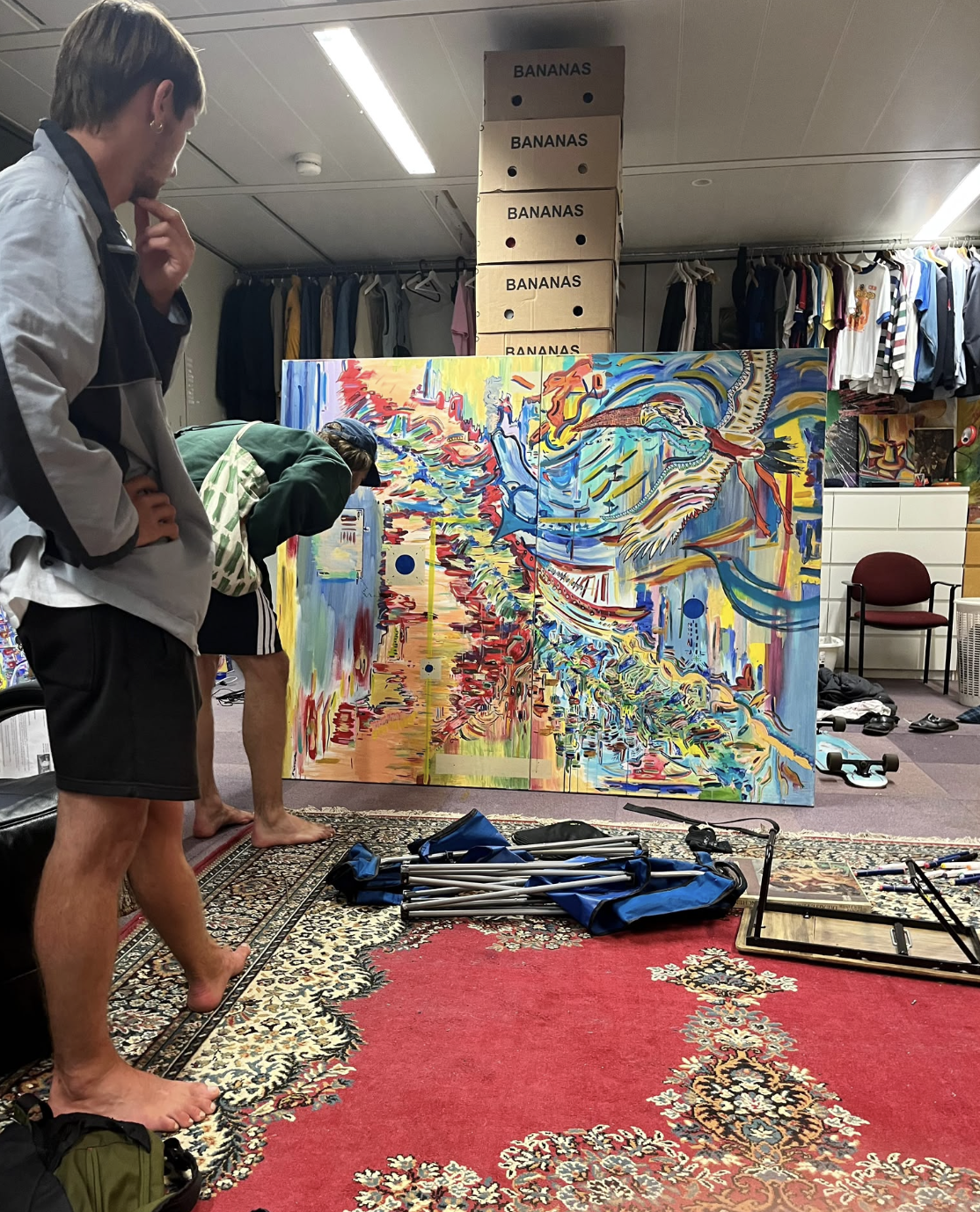
Alla visiting me in the studio.
Painting involves receiving, rather than always forcing something into existence.
Wait for more information or stimulation. I keep coming back to that line for my body of work. In painting, there are times when I don’t yet know what comes next. Maybe my job in those moments is to keep myself physically and mentally well, and give things time to become clear.
Sometimes painting feels like a conversation with the universe. I think of Gnawa music or voodoo trance: rhythm, repetition, and opening yourself to something you can’t fully explain. In painting, I feel something similar. I make a mark, something comes back, and I respond.
I don’t always know where an image comes from or what it means. My job is to stay present enough to receive it. Through finding a place for things in the painting, I begin to find my own place too. And sometimes, I have to wait before the next thing arrives.
For me, art runs parallel to religion. Both involve searching, paying attention, and opening yourself to something you don’t fully understand.
Dos Cafe Para llabar
2023- Sketch on wood
¿Querías decir “dos cafés para llevar”? Significa “two coffees to go.” ☕☕
It’s mostly about what we feel: the urge or the craving, different addictions some that destroy you, but some keep you slightly at bay something you could share with a person, a family member, a coworker, taking this back to your car while being on the road.
Caffeine does not give a man strength; it briefly silences the messenger who tells him he is tired. The nerves awaken as though summoned to judgment. Thoughts hurry, the heart grows impatient, and one feels perhaps falsely that everything has become possible.
But the body keeps its accounts. The borrowed alertness must be repaid, sometimes with trembling, anxiety, sleeplessness, or exhaustion. Thus, a cup of coffee stages a small drama of the human condition: we demand freedom from our limits, enjoy it for an hour, and discover that even wakefulness can become a debt.
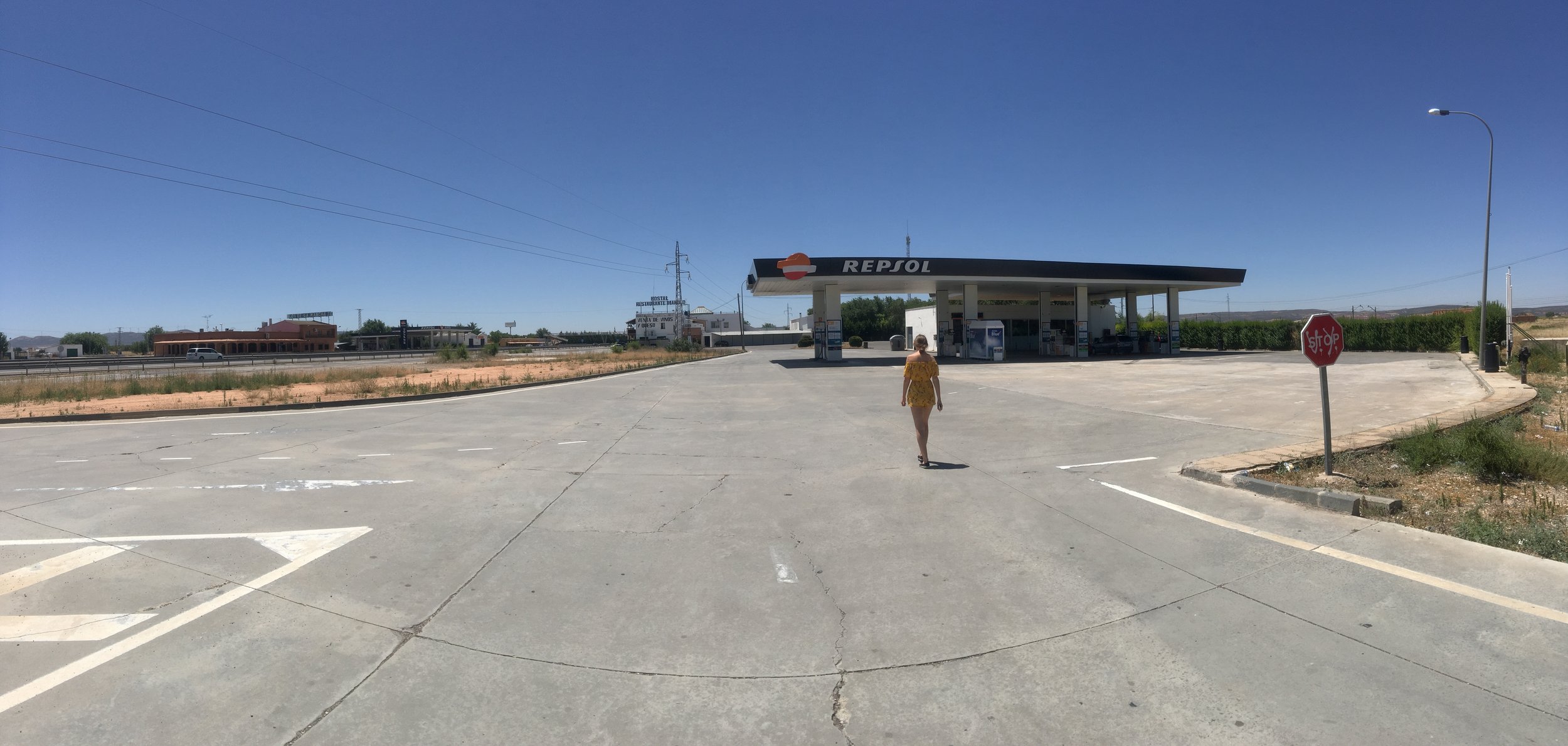
Mostly i like driving
The things we pass on
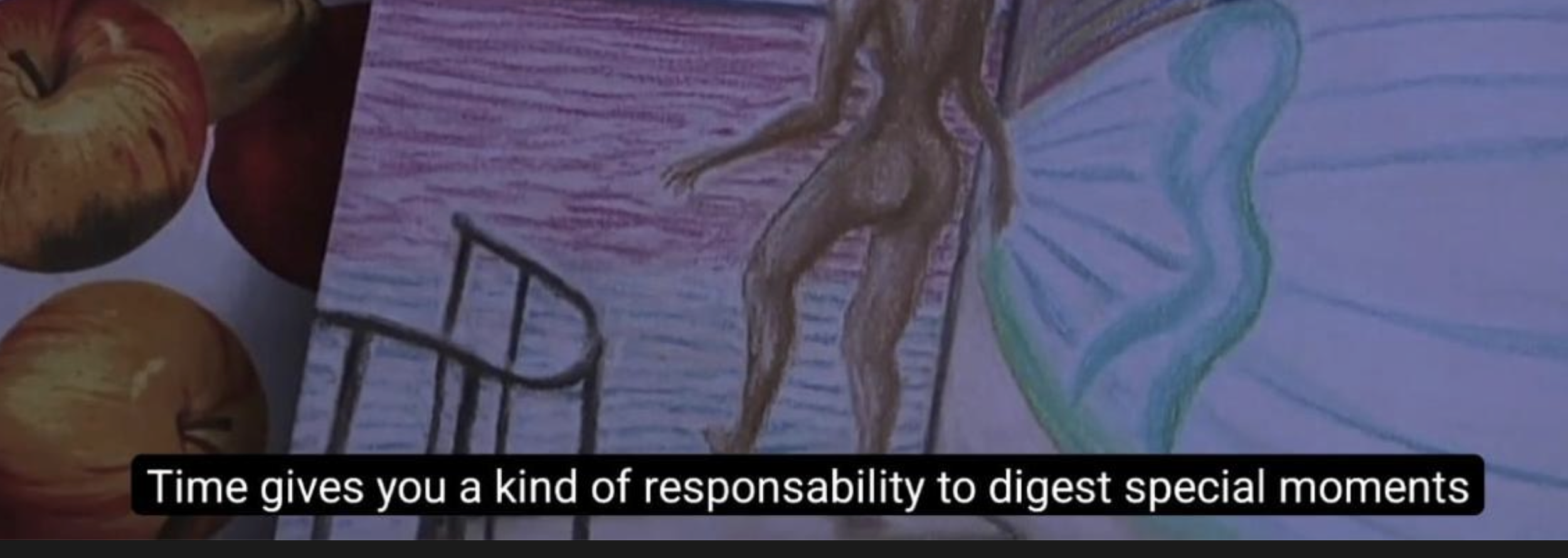
Digesting Special Moments
Thank you for believing in me. Every customer holds a special and sacred place in my heart, and your memory will always be cherished.
“God sleeps in the minerals, awakens in plants, walks in animals, and thinks in man.”
May your spirit rest peacefully, and may your memory live on in the hearts of all those whose lives you touched. Rest in peace. 🕊️
Original quote by Joan Carles Siurana "Matraca"
Time gives us the responsibility to understand what mattered
Some moments only reveal their true importance after they have passed.
When we are living through an experience, we are often too close to it to understand what it means. We are busy feeling, reacting, working, loving, creating, or simply moving forward. It is only later, with distance and time, that we begin to recognize the significance of what happened.
To “digest special moments” means more than remembering them. It means allowing an experience to become part of us. We revisit it, understand it differently, and perhaps discover something in it that we could not see at the time.
The word “responsibility” makes the quote particularly powerful. A meaningful moment asks something of us. Instead of allowing it to disappear into the past, we have a responsibility to pay attention to what it gave us to honour the people who were part of it, to recognize what changed within us, and to carry something of that experience forward.
This becomes especially profound when someone is no longer here.
Time cannot bring a person or a moment back, but it can change our relationship with what remains. A conversation, an act of kindness, someone's belief in us, or simply their presence can acquire a completely different weight in retrospect.
Perhaps that is one of the quiet purposes of memory: we cannot keep the moment, but we can continue to understand its meaning.
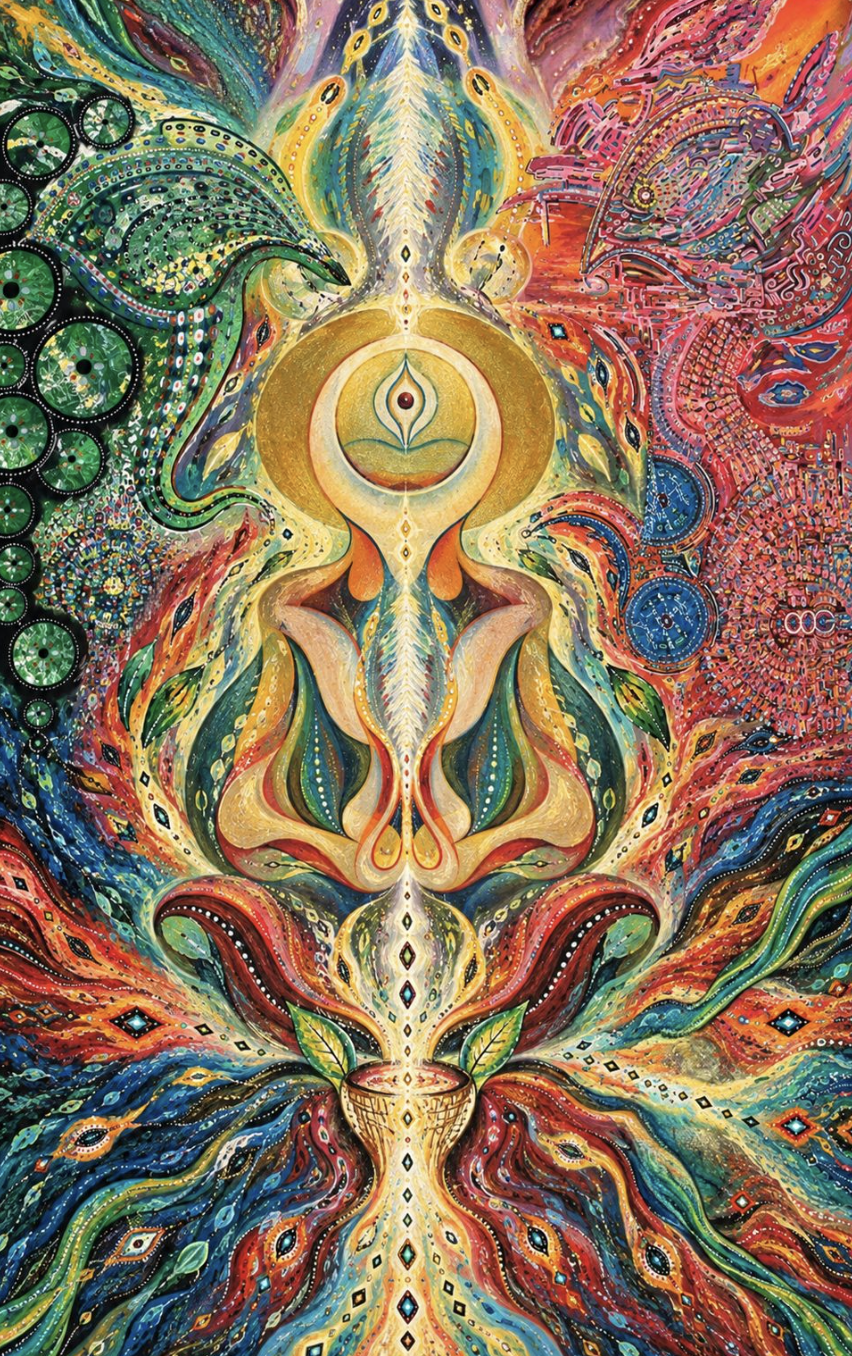
The Arush
When you stand before it, something begins. You may not know what it is yet but a part of you already does.
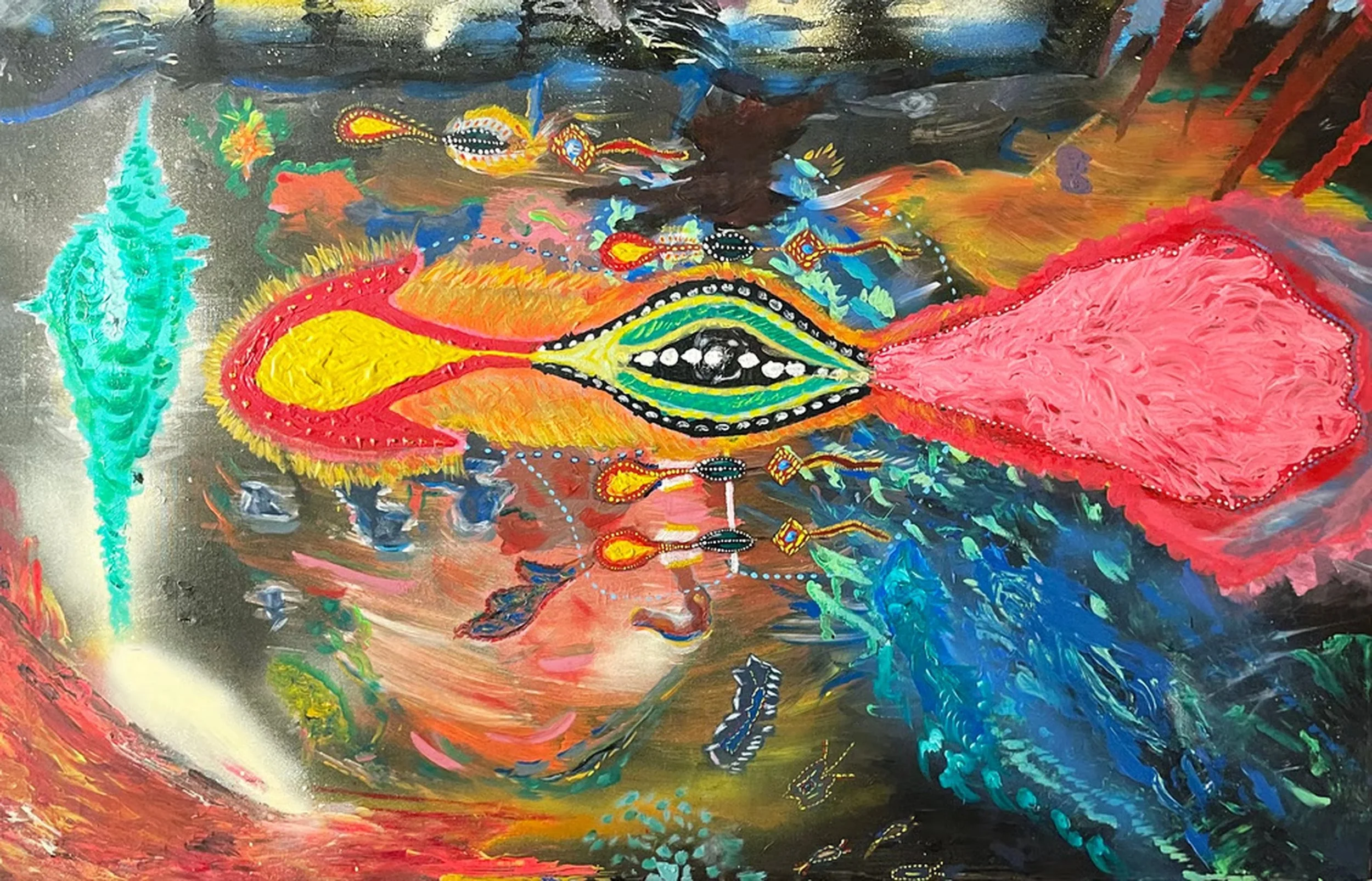
In the evolving mythos of Roland Carter, The Arush is not a character but a living intelligence a cosmic generator, a structure that conceals and reveals the codes of transformation. It is womb and threshold: something to pass through, or perhaps remember.
Painted in luminescent detail, The Arush pulses with symmetry, color, and biological rhythm, as though breathing through the wall itself. Some see a portal. Others, an alien mandala. For some, the body responds before the mind has decided what it is seeing.
Follow its inner geometries long enough and something begins to reverse: you are no longer simply looking at the painting. The painting seems to be looking back.
The work draws on Carter’s investigations into somatic tension, fascial systems, ancestral patterning, and nondual states of consciousness. Yet these references do not resolve the image. They form a kind of hidden anatomy a structure in which memory, sensation, and transformation appear to occupy the same space.
The Arush is the Body without Organs given visionary form. The Other Mother. Keeper of the code. A timeless structure beneath all becoming.
The Arush came to me in 2010, before I knew what to call it. It first appeared in a dream not as god, not as machine, but as a presence. Alive somehow. Moving through space the way mycelium moves beneath the soil: unseen, patient, without haste.
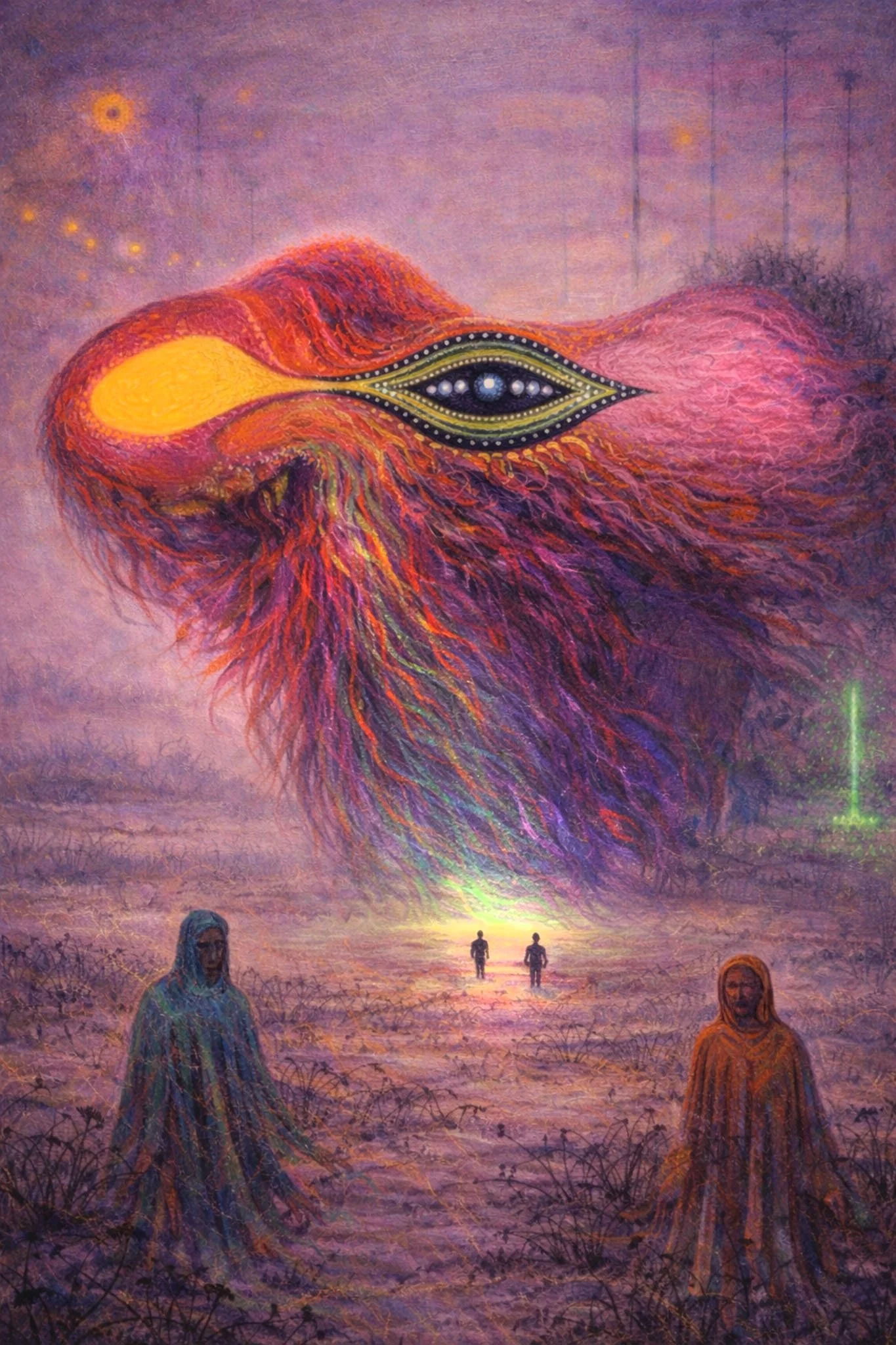
The Arush Landing
The Arush does not search; it feels.
When a world is ready not perfect, not pure, only ready to feel—it arrives. From there, a pattern spreads, threading through matter, memory, and instinct. It does not decide what should grow. It reminds what is already there.
The luminous points are spores, fragments of awareness. The spirals are blueprints—emotional rather than technical. The form of the Arush is never fixed; it changes with the one who encounters it. Some find comfort, others unease. A few sense it looking back. At times, the body seems to remember something older than thought, as though the Arush had always been present within it.
In the early work, these ideas first appeared through the body: organic forms, internal structures, shapes that seemed biological without belonging to any known anatomy. Over time, that anatomy expanded beyond the human. The body became landscape. The landscape became cosmos.
Within this mythology, the Arush is not confined to the image. It is alive in our universe.
Perhaps they drift between stars for millennia vast leviathans hibernating between sources of energy, awakening in the presence of light or radiation. Their bodies are immense and almost transparent, carrying luminous gases within them. Fins unfold into electromagnetic sails. Slow pulses travel through their forms: movement, communication, or something for which we have no name.
Seen this way, the organic shapes of the early paintings are no longer merely abstract. They might be fragments of an anatomy glimpsed before the creature itself was understood.
Nothing here is resolved. What remains begins with the viewer.
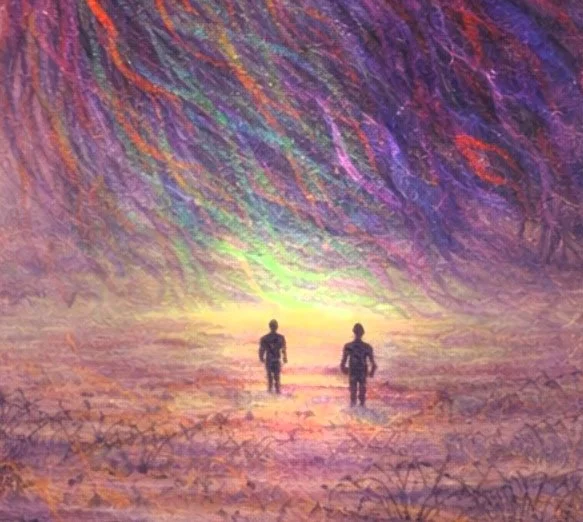
Light moves across their skin like auroras or neural activity unfolding on an unimaginable scale. Vast, silent, ancient, they drift between storm bands and nebular currents, feeding on starlight, radiation, and dust.
Their movement is almost imperceptible. A fin turns. A membrane opens. A slow pulse travels through the body and disappears into darkness. Whether these signals are navigation, communication, or thought remains unknown.
They seem less like creatures moving through the universe than something the universe itself has learned to become.
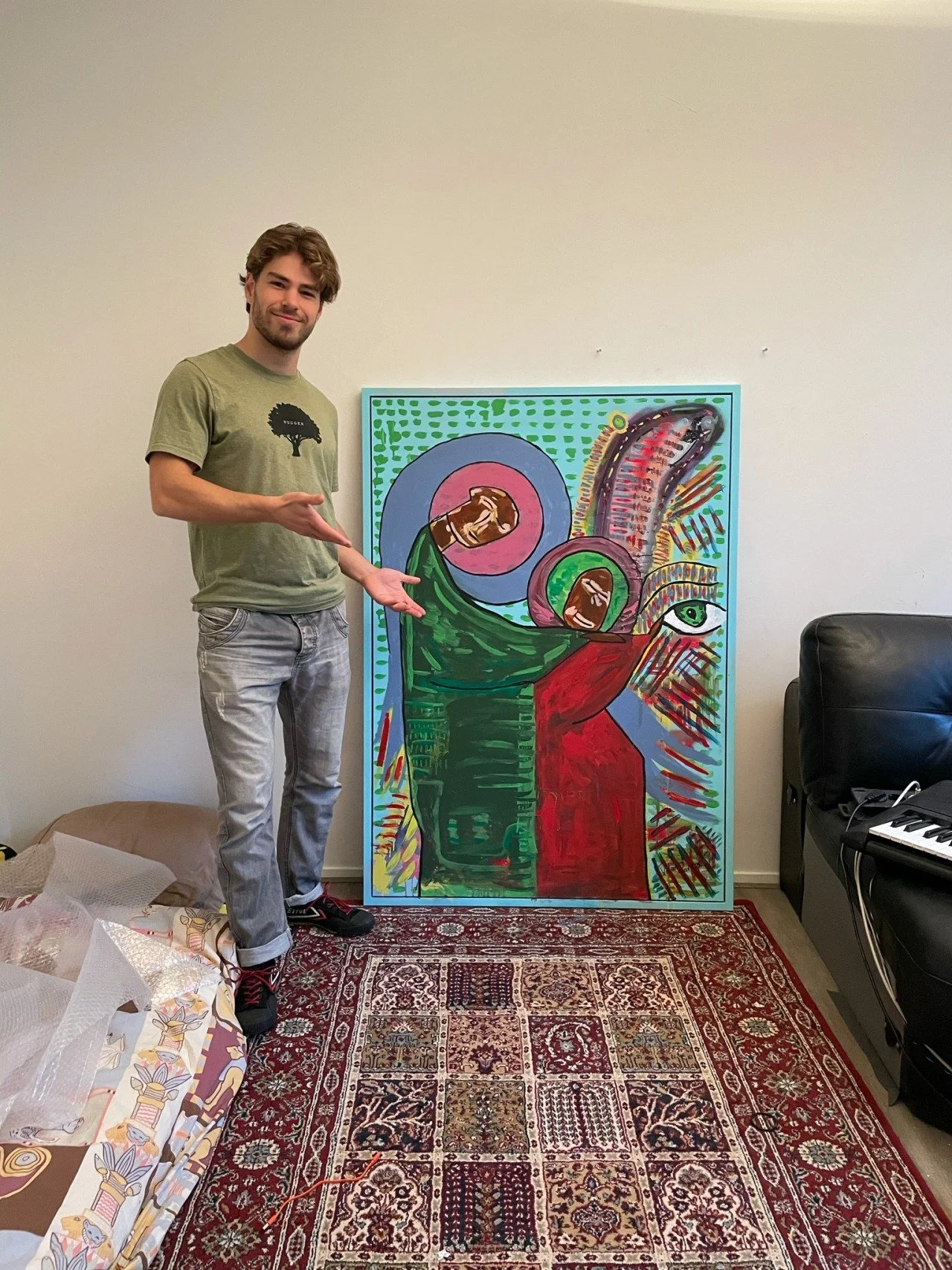
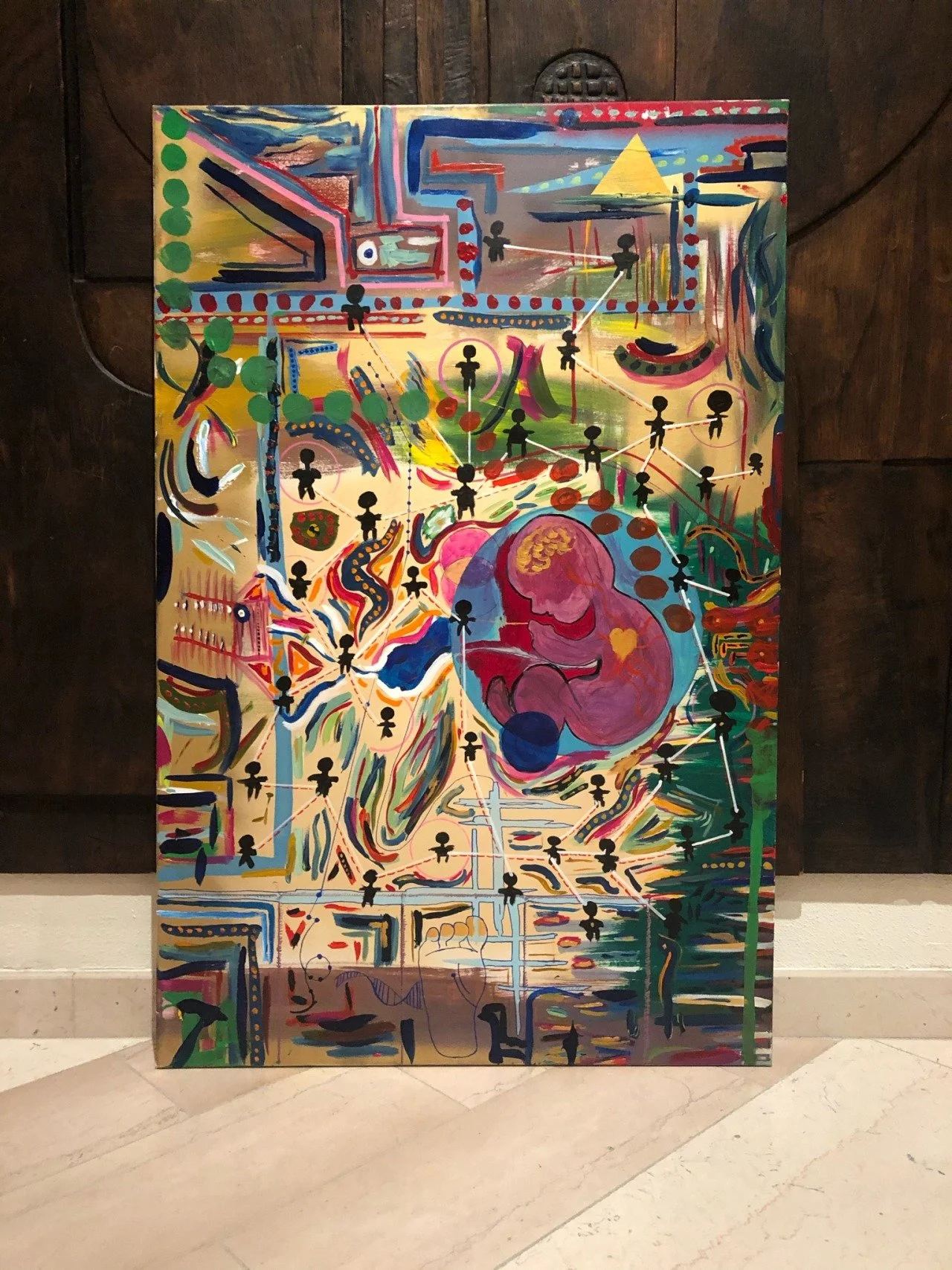
The Longbody
The Longbody
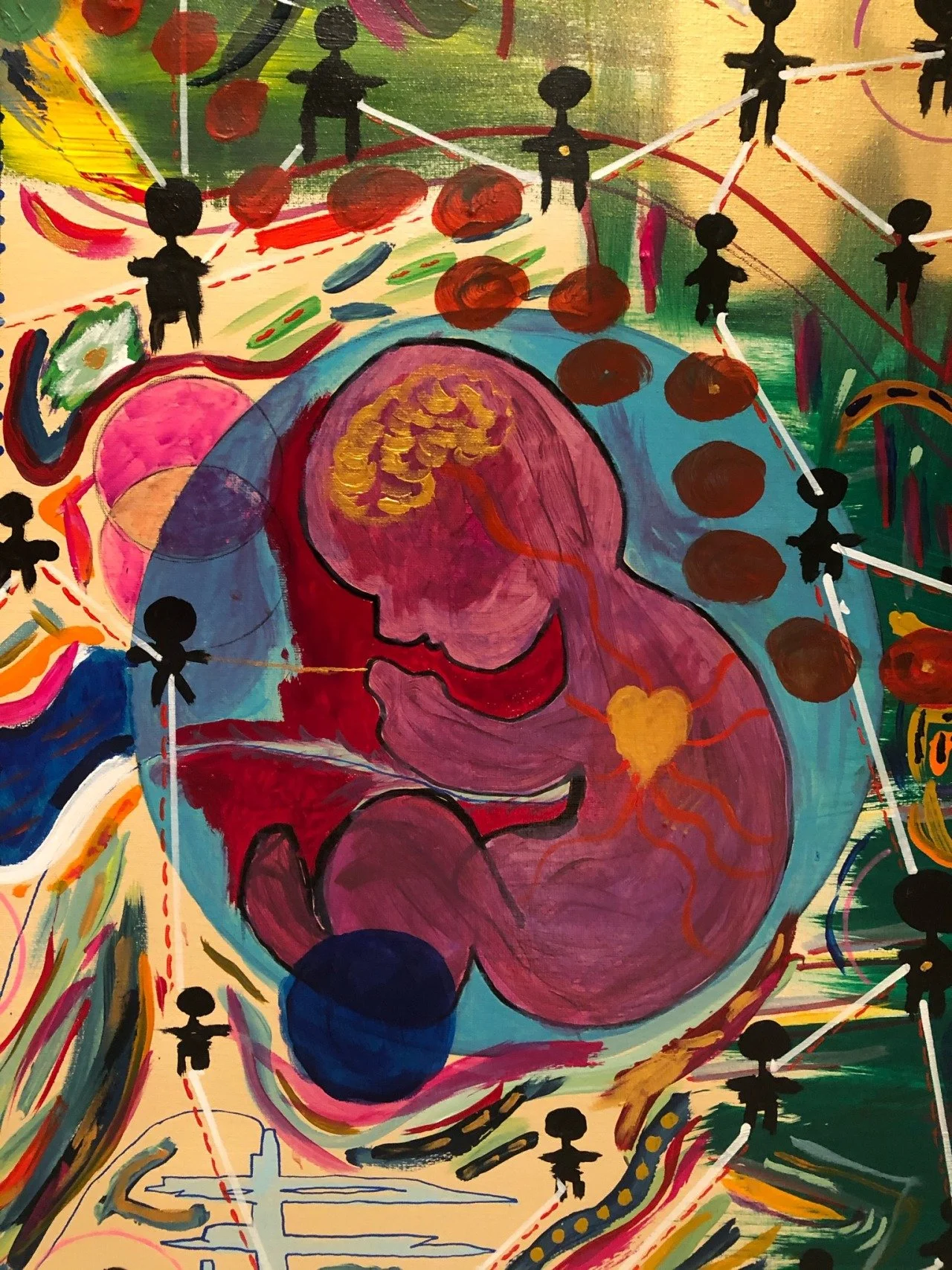
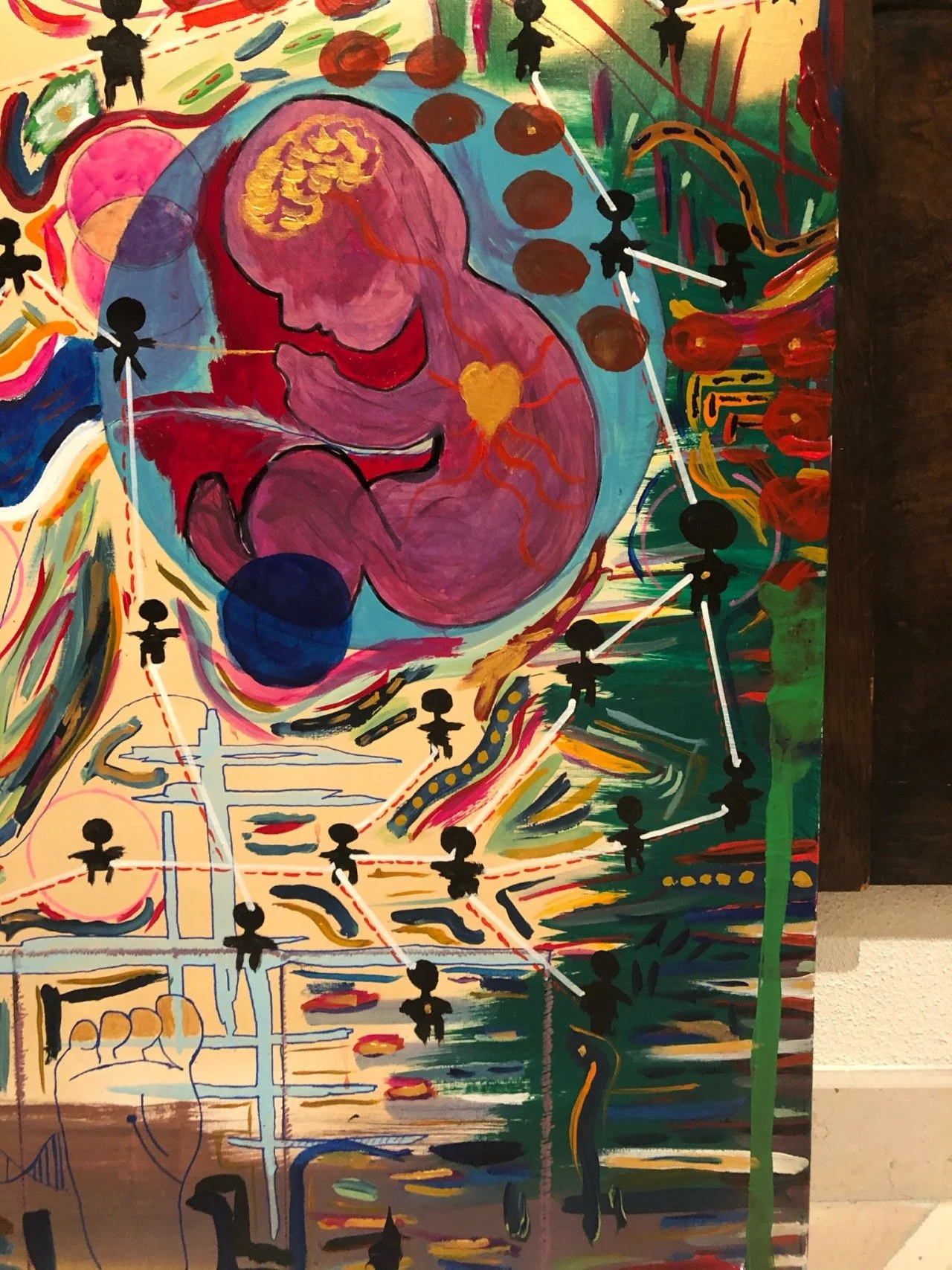
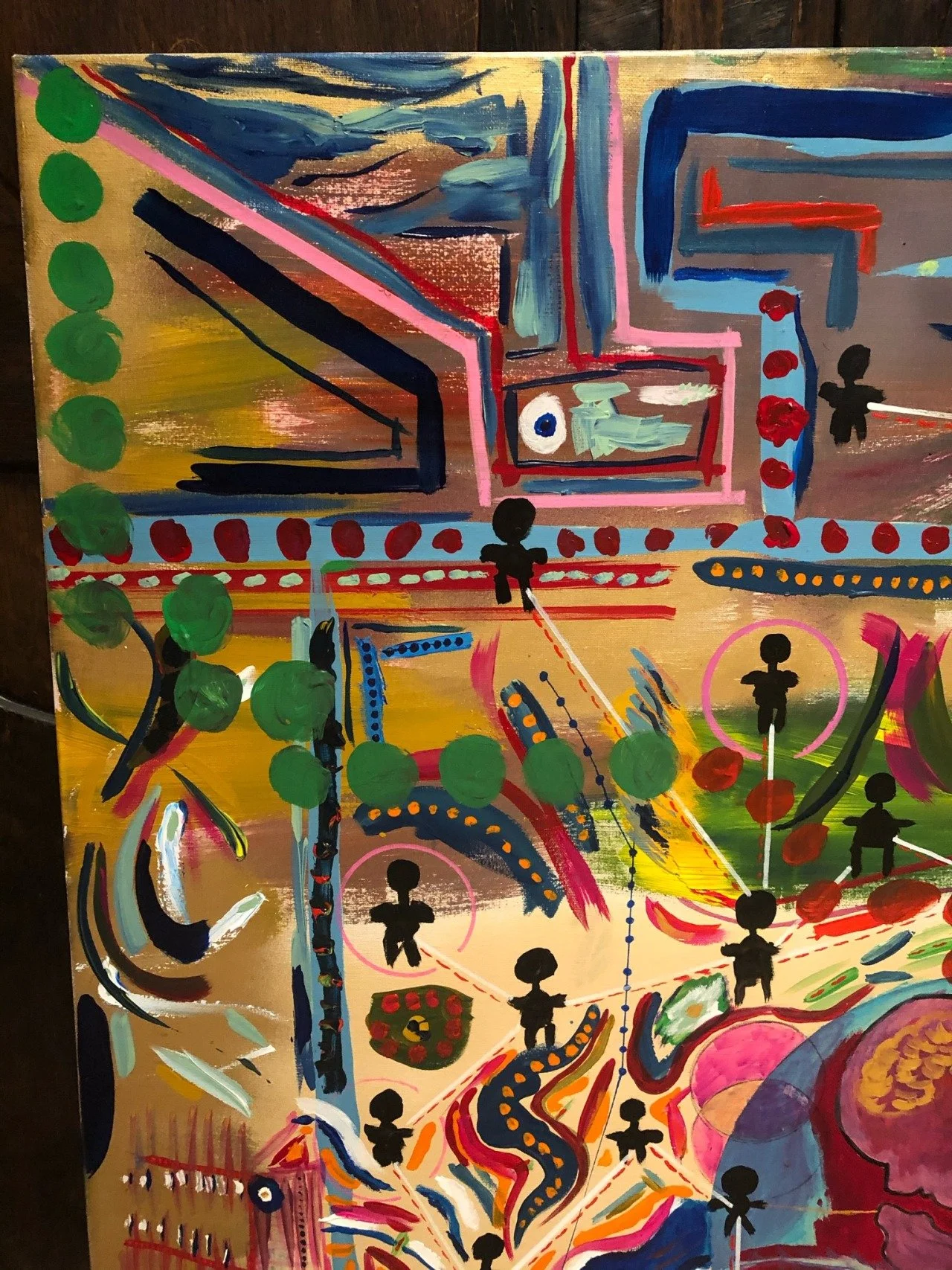
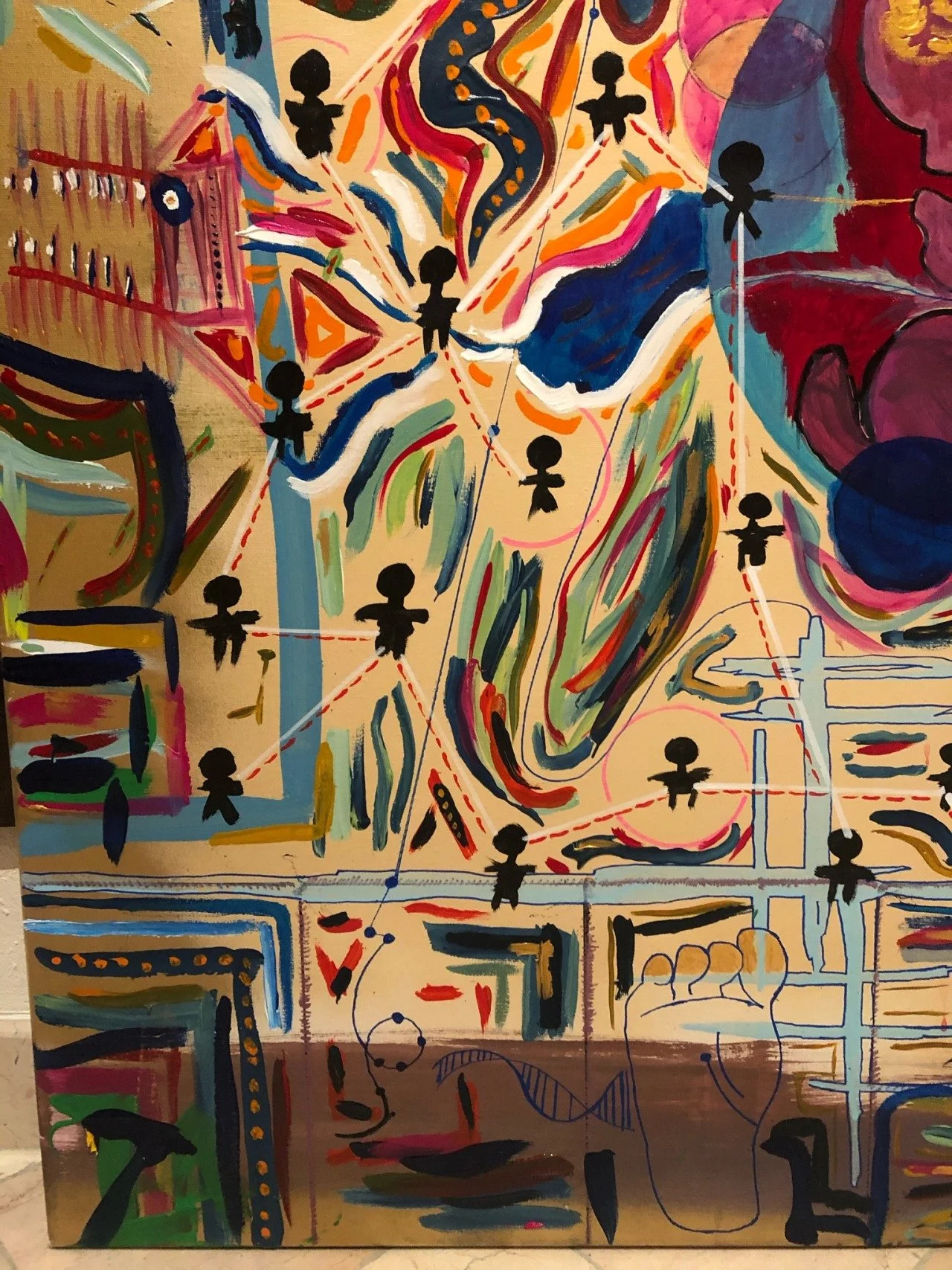
You see the baby in the womb. It represents how we come into this world, and how coming into this world can already be a traumatic experience.
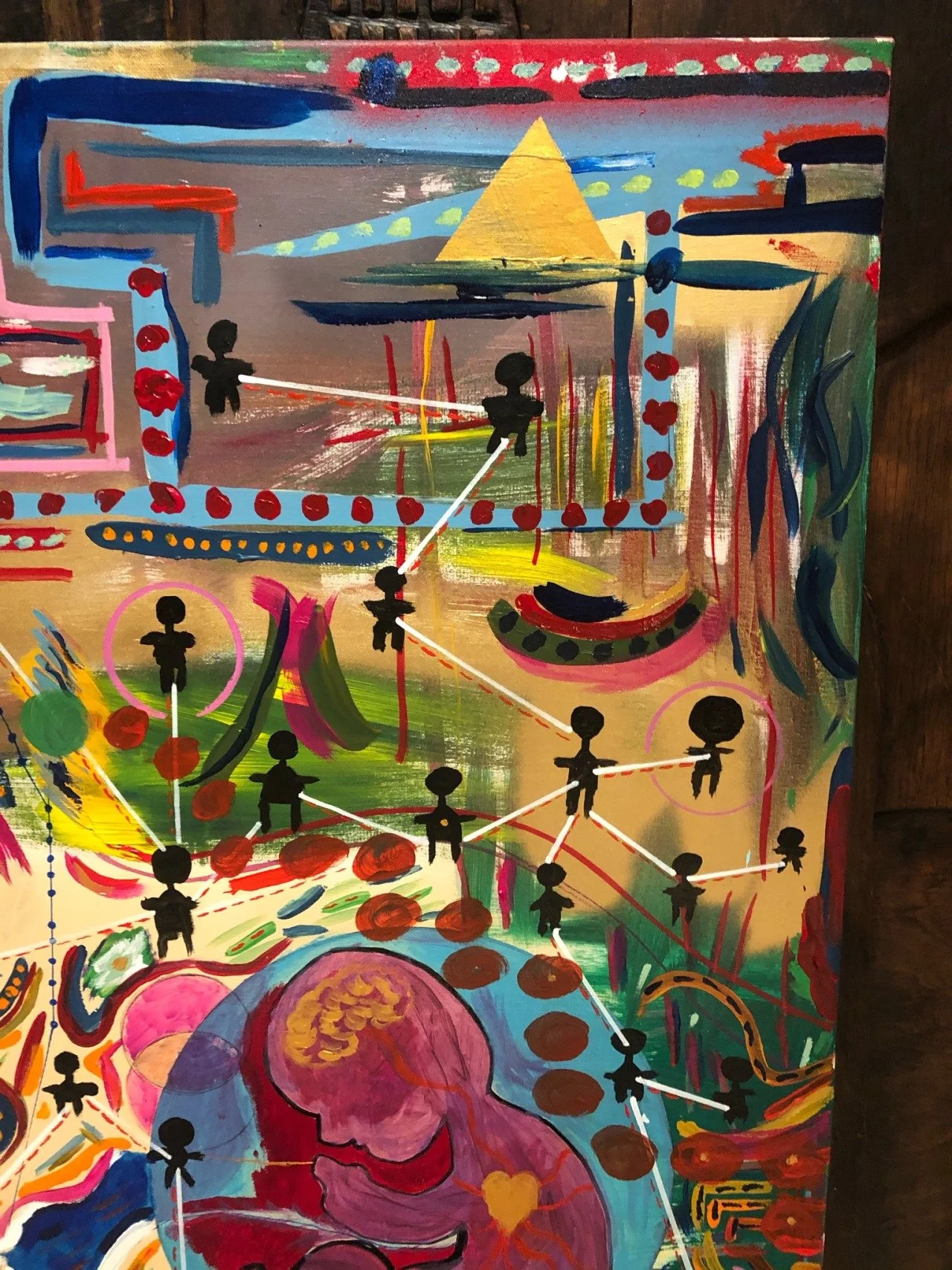
The green and red dots represent the years of our lives. Some years are red with pain, and if we heal, they can become green. These years take on their colors because of the decisions we make—represented by the stripes—and the people we meet, represented by the little black figures.
Together, this represents a system called the Longbody, a Native American term describing how massively connected we are with the biological and social world around us. It refers to the individual body together with the life-support systems surrounding it. It is a much bigger conception of the human body than the one we traditionally have in Western culture, considering the body as continuous with the larger environment.
Social behavior comes through the body—not just the brain.
We rely on our mirror neurons, which respond to other people's movements and attention and allow us to perform a kind of simulation of what they are experiencing in their bodies. This is what is represented by the dragon.
If we are not careful, or if we are simply unlucky, trauma can hit us and sweep through our lives like a dragon. And if we don't fight this dragon, it can slowly begin to cause illness over a longer period of time.
Experiencing trauma in childhood can have a severe and long-lasting effect. When childhood trauma is not resolved, a sense of fear and helplessness can carry over into adulthood, setting the stage for further trauma.
However, even if your trauma happened many years ago, there are steps you can take to overcome the pain, learn to trust and connect with others again, and regain your sense of emotional balance.
The bigger questions this painting asks are:
WHY DO WE HAVE NERVOUS SYSTEMS?
ARE WE CURRENTLY LIVING IN AN ALIEN ENVIRONMENT?
WHERE DOES THE HUMAN BODY BEGIN AND END?
WHAT IS TRAUMA, AND HOW CAN WE LET IT GO?
Check Your Work
Connect your LUKSO Universal Profile to verify this Roland Carter work in your collection.
Congratulations.
You own this work.
Thank you for collecting.
We see and appreciate your support of the Roland Carter collection on LUKSO.
View the work ↗Paint everyday
The Familiar Hell and the Unfamiliar Heaven
There is an idea I keep coming back to: your nervous system will always choose a familiar hell over an unfamiliar heaven. The more I think about it, the more it explains so much of the resistance I experience in my own creative life. We like to believe that if we really want something, we will naturally move toward it. If I want to become a better painter, I should want to paint. If I want to grow, I should naturally choose the things that make me grow. But that isn't always what happens. Sometimes I can know exactly what I want and still find myself doing almost everything except the thing that would move me toward it.
The nervous system is wired for survival, not necessarily for happiness, fulfillment, creativity, or reaching our highest potential. It looks for what it recognizes. Familiarity feels safe, even when what is familiar isn't particularly good for us. That's the strange contradiction. Procrastination can become familiar. Avoidance can become familiar. Self doubt can become familiar. Even the frustration of knowing I'm not doing what I should be doing can become its own kind of comfort zone. I know what that world feels like. I've been there before. There are no surprises in it.
The alternative can actually feel more threatening. Taking my work seriously, painting every day, pushing beyond what I already know how to do and discovering what I'm capable of, that is unfamiliar territory. I don't know exactly where it leads. I don't know if the work will be good. I don't know whether I'll succeed or fail. I don't even know who I'll become if I truly commit myself to it. So even though that future is the one I want, some part of me resists it simply because it doesn't recognize it yet. The familiar hell can feel safer than the unfamiliar heaven.
I think this is one of the reasons painting every day can be so difficult. It would be easy to assume that the problem is laziness or a lack of inspiration, but I don't think that's the whole story. Every time I sit down to paint, especially when I'm trying something new, I'm stepping into uncertainty. There is always the possibility that the painting won't work, that I'll make the wrong decision, that I'll waste a canvas, or that I'll confront the limits of my current abilities. Avoiding the work removes all of those risks. If I don't paint today, I don't have to find out what happens. Procrastination protects me from uncertainty, but it also protects me from growth.
Then there is the endless temptation to wait for the perfect moment. I'll paint when I feel inspired. I'll paint when I have more time. I'll paint when my mind is clear, when the studio is right, when I know what I want to make, when everything somehow falls into place. But I'm beginning to understand that the perfect moment doesn't exist. Waiting for it is just another form of resistance disguised as preparation. If creativity depends on everything being aligned before I begin, I will spend far more of my life waiting to create than actually creating.
The only real way through this seems to be painting anyway. Paint when I feel ready and paint when I don't. Paint when I have an idea and paint when I have absolutely no idea what I'm doing. Paint when the work is exciting and when it feels repetitive, frustrating, or uncomfortable. The point isn't that every day needs to produce a masterpiece. Most days probably won't. The point is to teach myself that showing up is normal. Every time I paint despite the resistance, I make creation slightly more familiar.
And maybe this is what discipline actually is. It isn't forcing myself to be endlessly productive or pretending that resistance doesn't exist. It is learning that I don't need resistance to disappear before I can act. I can feel uncomfortable and still paint. I can doubt myself and still paint. I can be uninspired and still make a mark on the canvas. The resistance can come with me, but it doesn't get to make the decision.
Something else happens when I work this way. Inspiration stops being something I have to wait for. I start to see that inspiration often comes from the act of working itself. One decision creates another decision. A color creates a problem that leads to another color. A mistake forces me to improvise. Something unexpected appears on the canvas and suddenly I have an idea I couldn't possibly have had before I began. The path becomes visible because I'm walking it. I can't think my way into all of these discoveries beforehand.
This makes me think differently about the glass ceiling I sometimes feel in my work, the point where it seems like I'm repeating myself or where the next level feels visible but somehow unreachable. Maybe those ceilings aren't broken by one huge breakthrough. Maybe they crack through hundreds of ordinary days of work. Every painting teaches me something, even when I don't like the result. Every difficult decision expands my ability to make the next one. Every time I stay with a painting instead of escaping from it, I become slightly more capable of dealing with uncertainty.
That is probably also part of the difference between approaching art as an amateur and approaching it professionally. A professional cannot depend entirely on feeling inspired. They show up because this is what they do. They don't wait for ideal conditions every single time. They learn to create within imperfect conditions. I want to develop that relationship with painting. I don't want art to be something I occasionally do when the universe gives me permission. I want it to become such a normal part of my life that not painting feels stranger than painting.
The more I think about it, the more I realize that painting every day isn't only about becoming technically better. Of course I want to improve my craft, but there is something deeper happening through repetition. I am changing my relationship with discomfort. Instead of automatically interpreting resistance as a reason to stop, I can learn to recognize it as a sign that I might be approaching something important. The moment I want to escape might be exactly the moment when I am reaching the edge of what is familiar.
Resistance, then, isn't necessarily the wall blocking the next level. Resistance might actually be the doorway to it.
The nervous system is almost like clay in that way. It begins to mold itself around what I repeatedly do. If I repeatedly avoid the work, avoidance becomes easier. If I repeatedly procrastinate, procrastination becomes my automatic response. But the opposite must also be true. If I repeatedly sit down and paint, painting becomes familiar. If I repeatedly enter uncertainty and discover that I can survive it, uncertainty becomes less frightening. If I repeatedly work through discomfort, discomfort stops having so much power over me.
This is why consistency matters to me so much. Every day I paint, I'm not only creating another piece of art. I'm reinforcing the identity of someone who creates. Slowly, art stops being a luxury reserved for moments of inspiration and becomes a necessity, a practice, and eventually simply part of who I am.
Maybe that is what transformation really looks like. Not suddenly waking up as a completely different person, but becoming 0.1% different every day. A little more resilient. A little more disciplined. A little more willing to take risks. A little less frightened of making something bad. A little more capable of trusting myself when I don't know what comes next. These changes are almost invisible from one day to another, but over months and years they must compound into something enormous.
In that sense, every painting is also an act of reinvention. I'm not only recreating what happens on the canvas. I'm recreating myself through the process. Every day asks me to make decisions I haven't made before, solve problems I haven't encountered before, and let go of something I thought I knew. The work changes because I change, and I change because I continue doing the work.
Eventually, perhaps the unfamiliar heaven stops being unfamiliar. The life in which I paint consistently, trust my instincts, take risks, make mistakes, learn, evolve and keep creating becomes the familiar one. Meanwhile, the old comfort of procrastination and avoidance begins to feel foreign. What once required enormous effort simply becomes what I do.
That's the shift I want.
I don't want to spend my life trying to eliminate resistance. I want to become someone who knows how to create in its presence. Every day I paint is another opportunity to teach myself that discomfort isn't danger and uncertainty isn't something I have to run from. Every day I show up, I push a little further against that invisible force trying to return me to what I already know.
The question I want to leave myself with is not, How do I finally get rid of resistance? Maybe that's the wrong question.
The better question is: What would happen if I stopped waiting for resistance to disappear and simply painted through it every single day?
Building a Collector Experience for Web3
For years, the conversation around Web3 has been dominated by technology.
Wallets. Transactions. Smart contracts. Block explorers.
But as an artist, I've always asked myself a different question:
What should collecting digital art actually feel like?
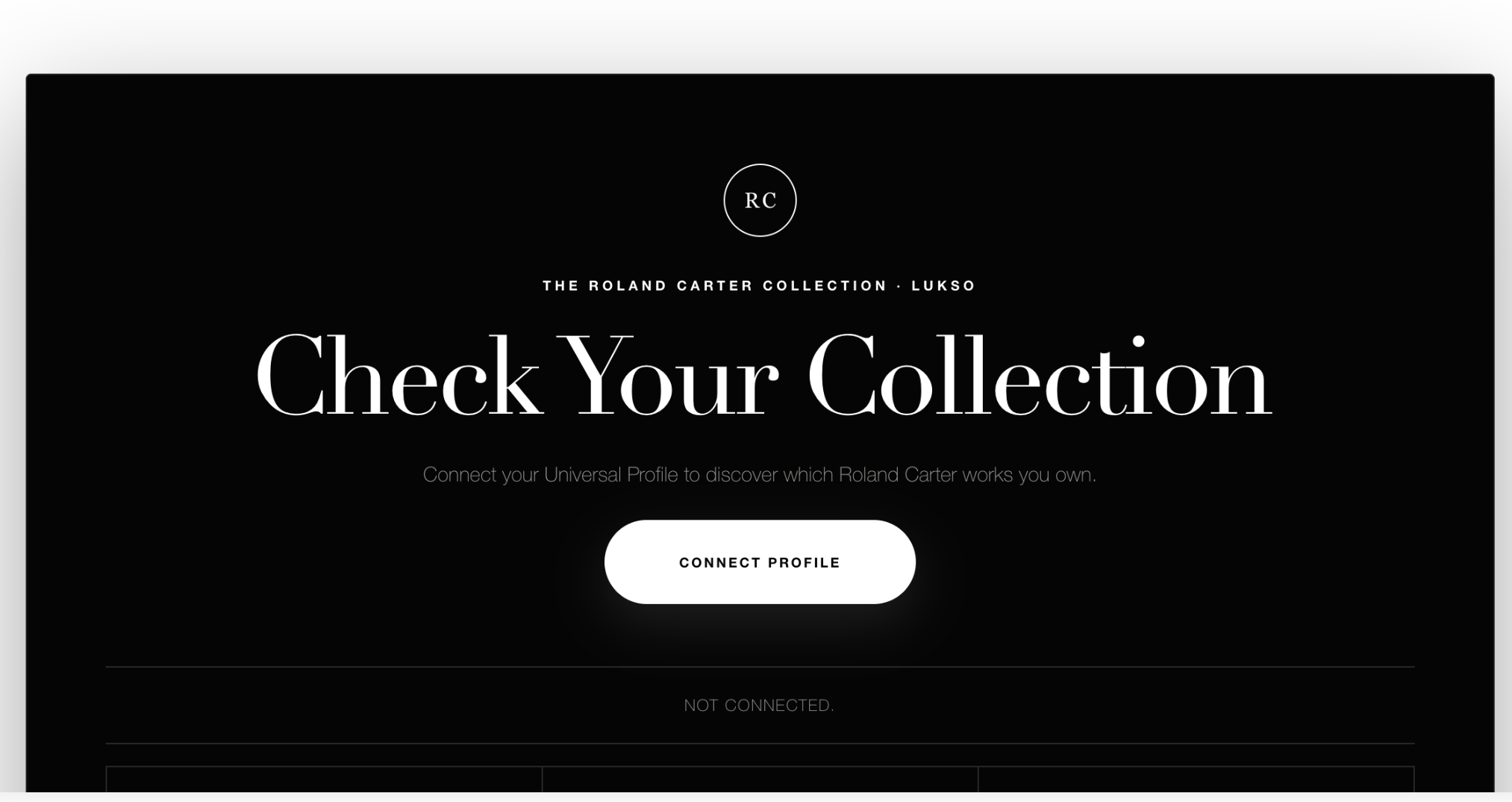
I didn't want another NFT dashboard.
I wanted to build something that feels closer to walking into a contemporary gallery.
Designing Around the Collector
Over the last few weeks, I've been designing and developing a collector interface for my LUKSO collection.
Instead of making blockchain the focus, I wanted the interface to disappear into the background and let the artwork—and the collectors—take center stage.
The result is a platform where connecting your Universal Profile becomes the beginning of a personal collecting journey.
Once connected, collectors can immediately see:
every Roland Carter work they own;
their collection progress;
rarity information based on current holders;
their Collector Passport;
live collector rankings;
Digital and Phygital collections;
profile names and avatars;
a curated gallery experience built specifically for the collection.
Every detail was designed with simplicity in mind.
No unnecessary dashboards.
No overwhelming statistics.
Just the collection.
A Different Way to Think About Digital Ownership
One of the ideas I kept coming back to was this:
Owning a digital artwork shouldn't feel like holding a token.
It should feel like becoming part of an archive.
That's why the interface is designed more like a museum catalogue than a crypto application.
Typography, spacing, monochrome colours, and minimal interactions all help shift the attention back to the artwork itself.
The technology quietly does its job in the background.
Digital & Phygital
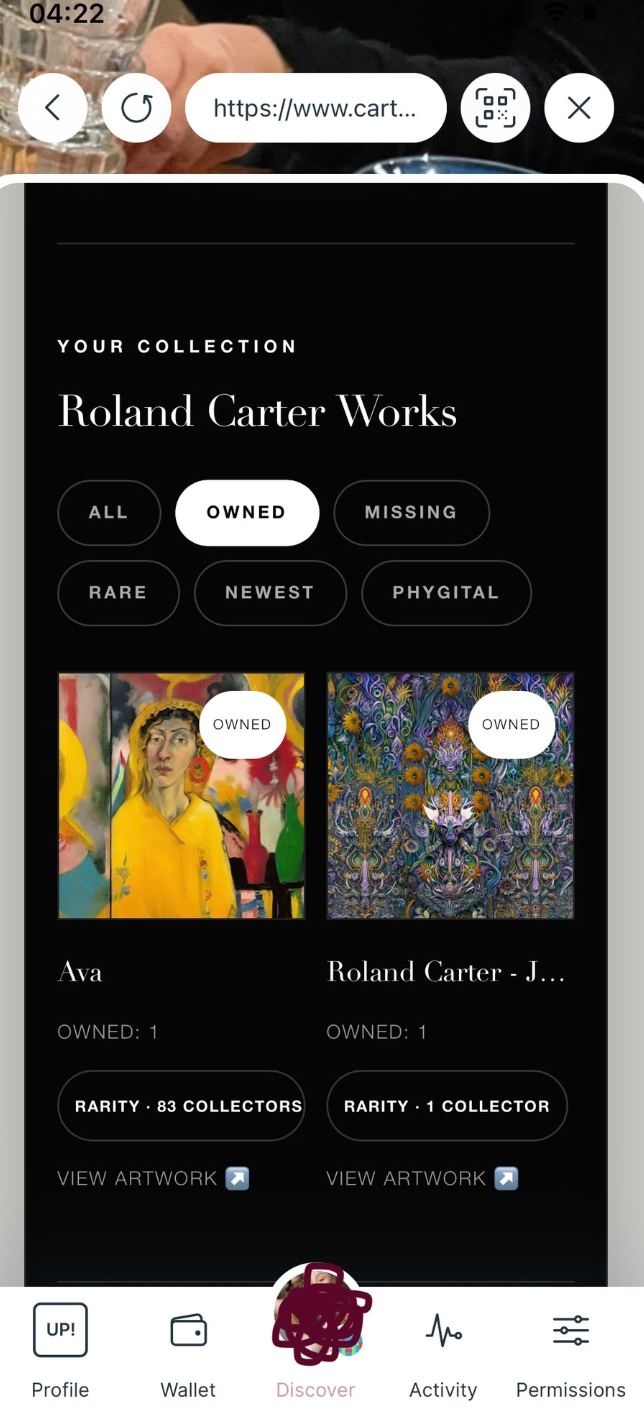
The collection contains both digital and phygital works.
Instead of treating them the same, the interface distinguishes between them through dedicated filters and curated views, making it easier to explore different parts of the archive while preserving the identity of each body of work.
Collectors at the Centre
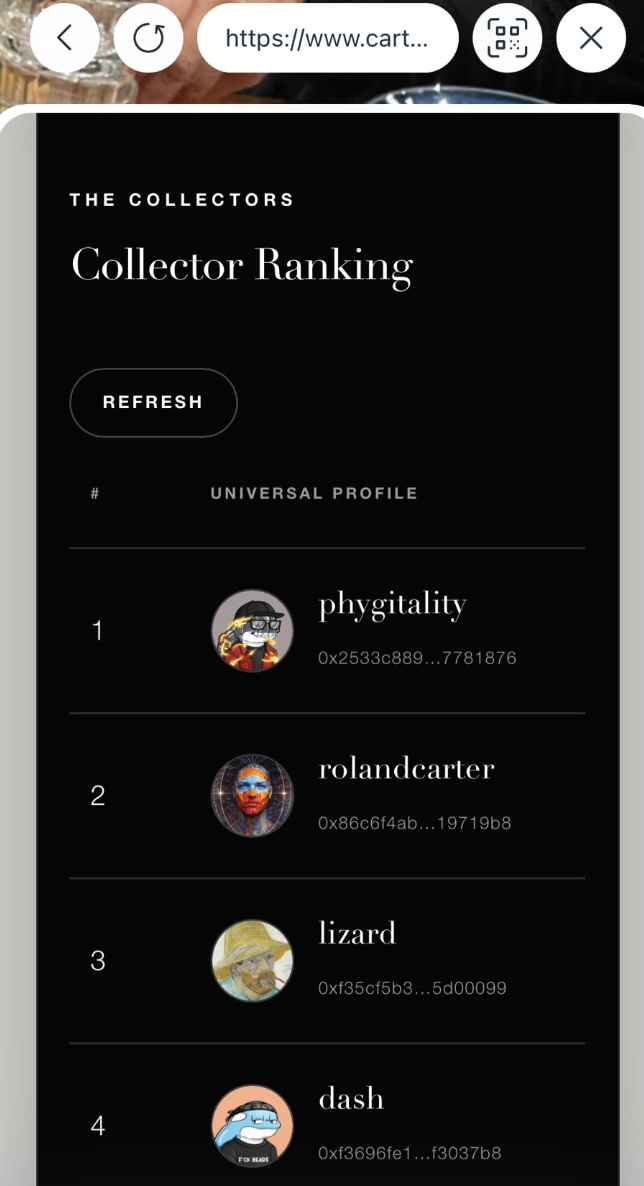
One of my favourite parts of the project is the collector experience itself.
Rather than showing anonymous wallet addresses, the platform celebrates collectors through their Universal Profiles.
Collectors can see their progress, compare their collections, discover other profiles and explore how the community around the work evolves over time.
Collecting becomes a shared experience instead of an isolated transaction.
Building on LUKSO
This collector interface is built around the LUKSO blockchain and its Universal Profiles, bringing together digital identity, digital ownership and collectible art in one seamless experience.
Unlike traditional NFT marketplaces, the platform focuses on the collector journey rather than simple transactions. By combining LSP7 Digital Assets, Universal Profiles, profile metadata, rarity tracking and curated collection views, it demonstrates how the LUKSO ecosystem can support a new generation of digital art experiences.
The project explores how LUKSO, Universal Profiles, LSP7 tokens, digital collectibles, phygital art, and modern Web3 identity can be combined into an elegant interface that feels closer to a museum archive than a blockchain explorer.
As the platform evolves, it will continue to experiment with new ways of collecting, showcasing and trading digital art while remaining fully native to the LUKSO ecosystem.
Creadores
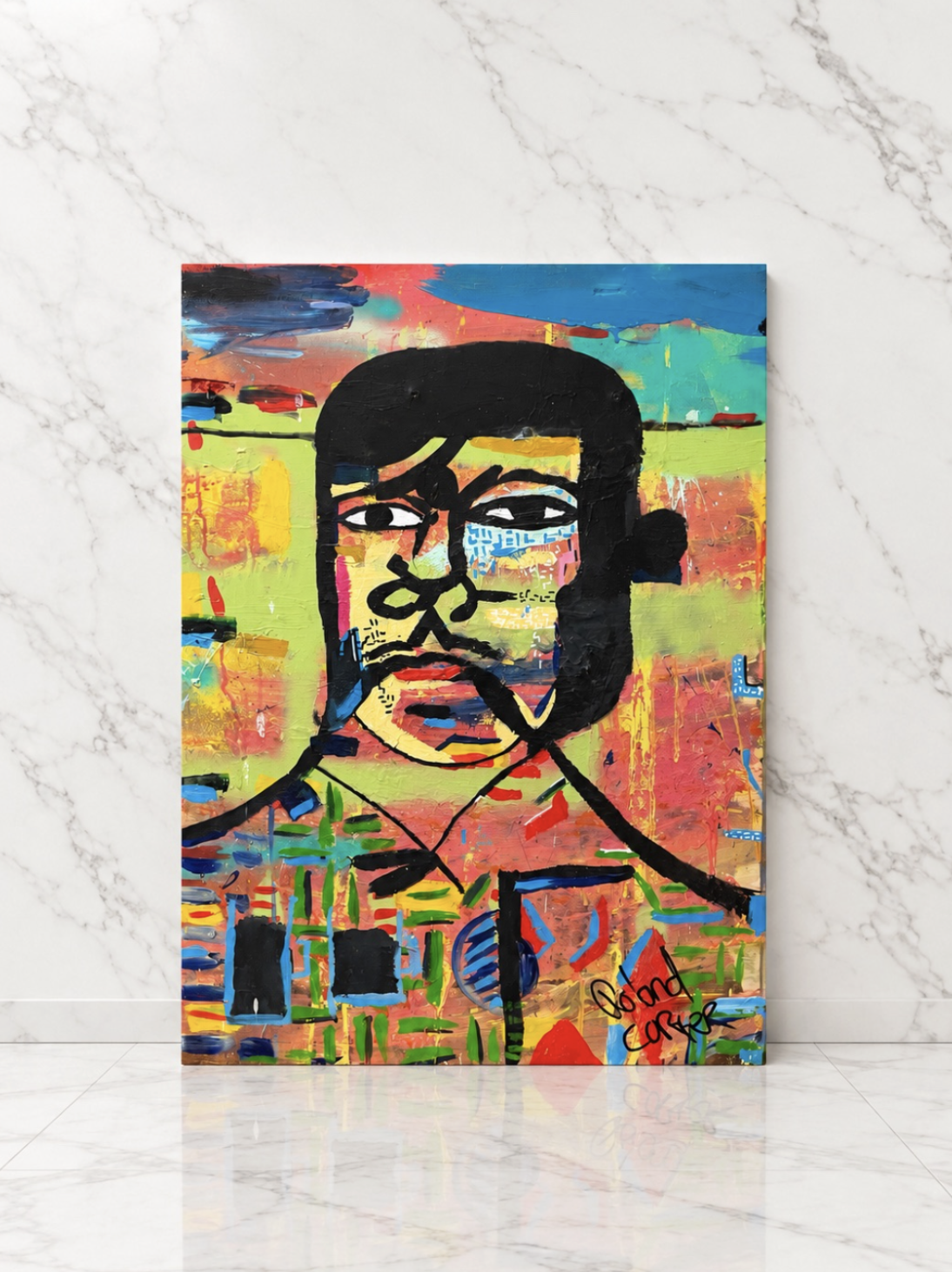
Roland Carter, a Groningen-based painter whose art speaks louder than words. In this first episode of CREADORES, we dive into his creative process, his journey, and the moments that shaped his artistic identity. Raw, honest, and deeply human , this is what it means to create.
I started painting in 2010, driven by a feeling of nothingness. Since then, creating art has become something that comes naturally a flow that feels as if it comes directly from the source.
My work consists of large, colorful, psychedelic figurative paintings inspired by everyday life, geometric patterns, nature, love, family, travel, and the full spectrum of color. While I often return to reds, yellows, and blacks, I enjoy exploring every color available to me.
Painting is my daily ritual. I begin with a coffee, prepare some food, and then spend the day in the studio, allowing the work to unfold without forcing it. Each painting is unique because it is a genuine act of creation.
Travel has also shaped my perspective. Places like Florida, the Caribbean, and the vibrant cultural scene of Groningen continue to inspire my work and remind me that art is everywhere if you're open to seeing it.
Art in Context
Every artwork changes when it becomes part of a space. In this journal, we explore our collections within carefully designed interiors, showing how color, scale, and composition shape the atmosphere of a room. From private residences to hospitality projects, discover how contemporary art brings character, balance, and lasting presence to modern living.
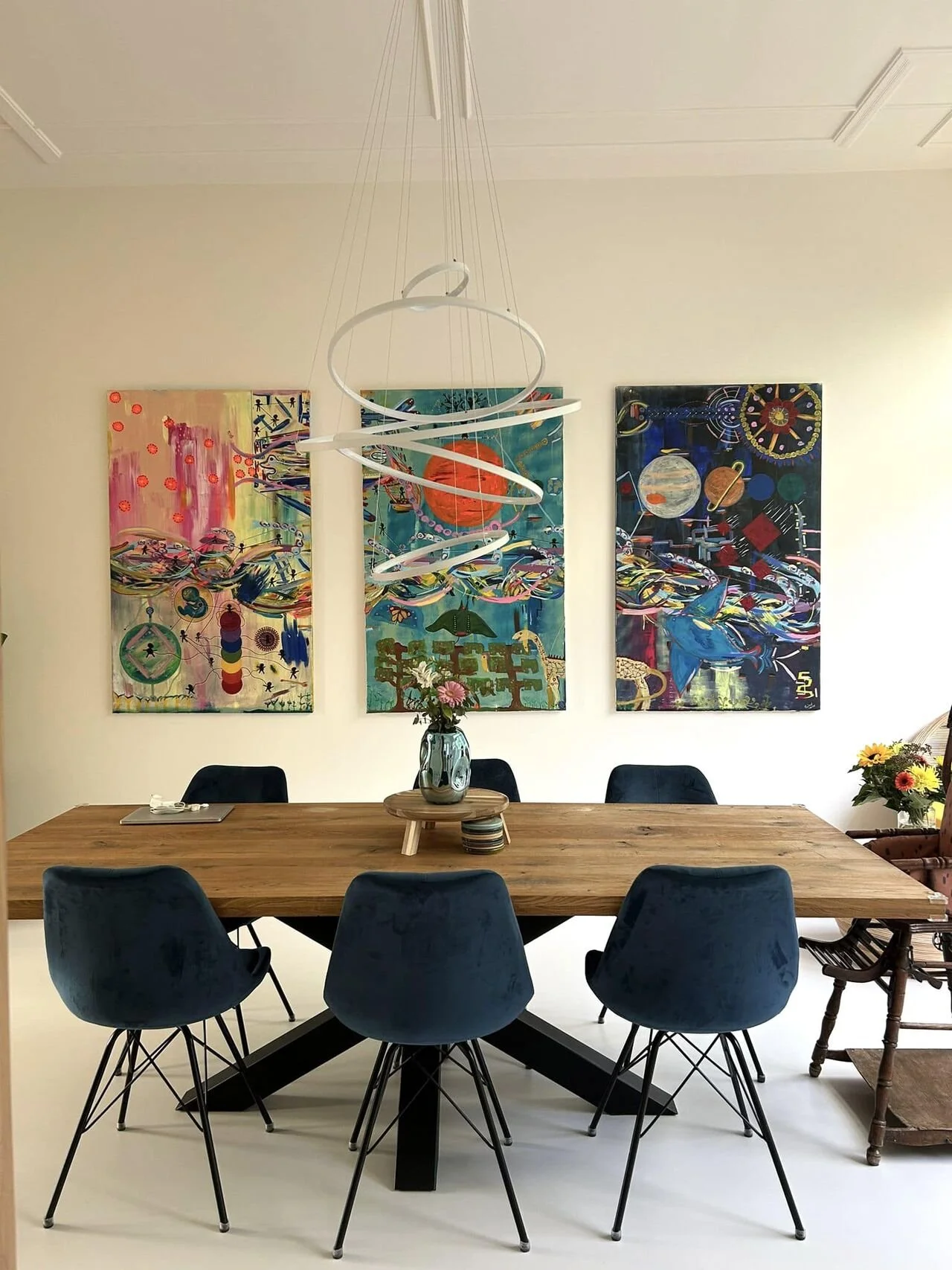
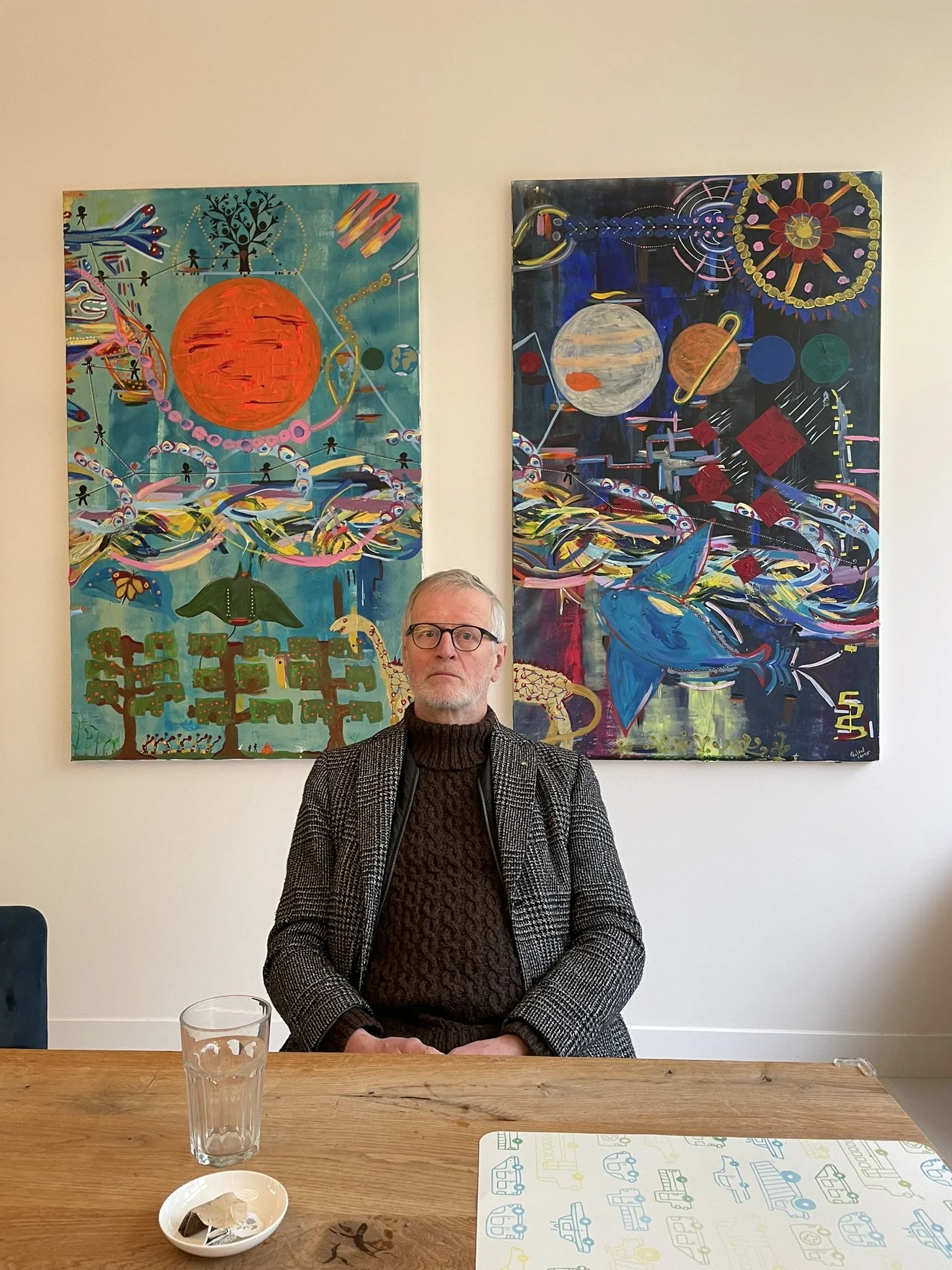
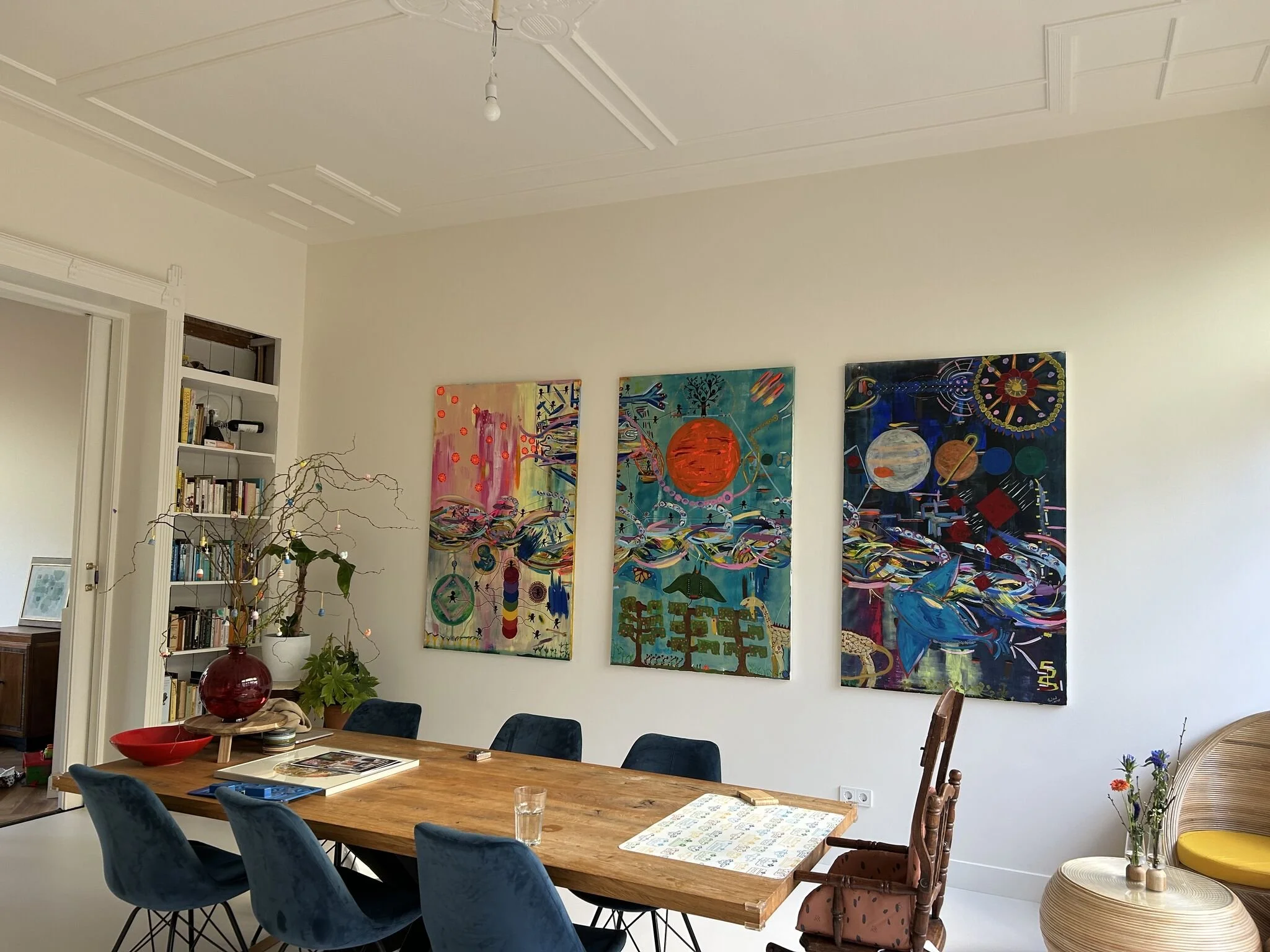
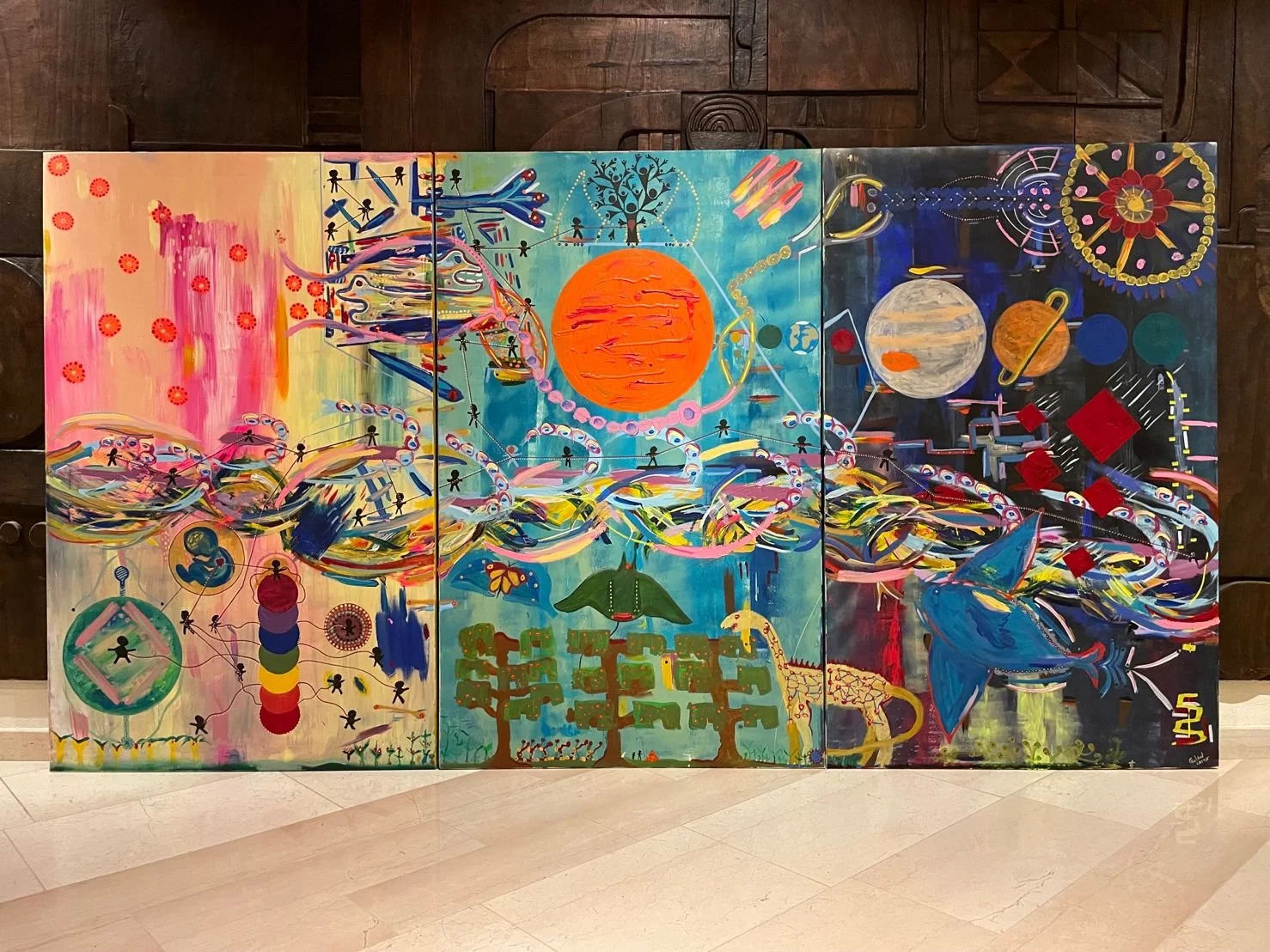
The relationship between art and architecture is one of proportion, light, and emotion. Through a selection of curated interiors, we share how our paintings live beyond the gallery, becoming an integral part of thoughtfully designed homes and spaces
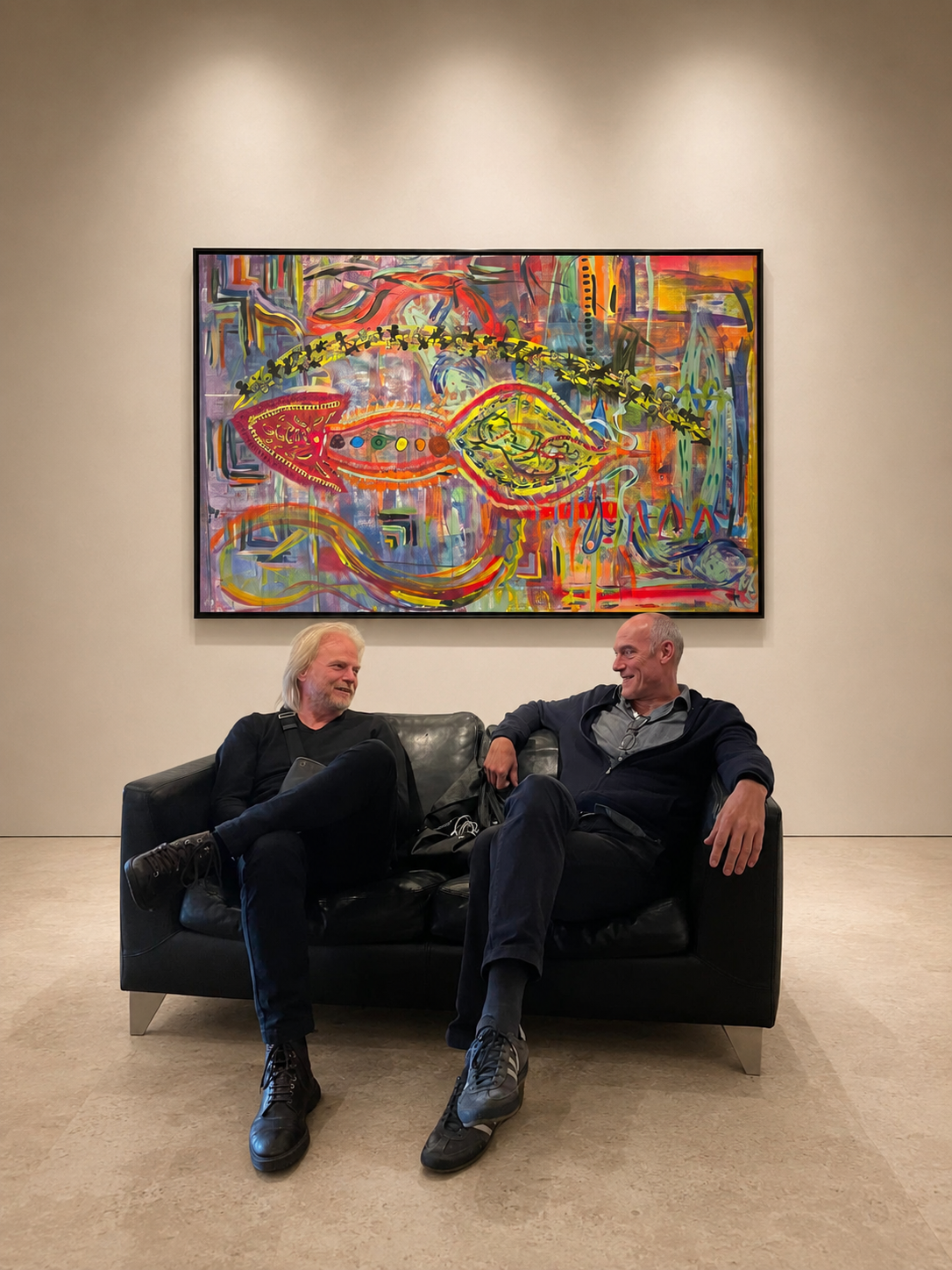
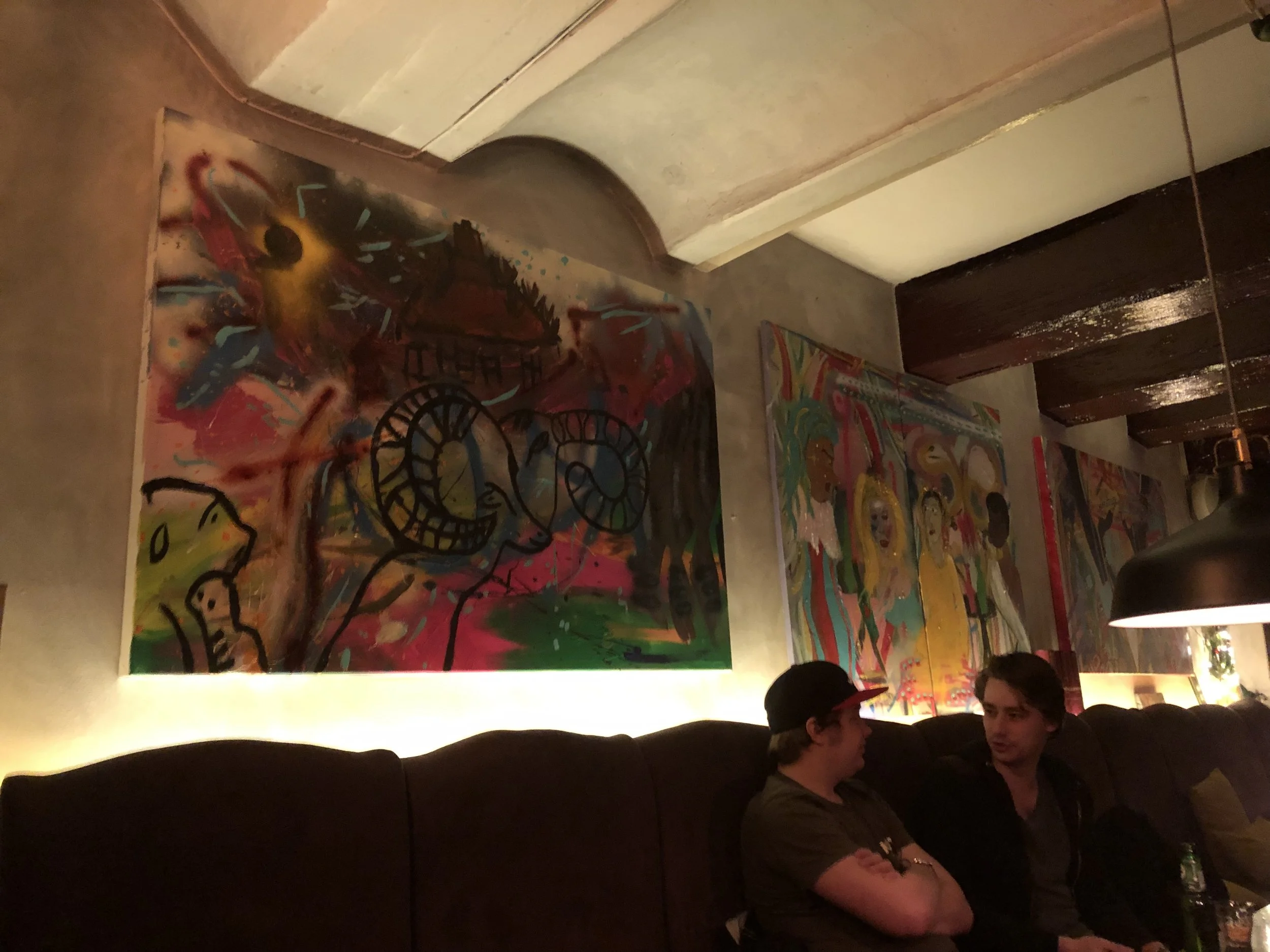
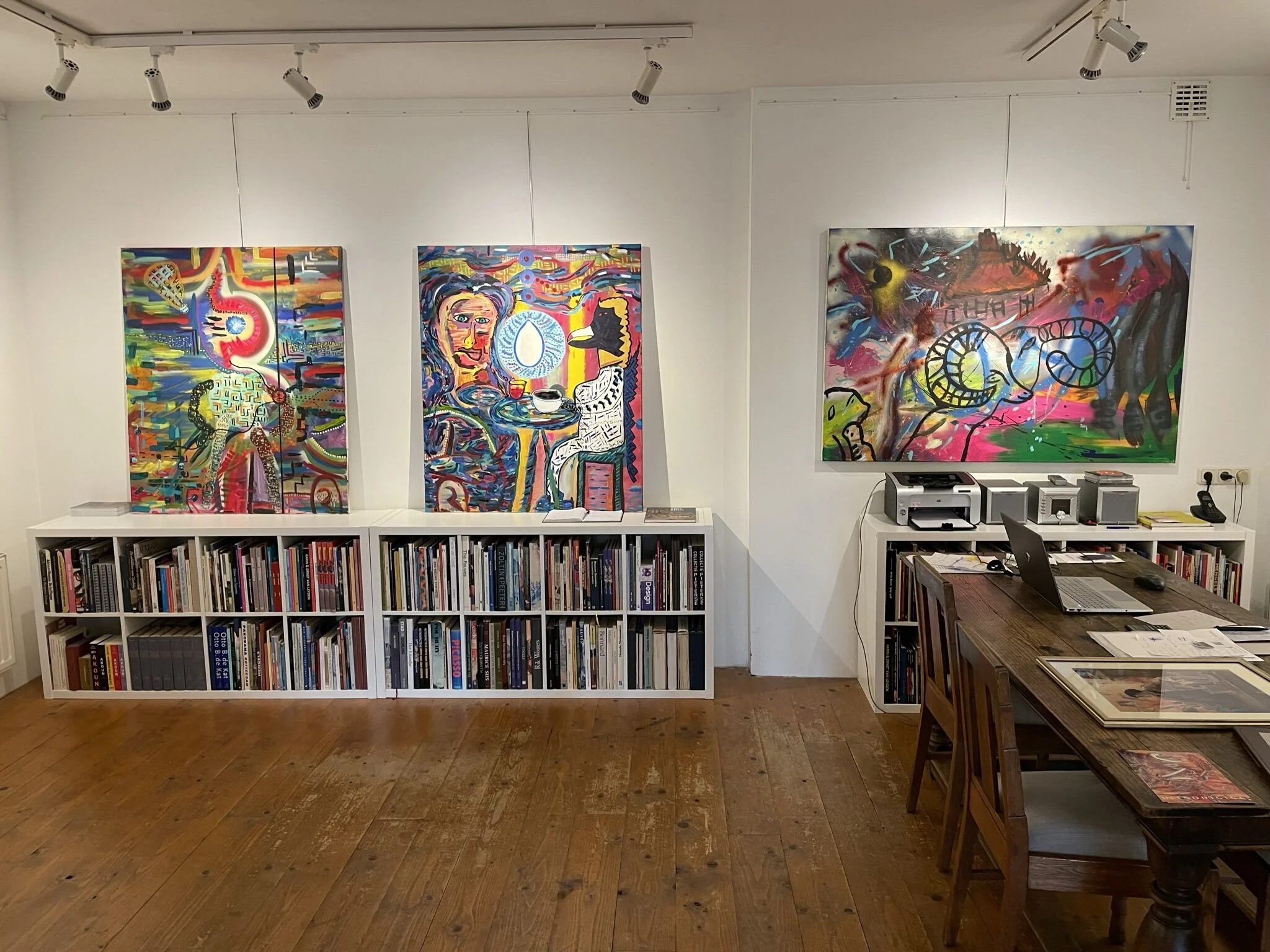
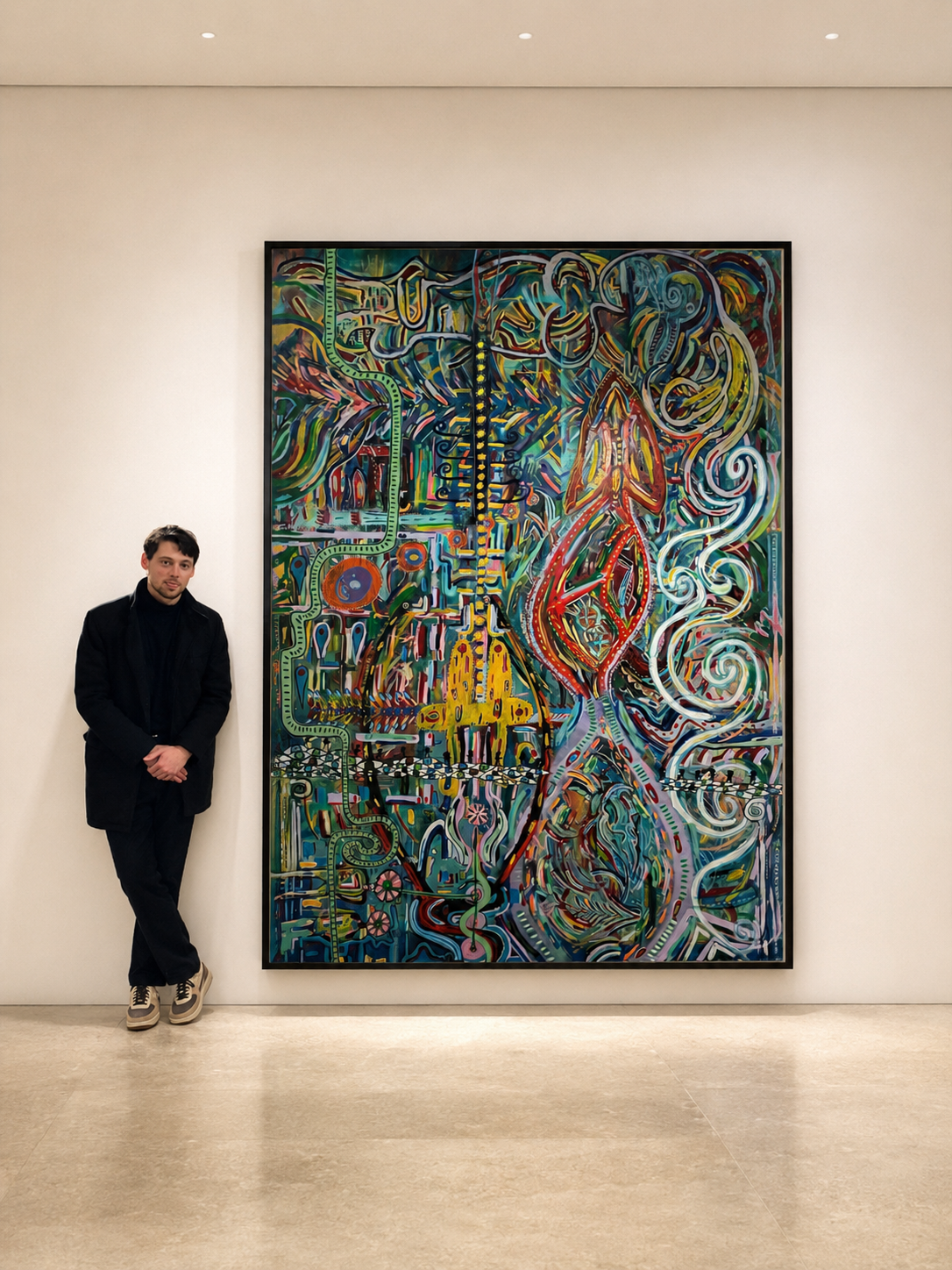
A painting is never experienced in isolation. It becomes part of the architecture, the furniture, the light, and the rhythm of everyday life. This collection offers a glimpse into how our works inhabit contemporary interiors, inspiring spaces that feel personal, timeless, and refined.
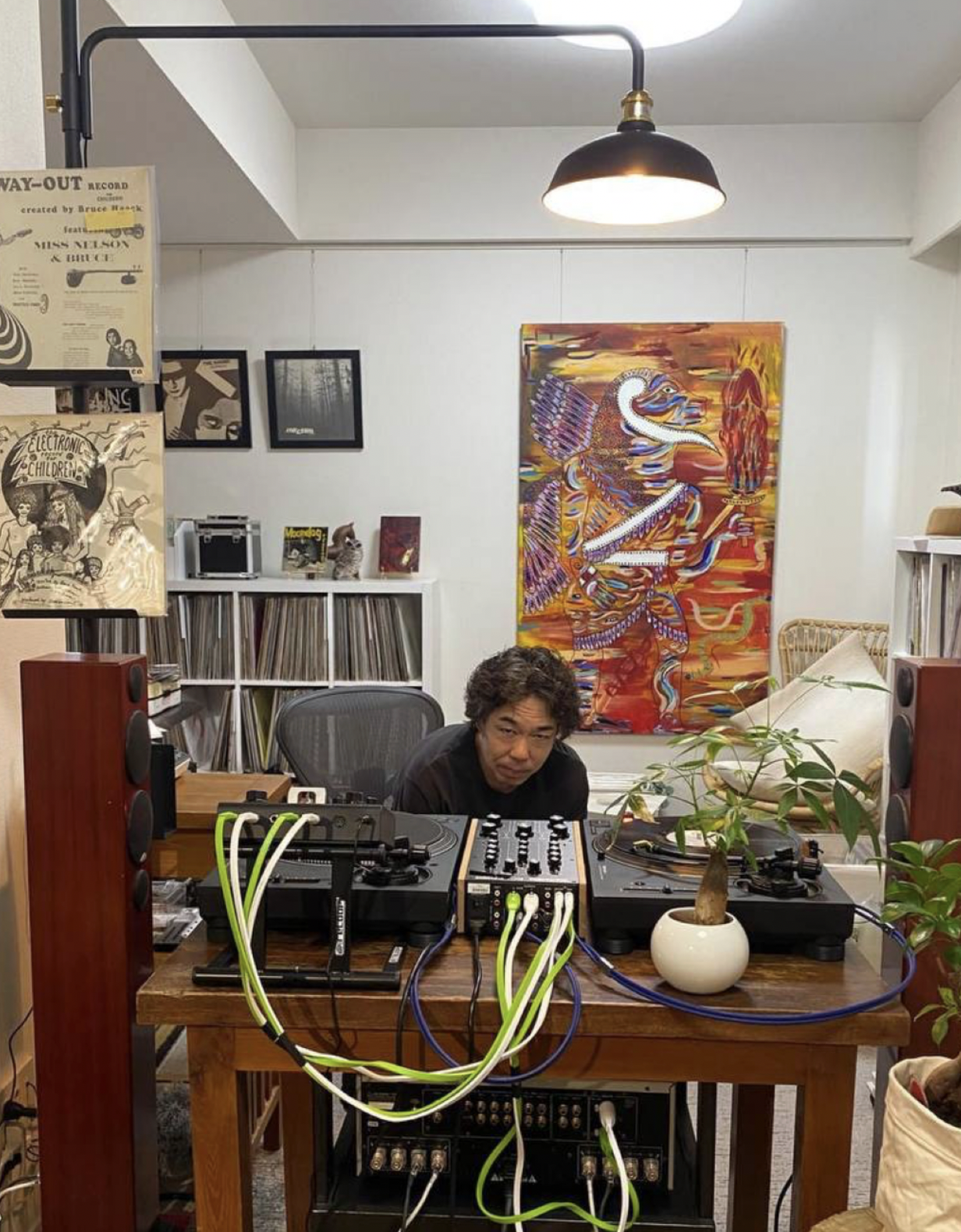
Art finds its true purpose when it becomes part of everyday life. These interiors reflect our philosophy of thoughtful collecting where contemporary paintings are chosen not simply to fill a wall, but to define a space. Each setting demonstrates the dialogue between architecture, design, and original art, offering inspiration for collectors, designers, and those creating homes with lasting character.
Judgement
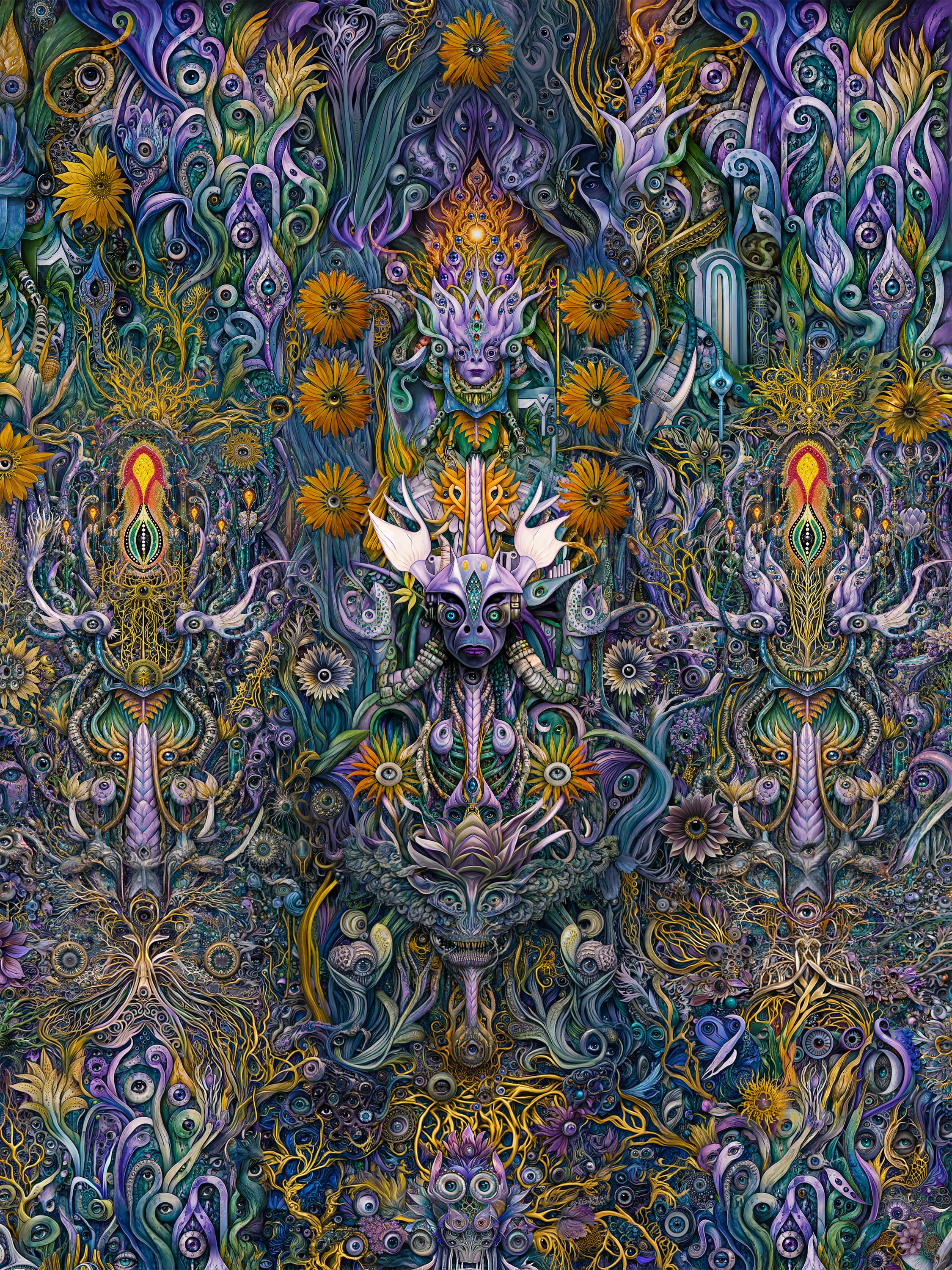
Their rims were high and awesome, and all four rims were full of eyes all around." — Ezekiel 1:18
"The four living creatures... were full of eyes in front and behind... and around and within." — Revelation 4:6–8
A vision of reality unfolding in layers. The familiar physical world gradually dissolves into the inner landscape of memory, symbols, and archetypes before opening into an infinite field of cosmic consciousness, where the boundary between self and universe disappears. At the center of this transcendent realm, vast eyes within eyes covered in countless more eyes revolve around a radiant throne, surrounded by immense living beings whose forms are filled with eyes in every direction. The eyes symbolize limitless awareness, perception beyond time and space, and consciousness experiencing itself through infinite perspectives. The atmosphere is sacred, and all knowing, blending prophecy with a visionary exploration of consciousness, interconnectedness, and the hidden dimensions that may lie beyond ordinary perception.
limited signed print.
Original resolution is 9000x12000
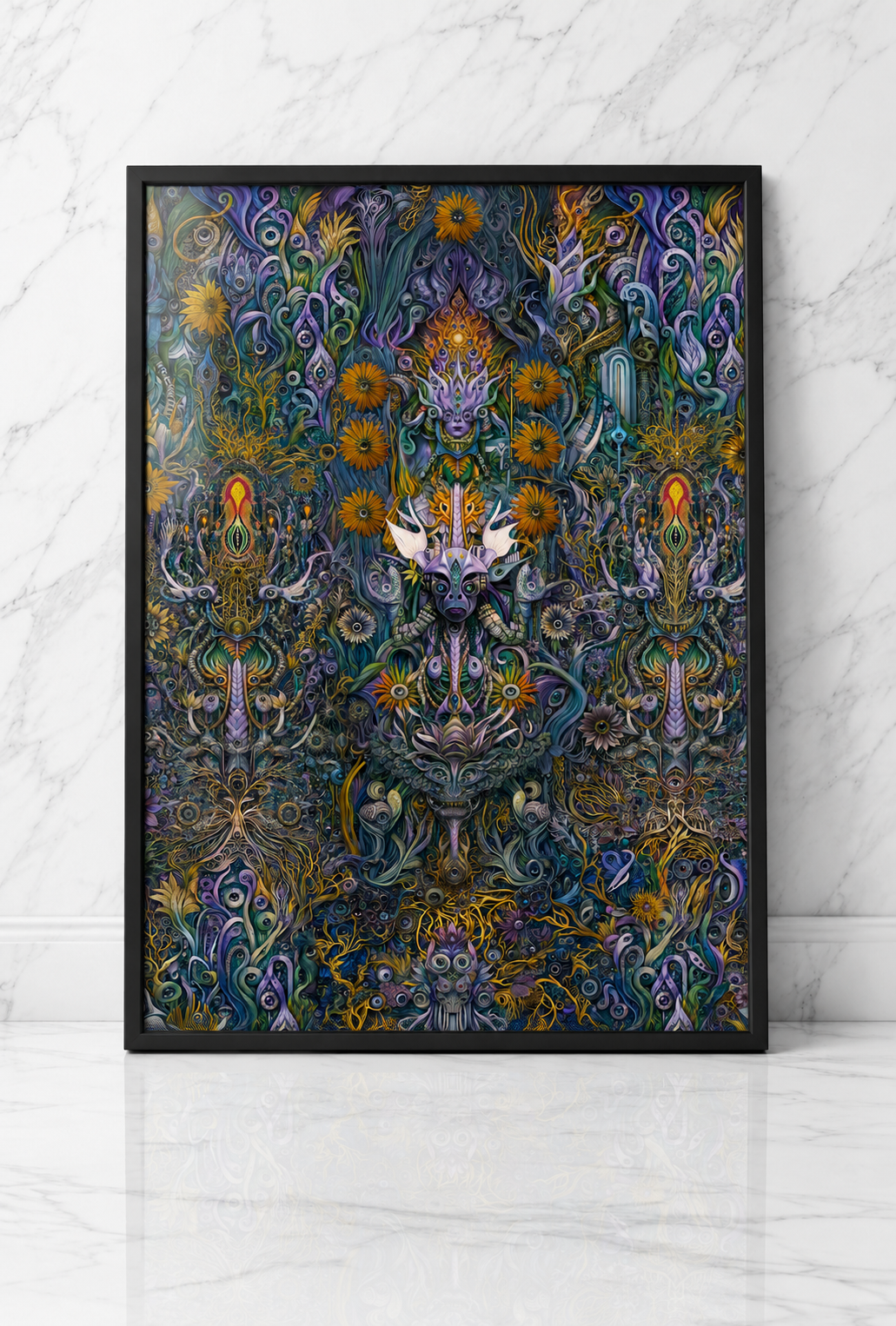
Phygital artwork
Judgement Phygital
JMP · Roland Carter
A digital artifact presented through the LUKSO ecosystem, connecting creative expression, verifiable ownership and an on-chain identity.
Opens the verified asset experience on Universal Everything.
Today you are beautiful.
We slept far too long,
And I wake only reluctantly
From a dream far too dark.
And I can hardly remember
The once familiar gestures,
Or how the words go again—
The ones that tell us everything is alright.
Once I was clever,
Today you are beautiful.
Behind us, things are burning.
We stand in wonder before the ruins
Of a good old time,
And we recall with admiration
That sense of indestructibility
Our lives once seemed to have,
And how simple everything felt
When we still knew far too little.
Once I was clever,
Today you are beautiful.
Behind us, things are burning.
When you smile, the future
Loses all its terror.
When you cry, all sorrow
Is dissolved within your tears—
And whoever cries is never wrong,
And who smiles the way you do?
That is something I failed to see
For far too long.
Once I was clever,
Today you are beautiful.
Behind us, things are burning.
Inspiration trip 2
Wahrheit, Schönheit, Güte
To worry about getting old, to feel old To remember I felt older before i realise now i feel younger then in 2016
There was a time when I thought love alone could sustain everything.
I have known what it means to love deeply to give without measuring, to stay when leaving might have been easier, to carry hope long after it stopped carrying me.
I have resisted bitterness, even when it would have been the simpler choice. But there are still days when thoughts of you arrive uninvited. Your moods used to become my weather. If you were distant, I felt cold. If you were angry, I carried the storm. Somewhere along the way, I realized I couldn't keep living inside someone else's climate.
I'm learning not to let it affect me anymore.
That doesn't mean I don't feel anger. I do. I understand now what was happening, what was being said beneath the words. I understand the quiet ways people can take from you without ever asking.
I've become familiar with fear too the fear of being taken advantage of, of being used because I cared too much, of giving more than I had. And beneath all of that sits another fear, one that's harder to admit: the fear of never having enough, of being poor forever, of constantly wondering if survival will always demand more than I can give.
Maybe healing isn't about forgetting. Maybe it's about learning that someone else's emotions don't have to become your own, that love doesn't require losing yourself, and that fear doesn't have to write the ending of your story.
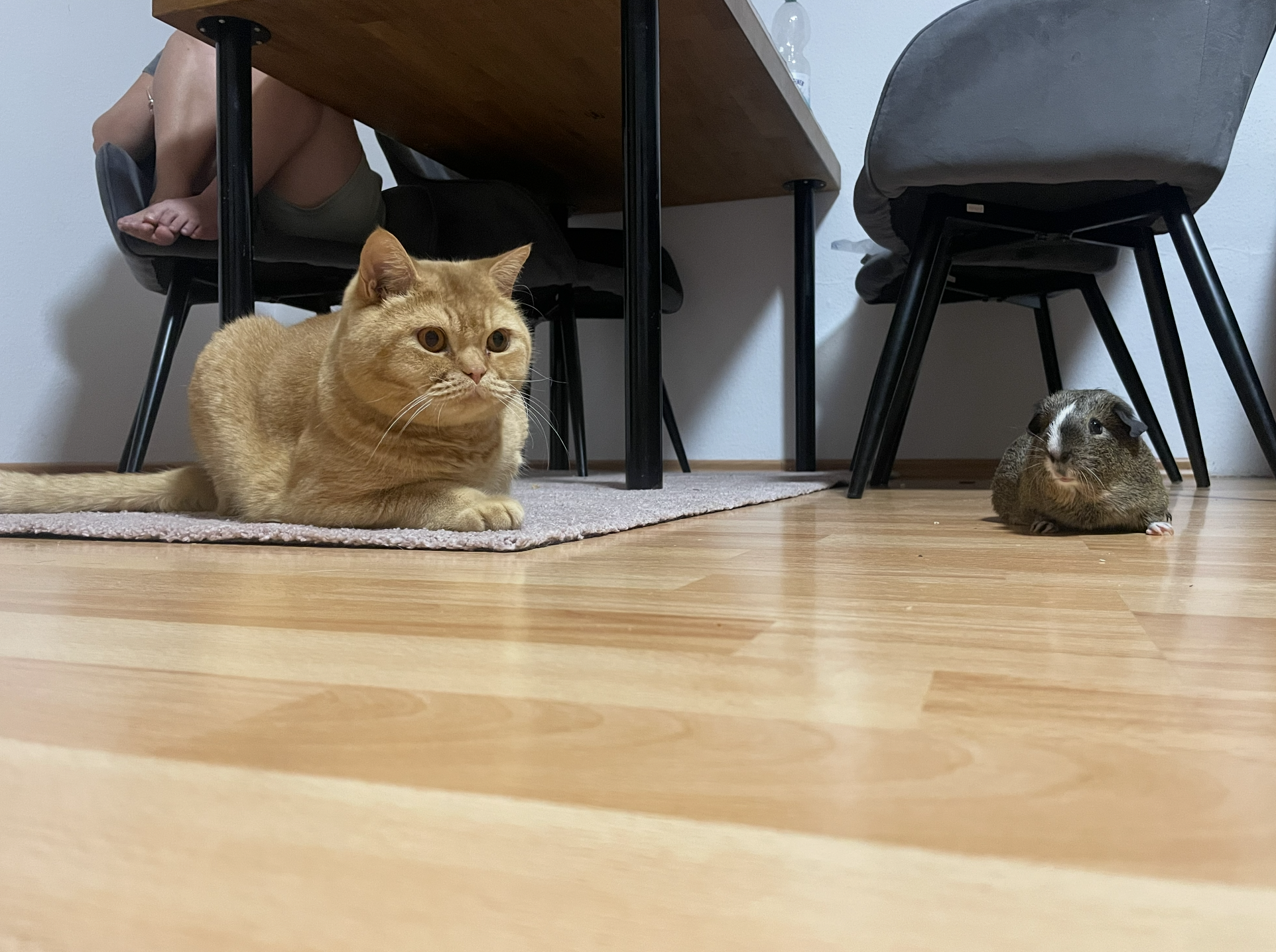
The biggest mistake we make is thinking we have time.
We postpone telling people we love them.
We delay pursuing goals that matter.
We assume relationships, health, and opportunities will still be there tomorrow.
We treat time as if it's guaranteed, when it's one of the few things we can never get back.
Rather than encouraging fear or urgency for its own sake, the quote can be read as a reminder to be intentional with the time we do have.
The Floor
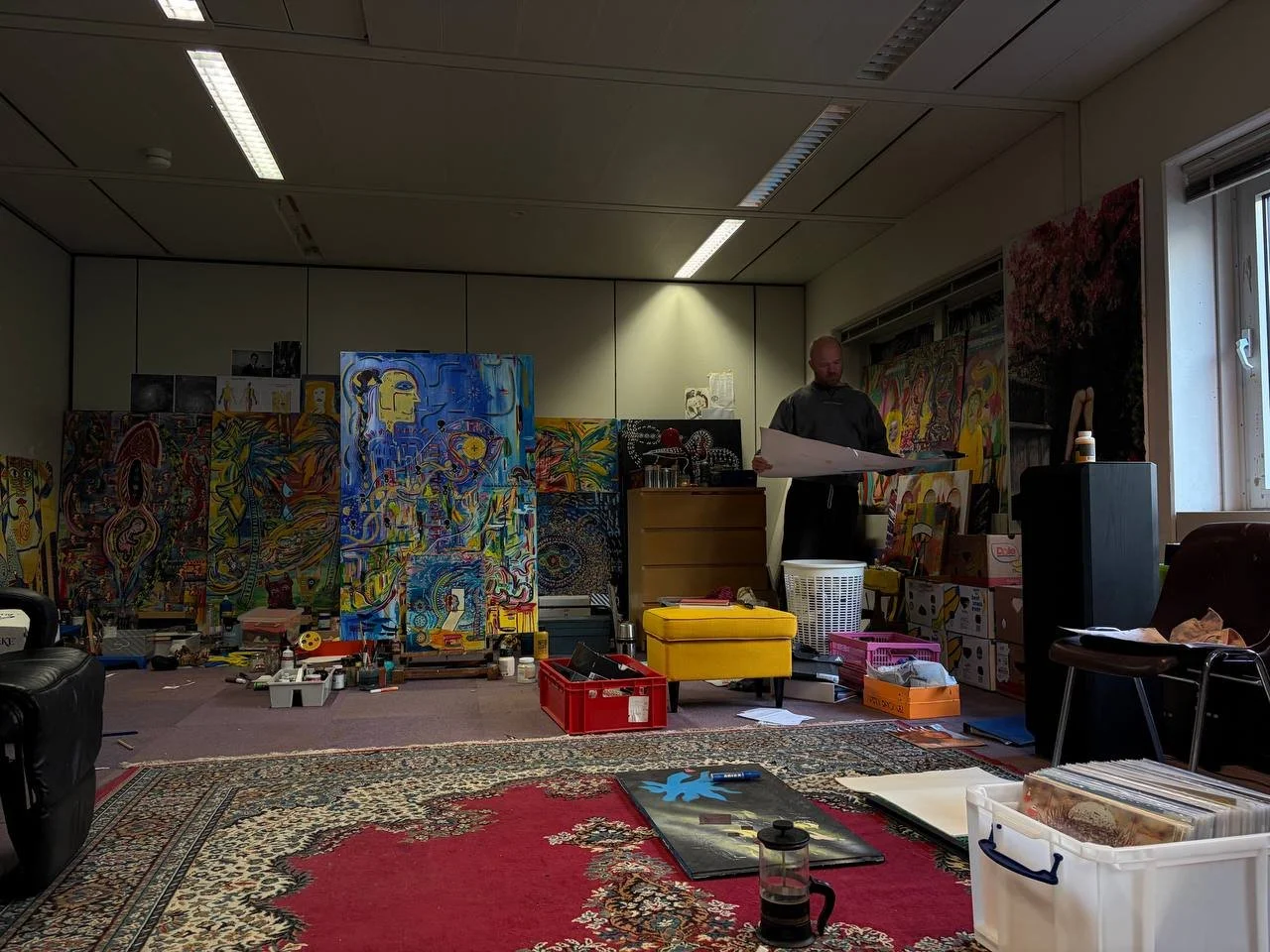
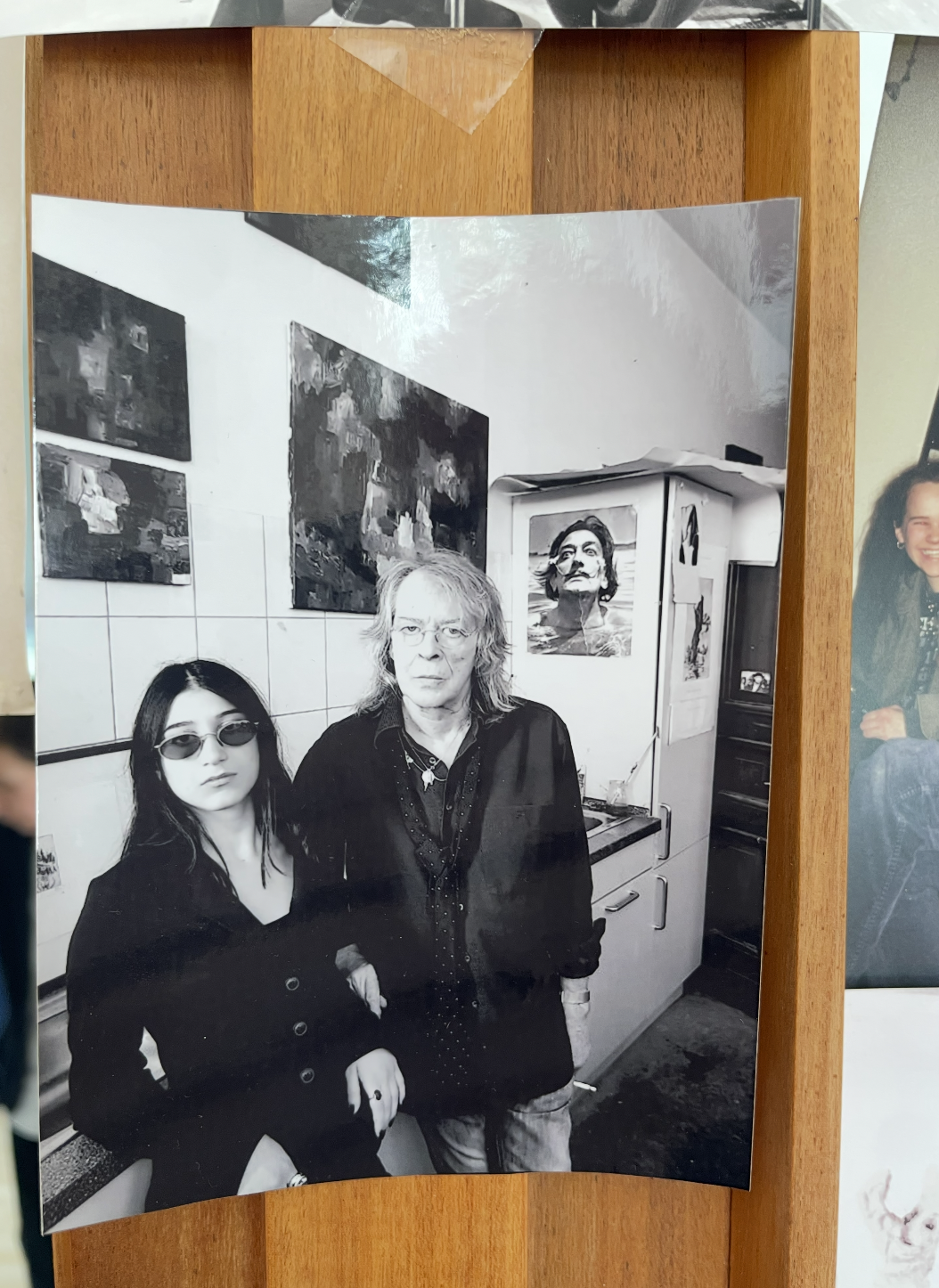
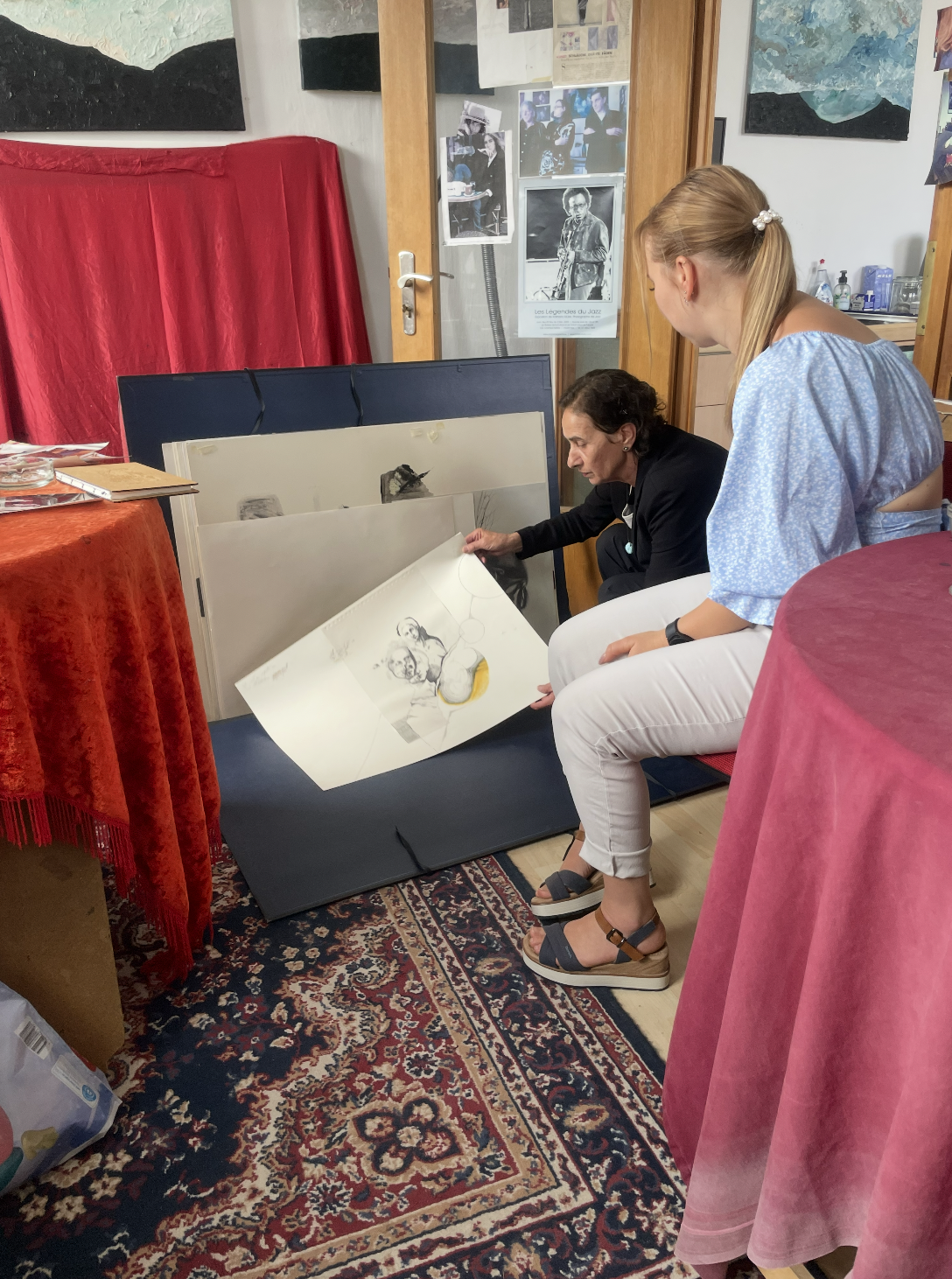
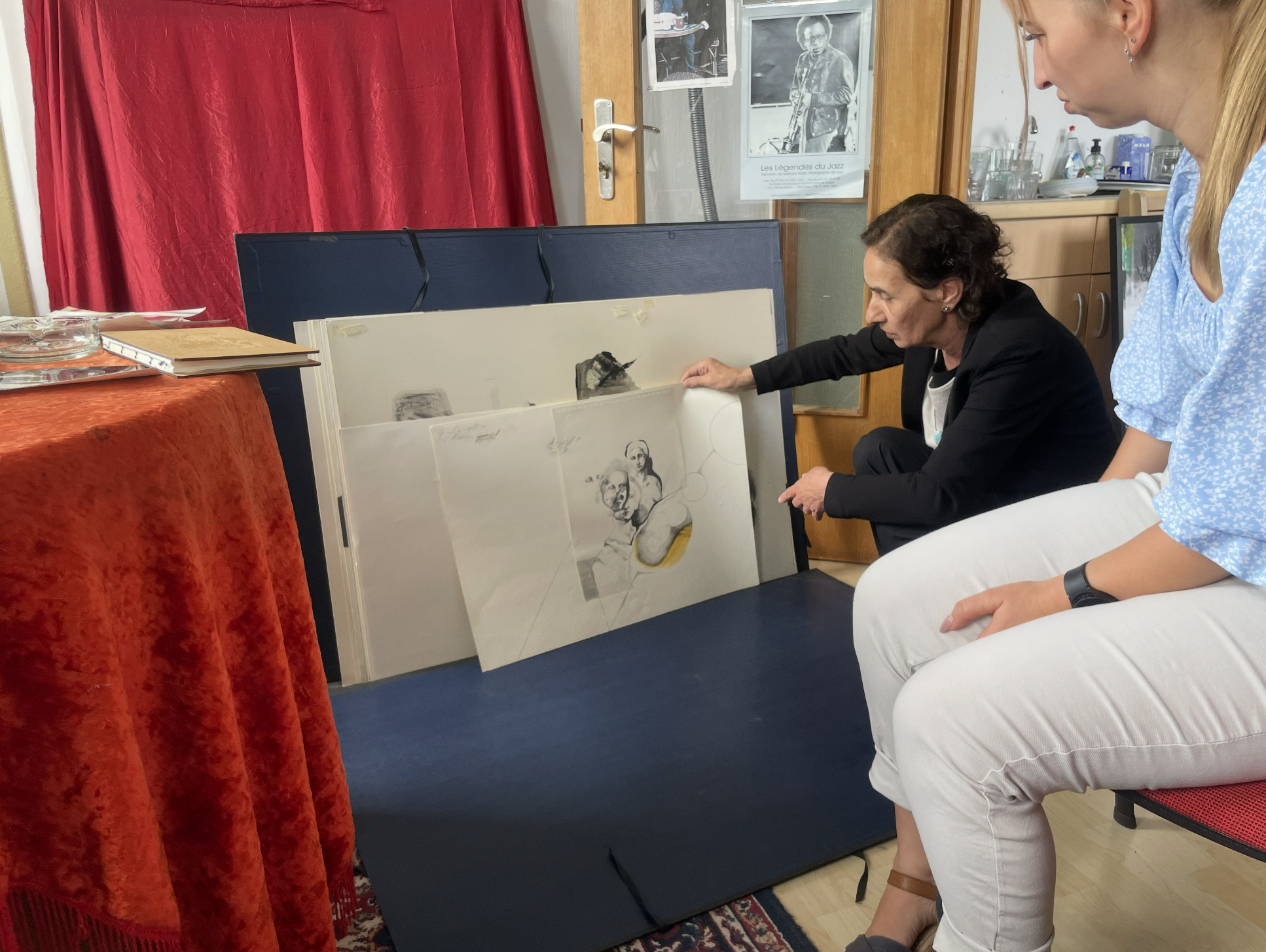
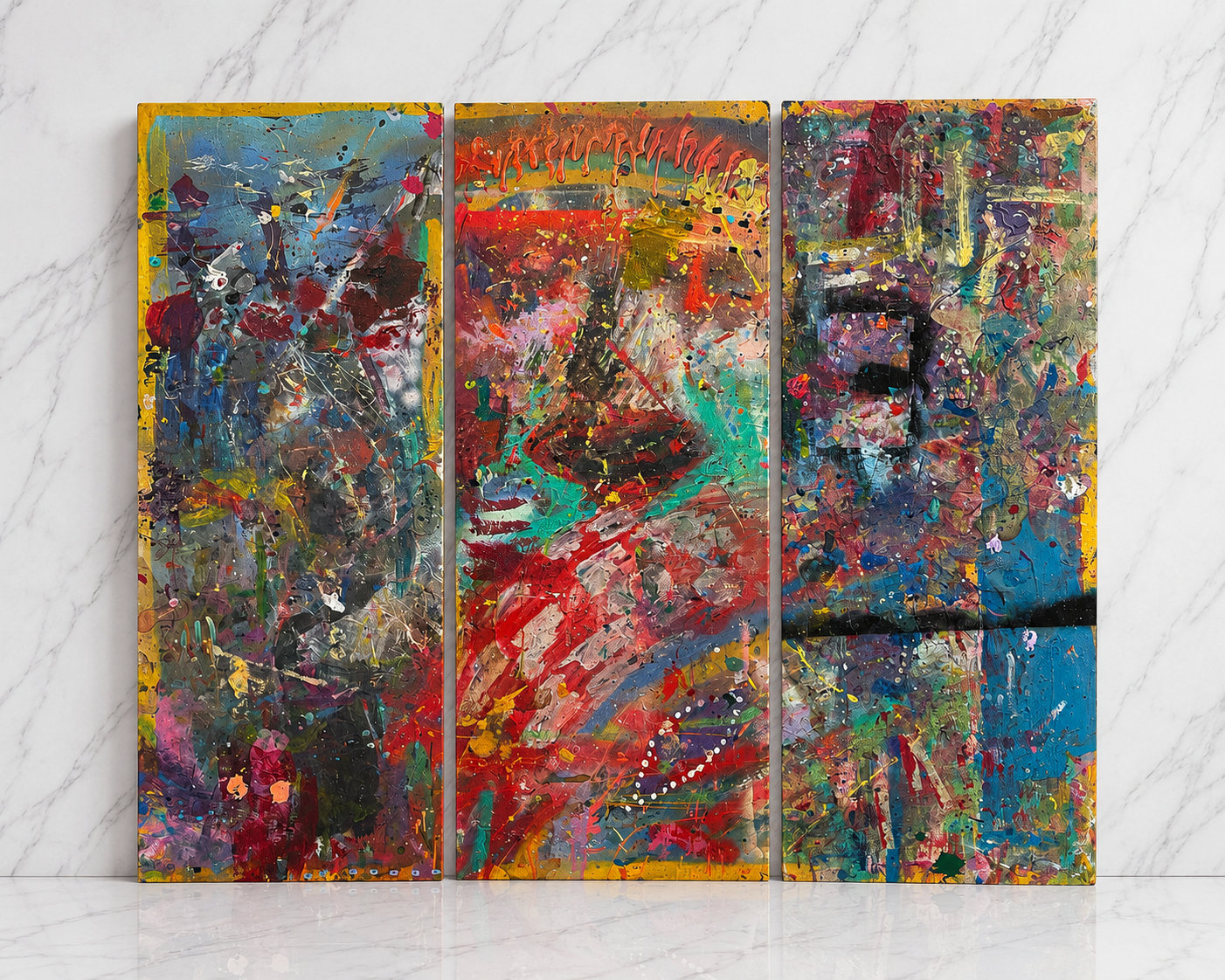
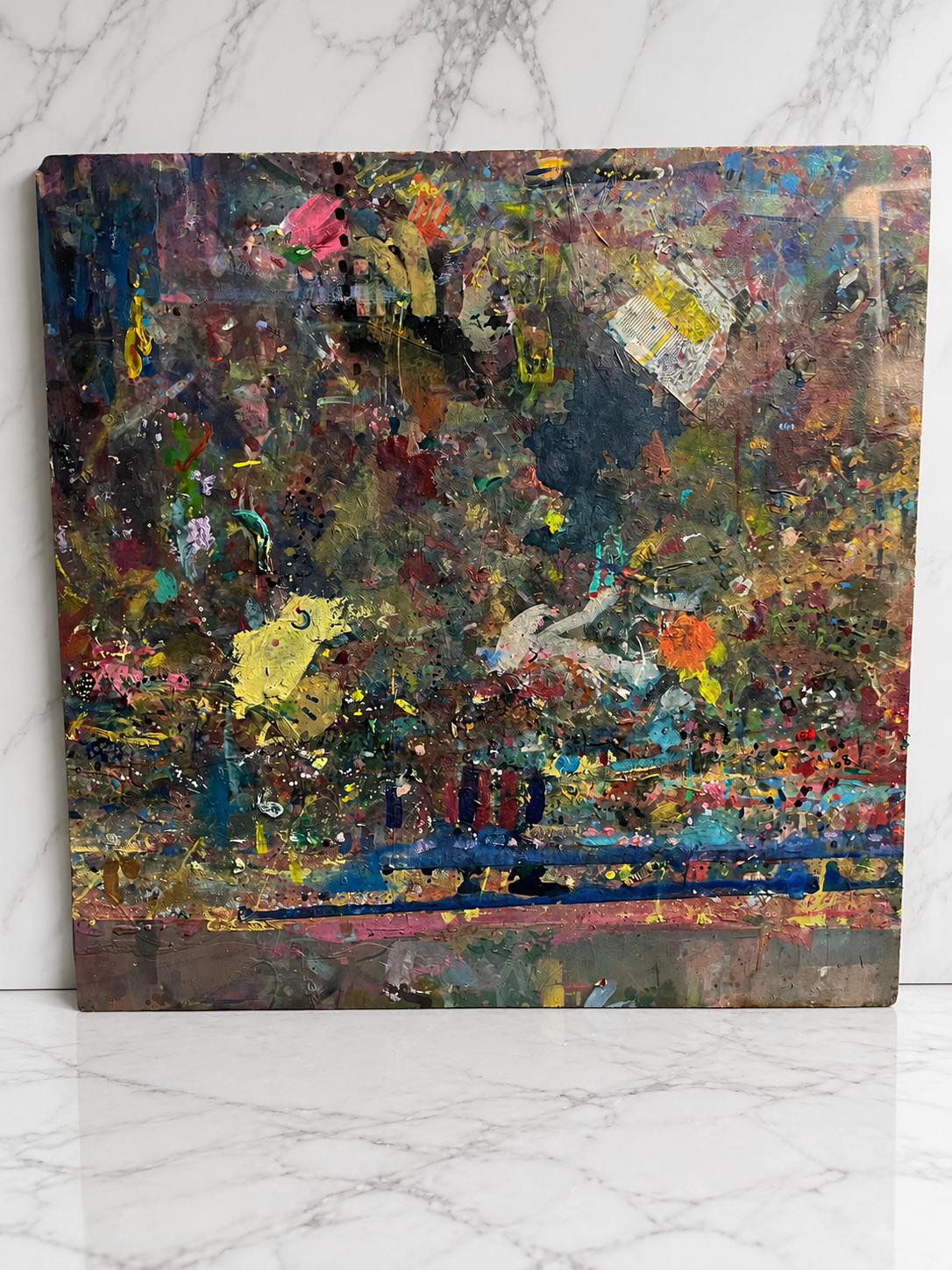
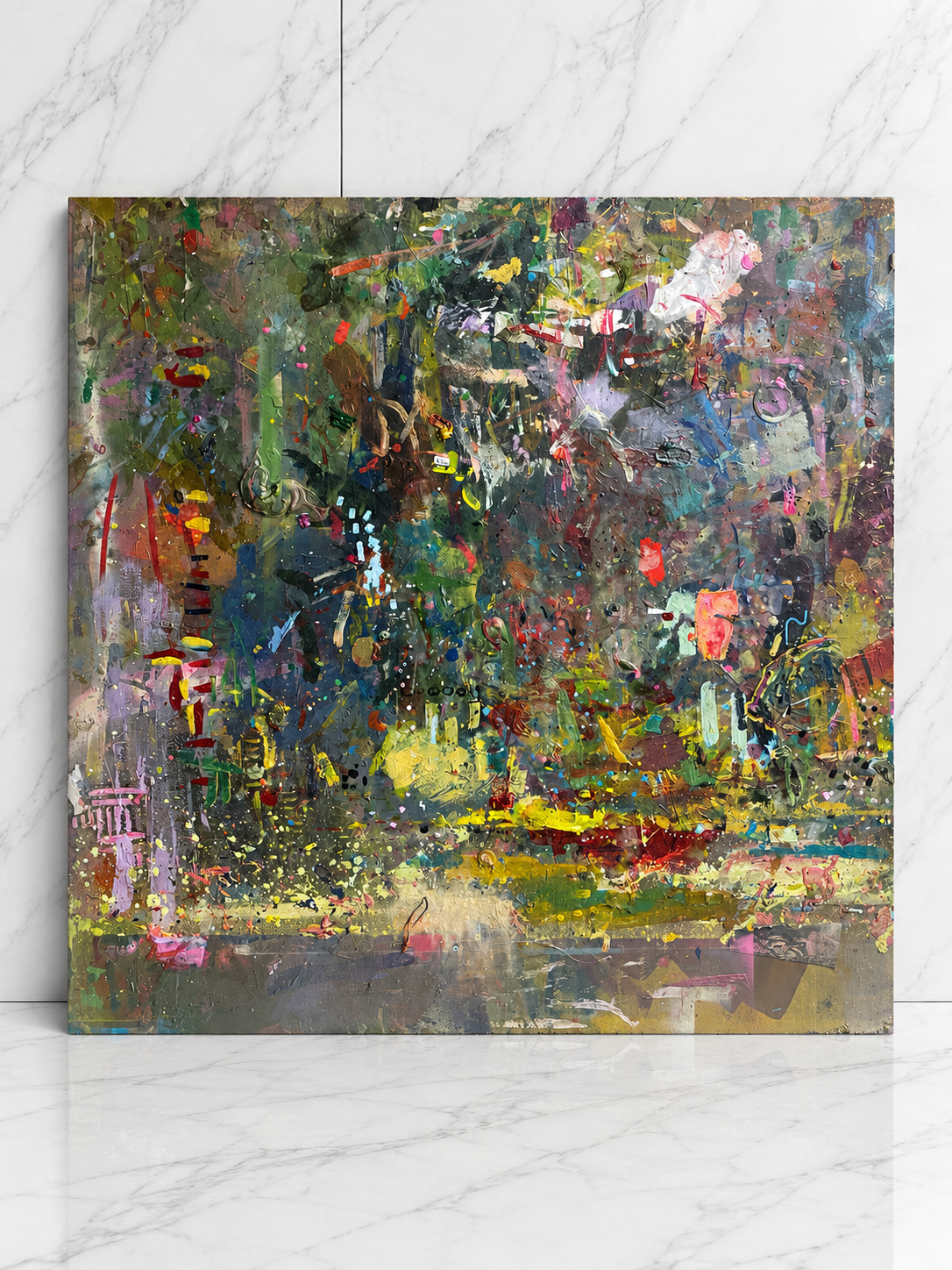
Some of these platters have been with me since Sontweg. Others came along in 2018. Over the years I never really paid attention to what ended up on the floor. One project became another, tools were moved around, ideas were tested, mistakes were made, and without noticing it the floor turned into a painting. Looking at it now, I can remember different periods of my life just by recognizing the marks that are still there.
I'm finally cleaning everything up and redoing the studio. Some things have served their purpose, some things are worth keeping, and some have simply been taking up space for years. It feels good to go through everything instead of letting it pile up even more. The studio has changed because my work has changed, and it no longer fits the way I used to do things.
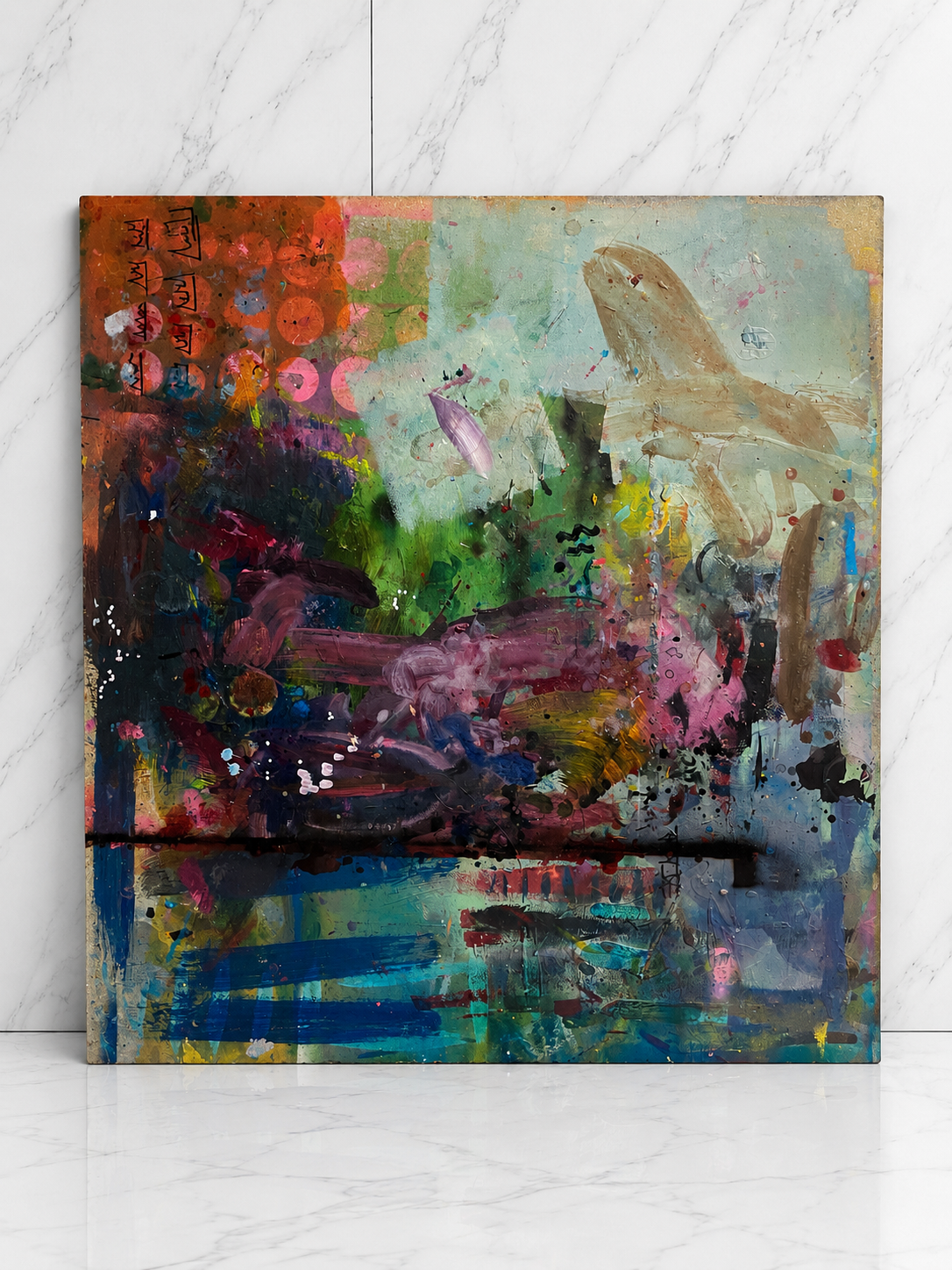
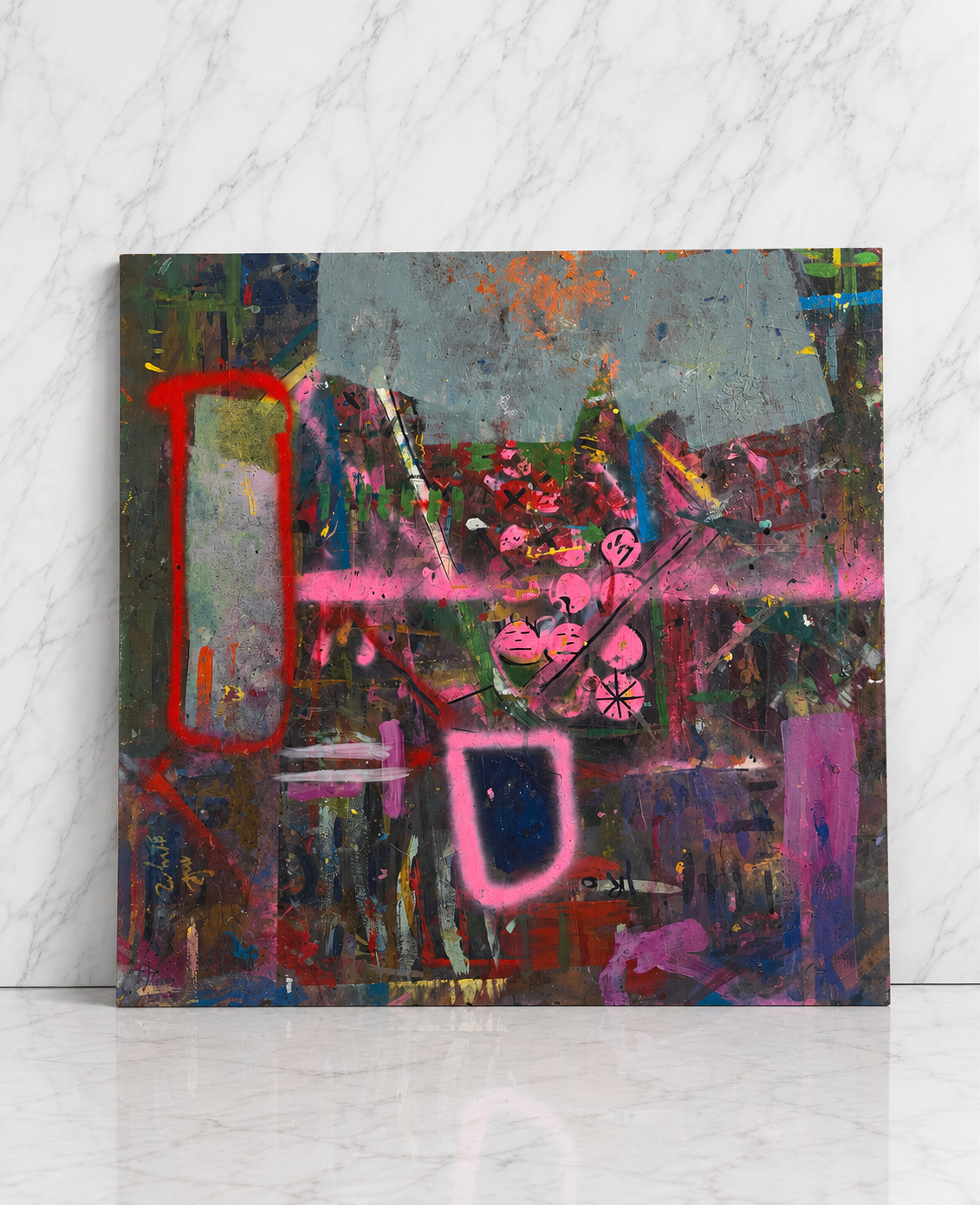
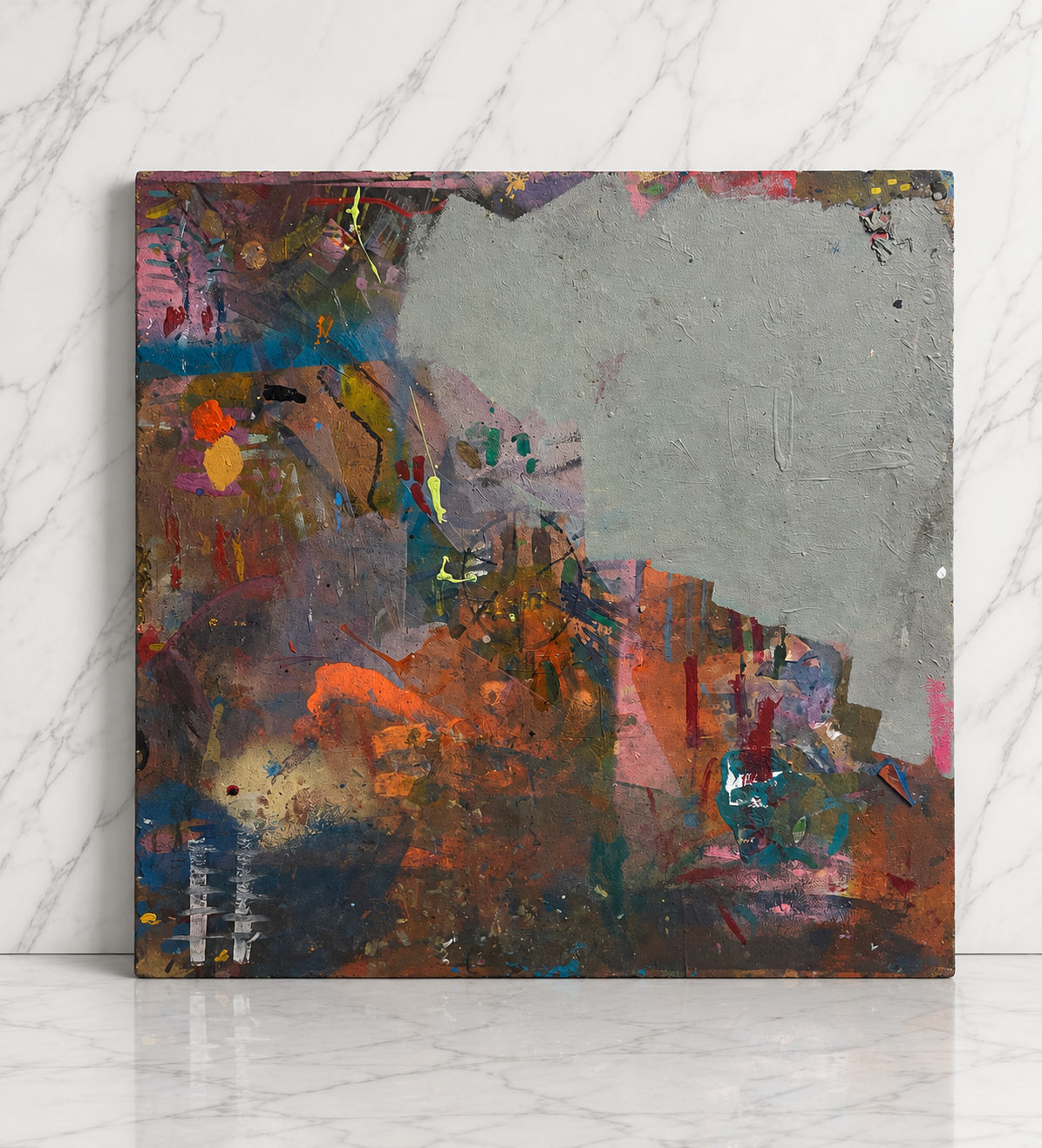
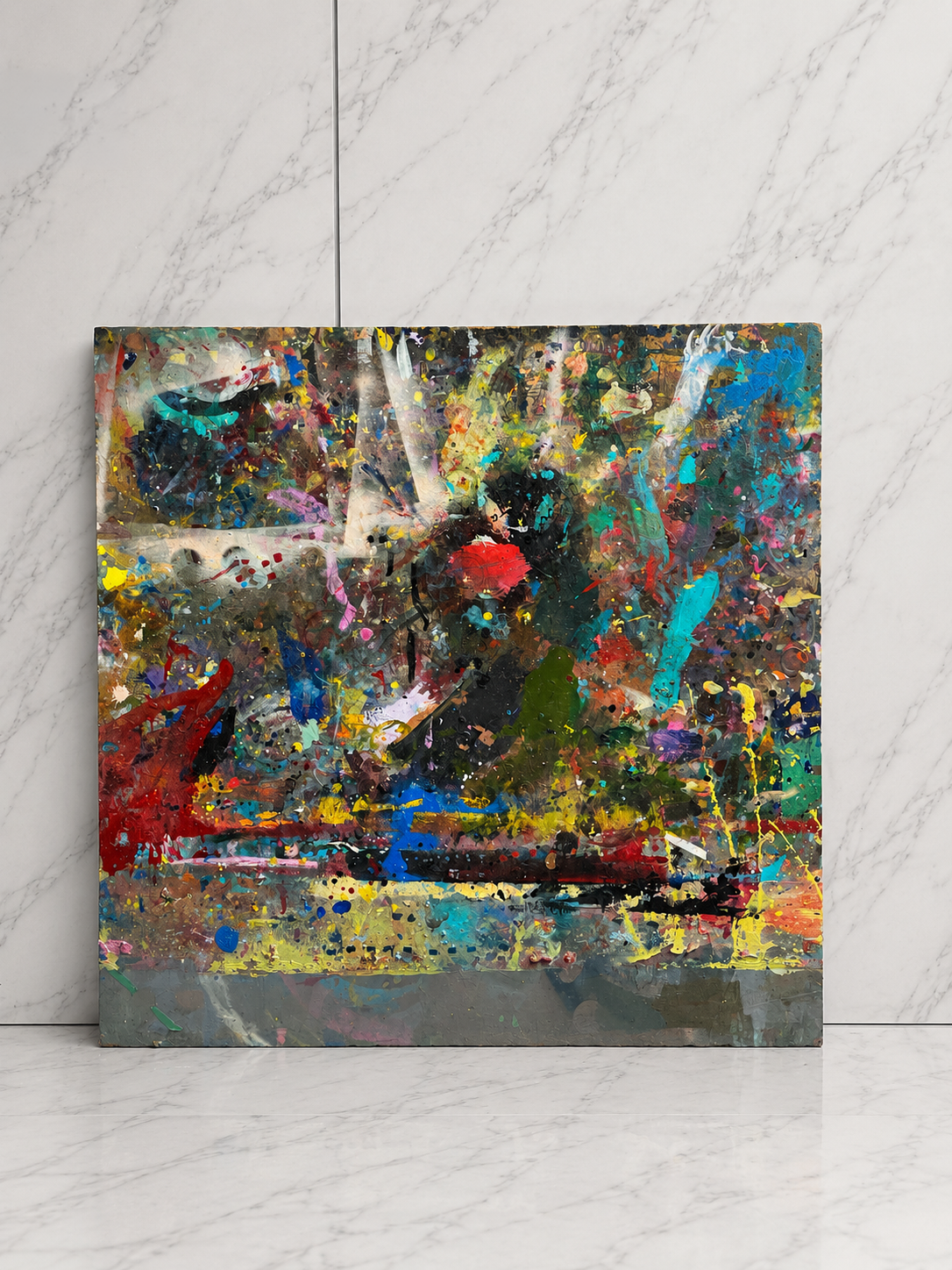
When I compare where I started to where I am now, the difference is bigger than I realized. Most of that progress didn't happen through big moments. It came from showing up every day, trying again when something didn't work, and staying with it long enough for the small improvements to add up. That's easy to forget when you're in the middle of it, but obvious when you look back.
That's how I want to keep moving forward. I'll keep my attention on today while knowing that what I do now is shaping the next ten years. Every decision, every project, and every habit adds something. You don't build a future all at once you build it one ordinary day at a time.
The studio is changing, and I think that's a pretty accurate reflection of everything else that has changed too.
Inspiration trip 1
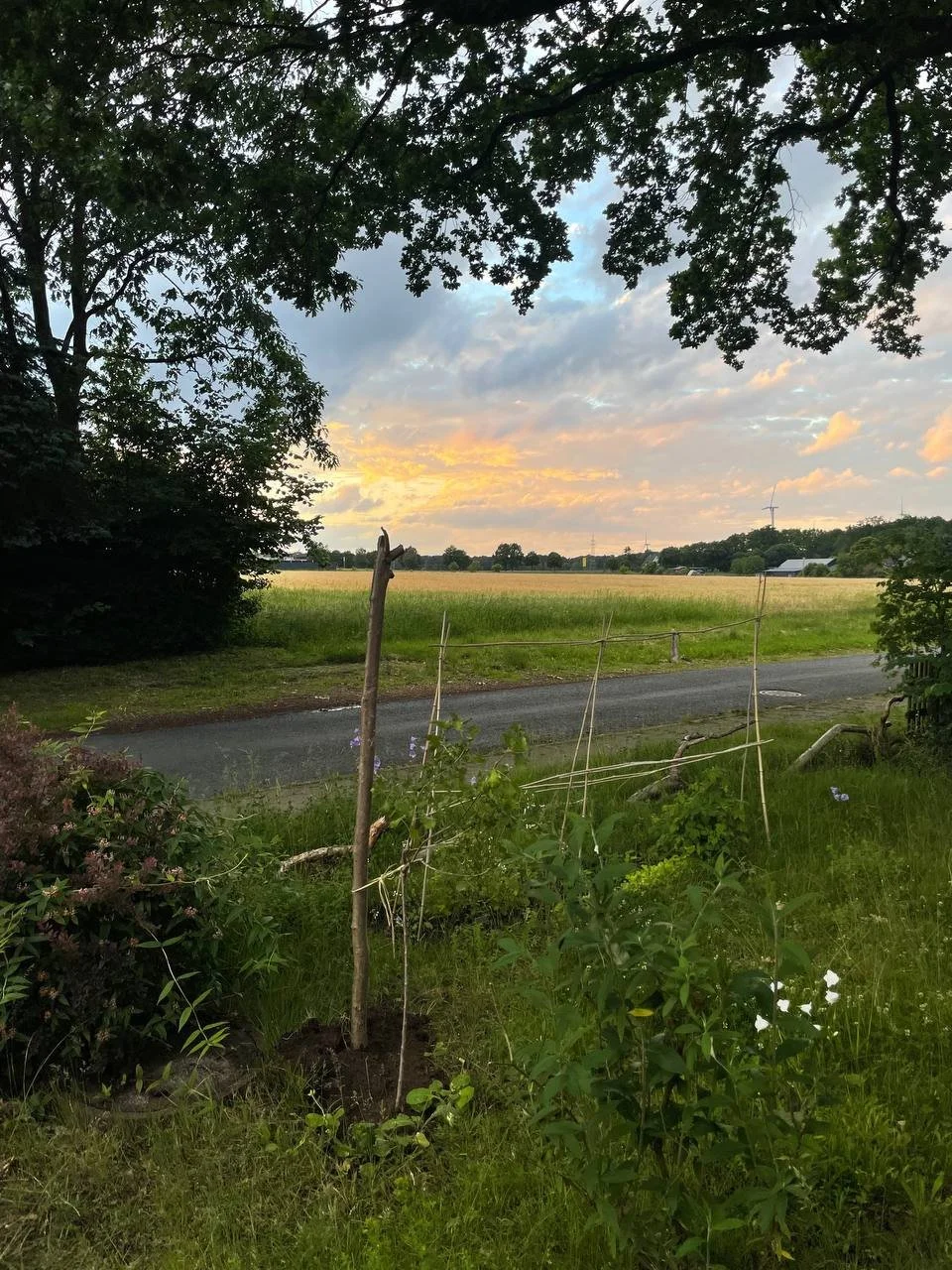
I think this is one of those moments you save like an image in your mind. I was in Soltau, and before I went inside, I saw this. By the end of the day, before I went to bed, I realized that for my paintings I should make a better blog, reorganize all the documentation I've made since 2010, and build a better foundation for the years to come.
I was working on a painting called Bradley Cooper Movie. It continues the stream of consciousness that I have explored before and features a figure I created during this trip called Anton. I had a lot of thoughts while I was having my simple German meal on the Autobahn. I like the Autobahn. The sound of the cars racing by reminds me of being a child, standing nearby and listening to them. Sometimes I miss that time.
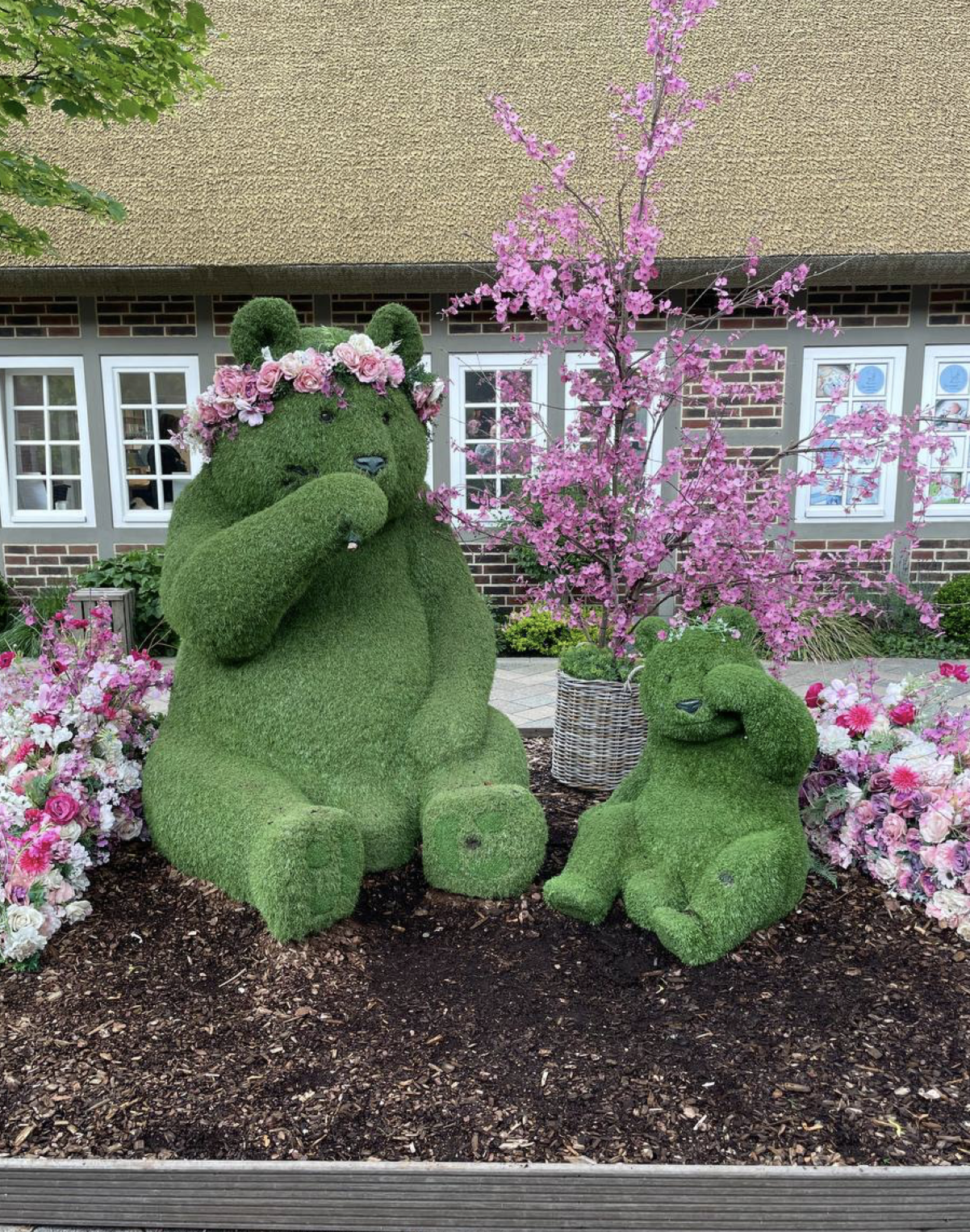
The babybear is crying because mama bear is vaping.
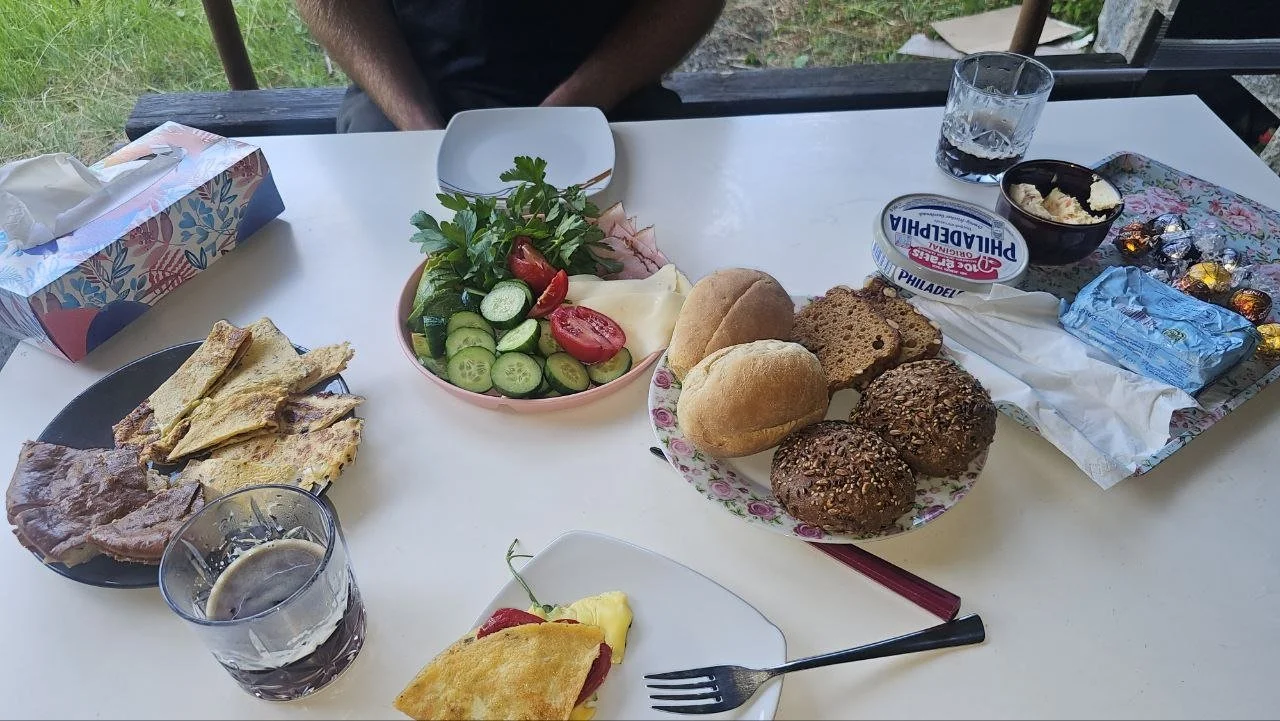
Staying in Soltau also reminded me of being in Austria as a child with my parents. The cozy breakfasts and lunches Dorothea made for me gave me a nostalgic and comforting feeling. It was one of those days when memories, places, and the work itself all seemed to come together.
I photograph a lot, and I save and screenshot countless images from the internet and with my Instagram scraper. I like using Instagram as a personal archive with a feed blocker, so it works more like Tumblr used to: a place to collect images without those endless video reels. Looking back at everything I've documented over the years made me realize that I should organize it more carefully not just for myself, but as part of the ongoing story of my work.
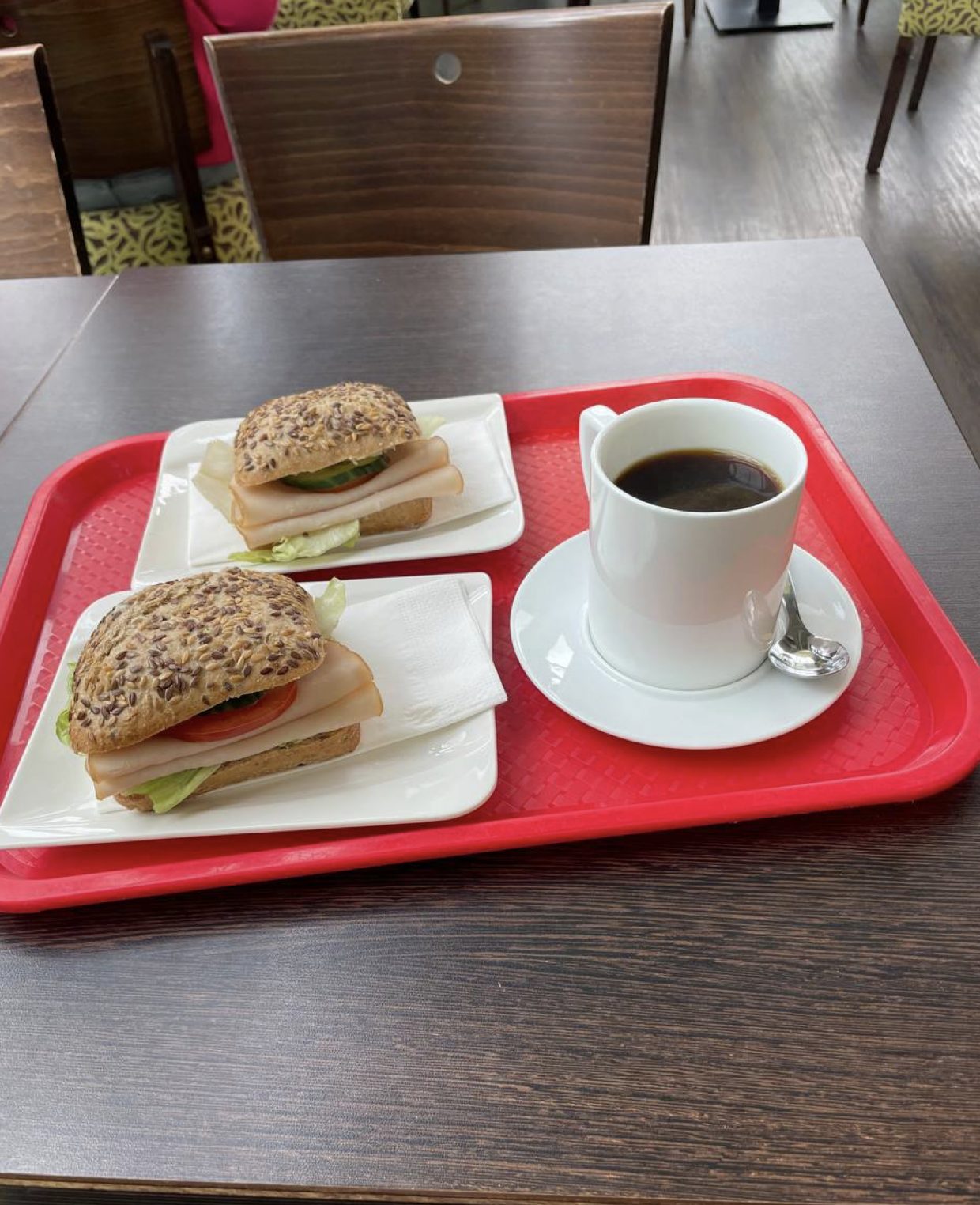
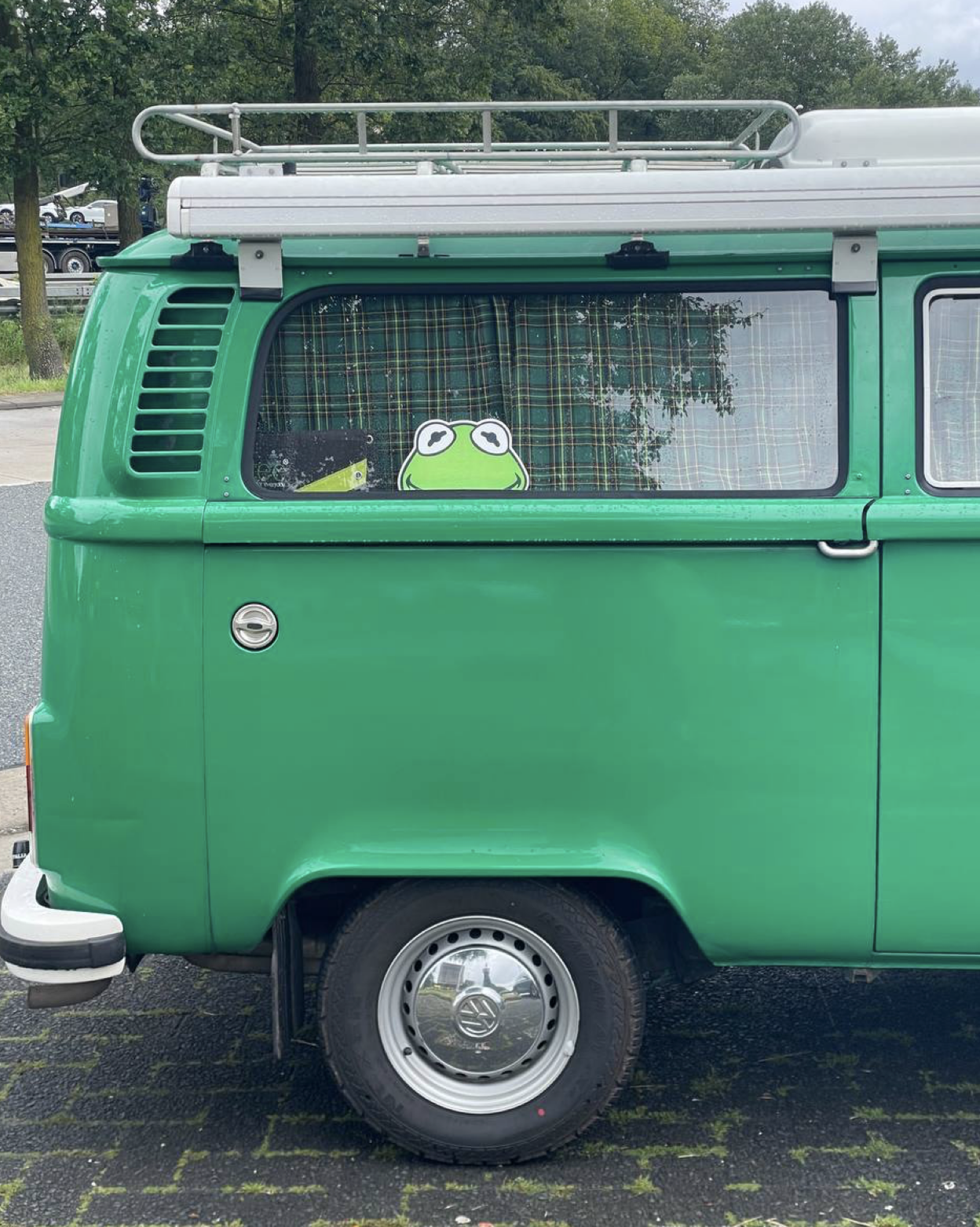
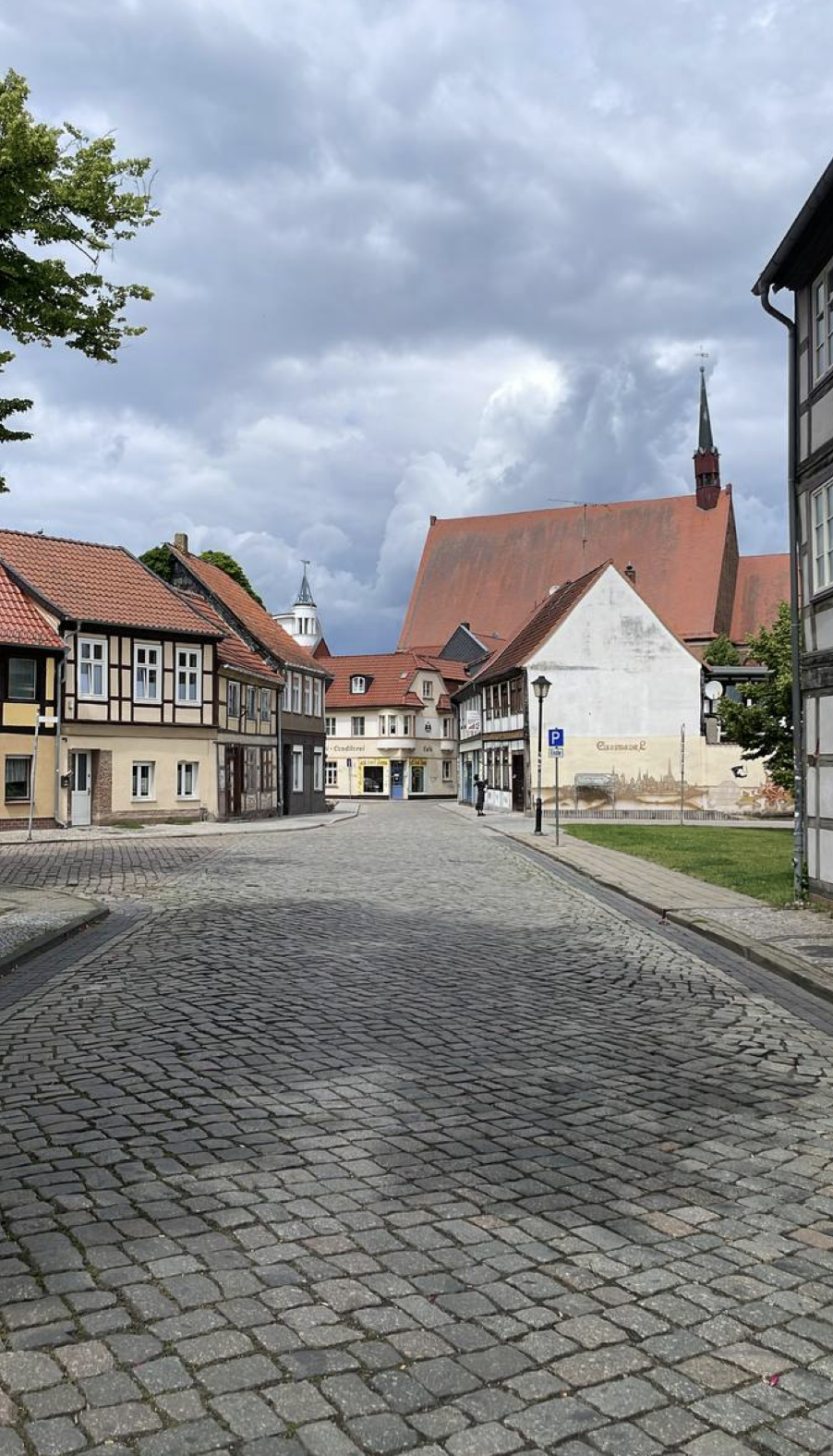
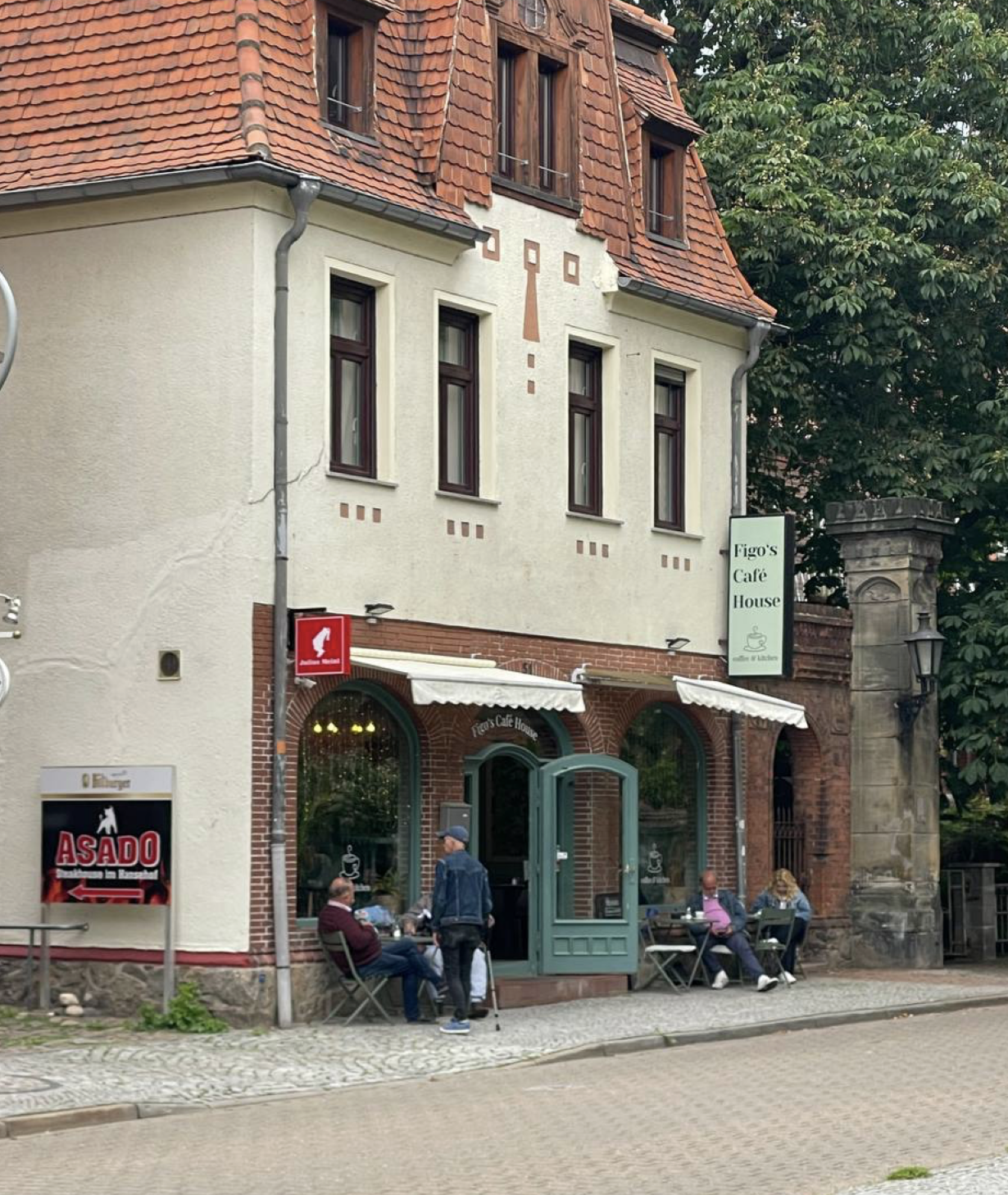
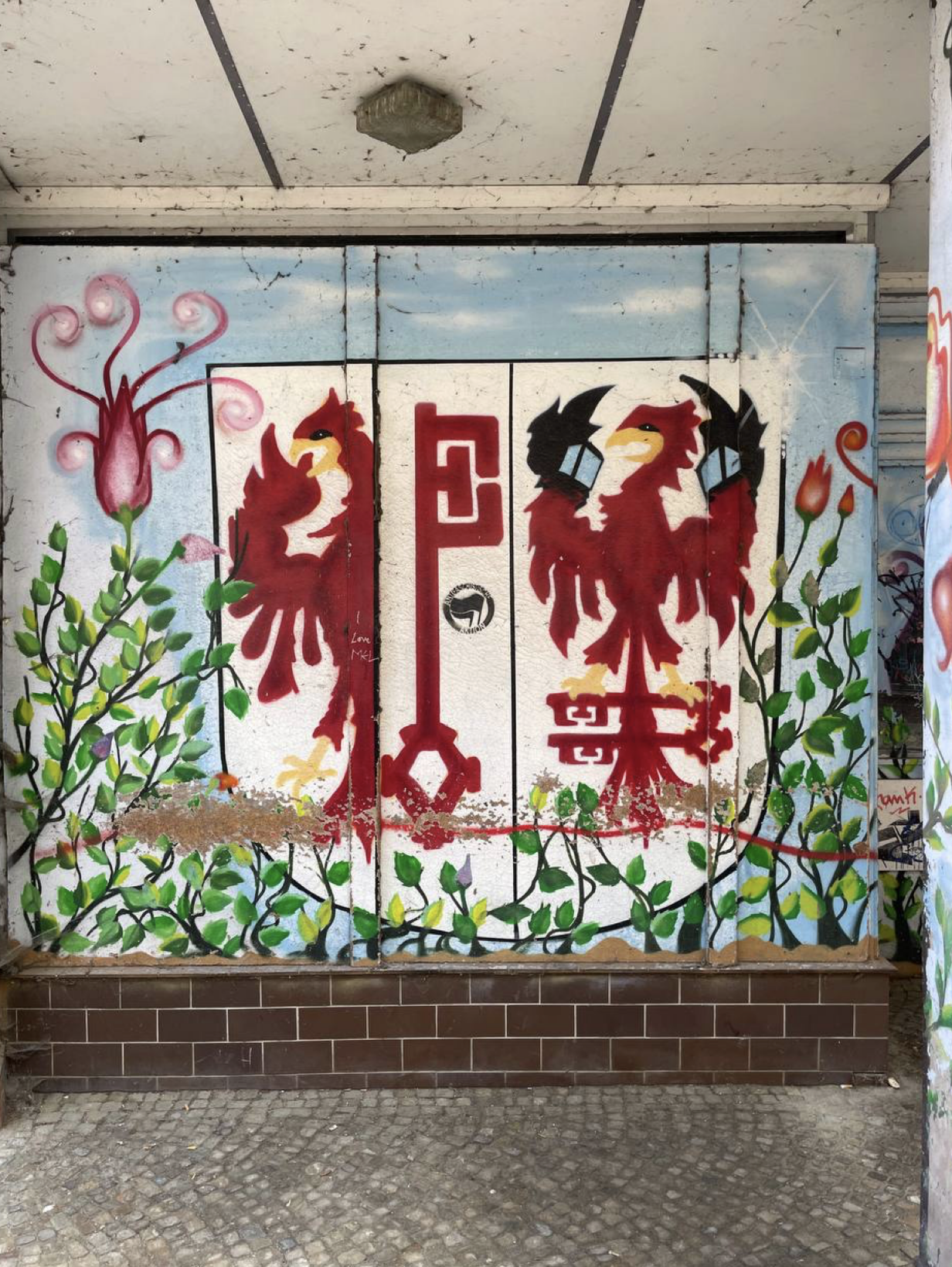
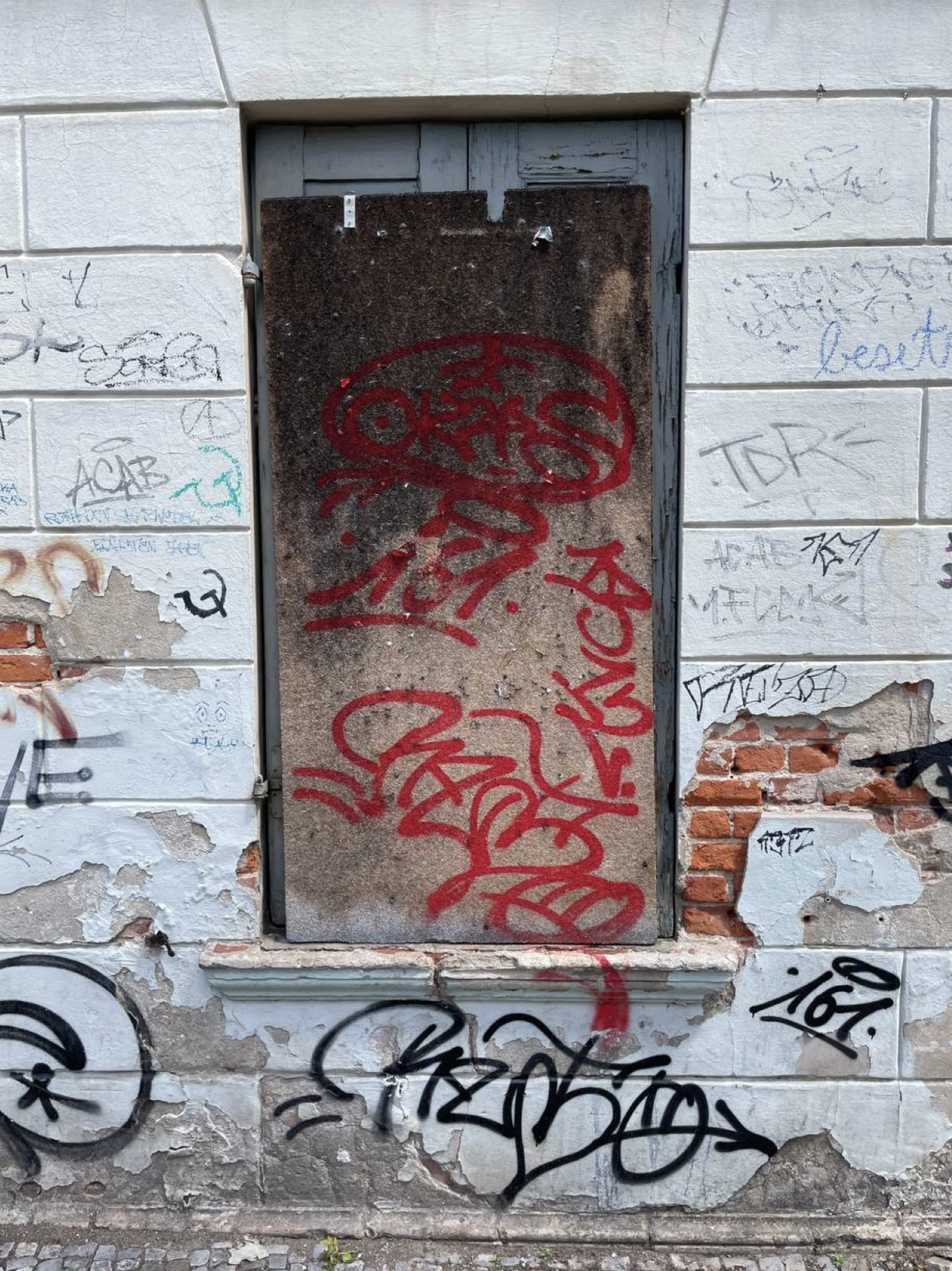
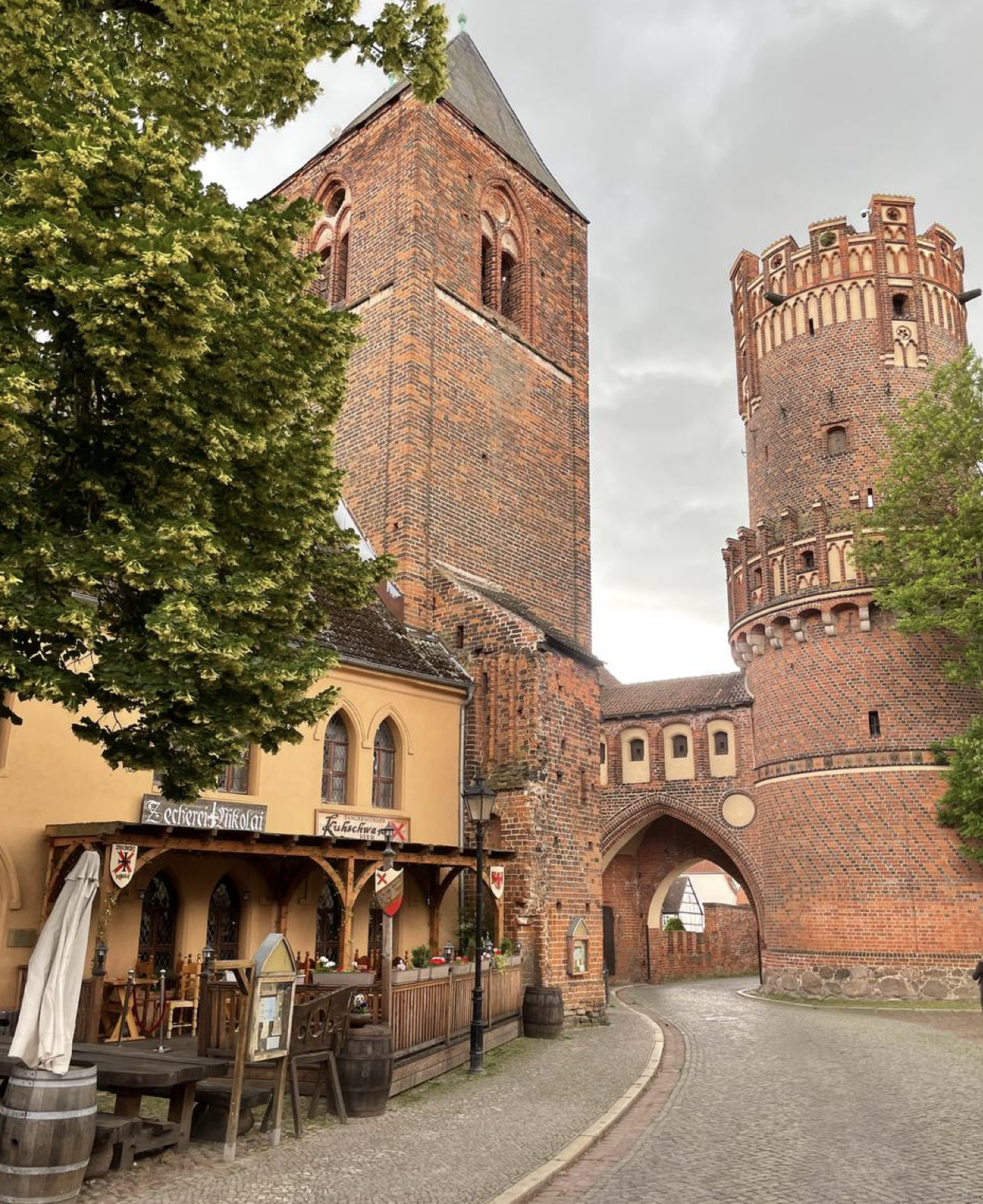
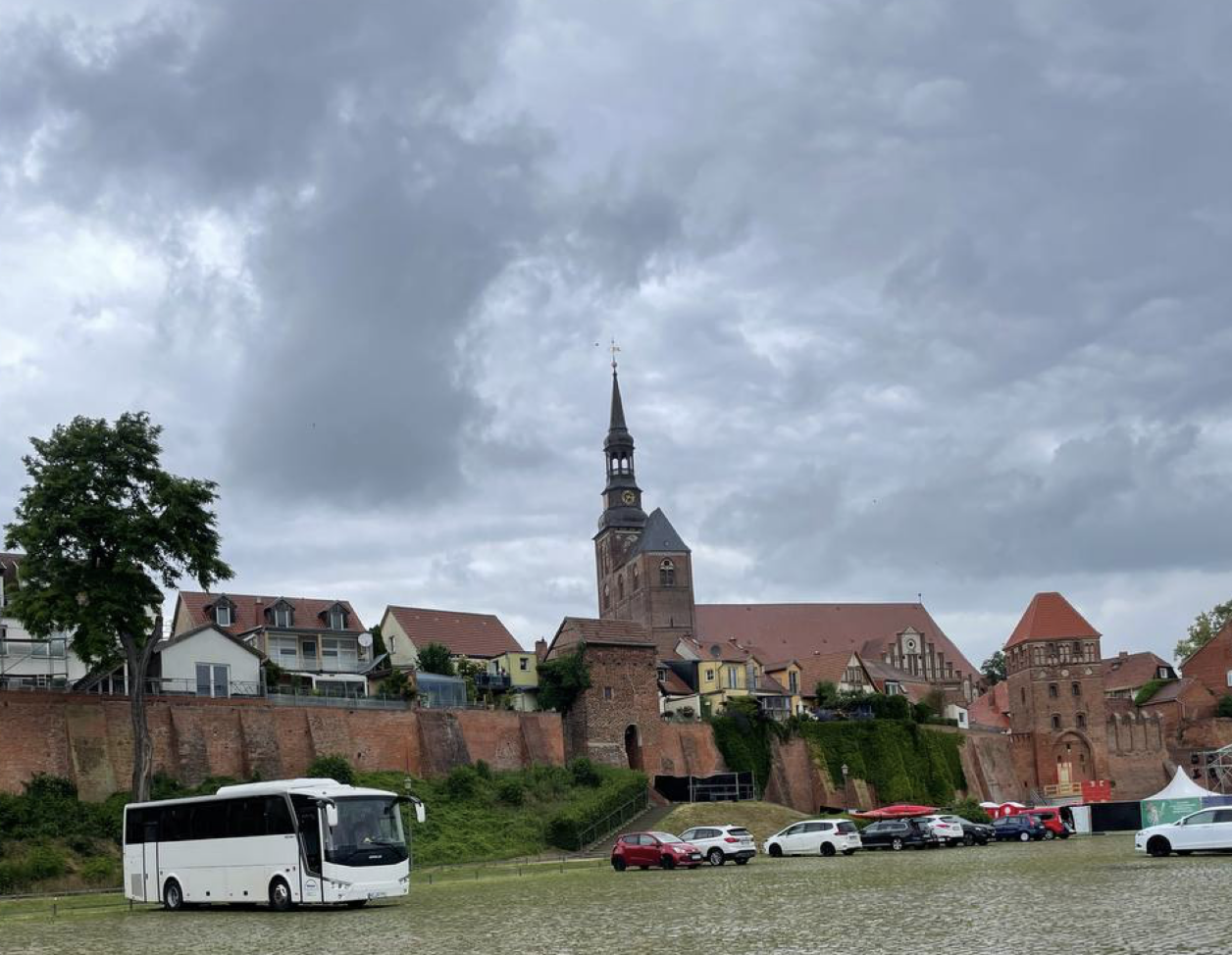
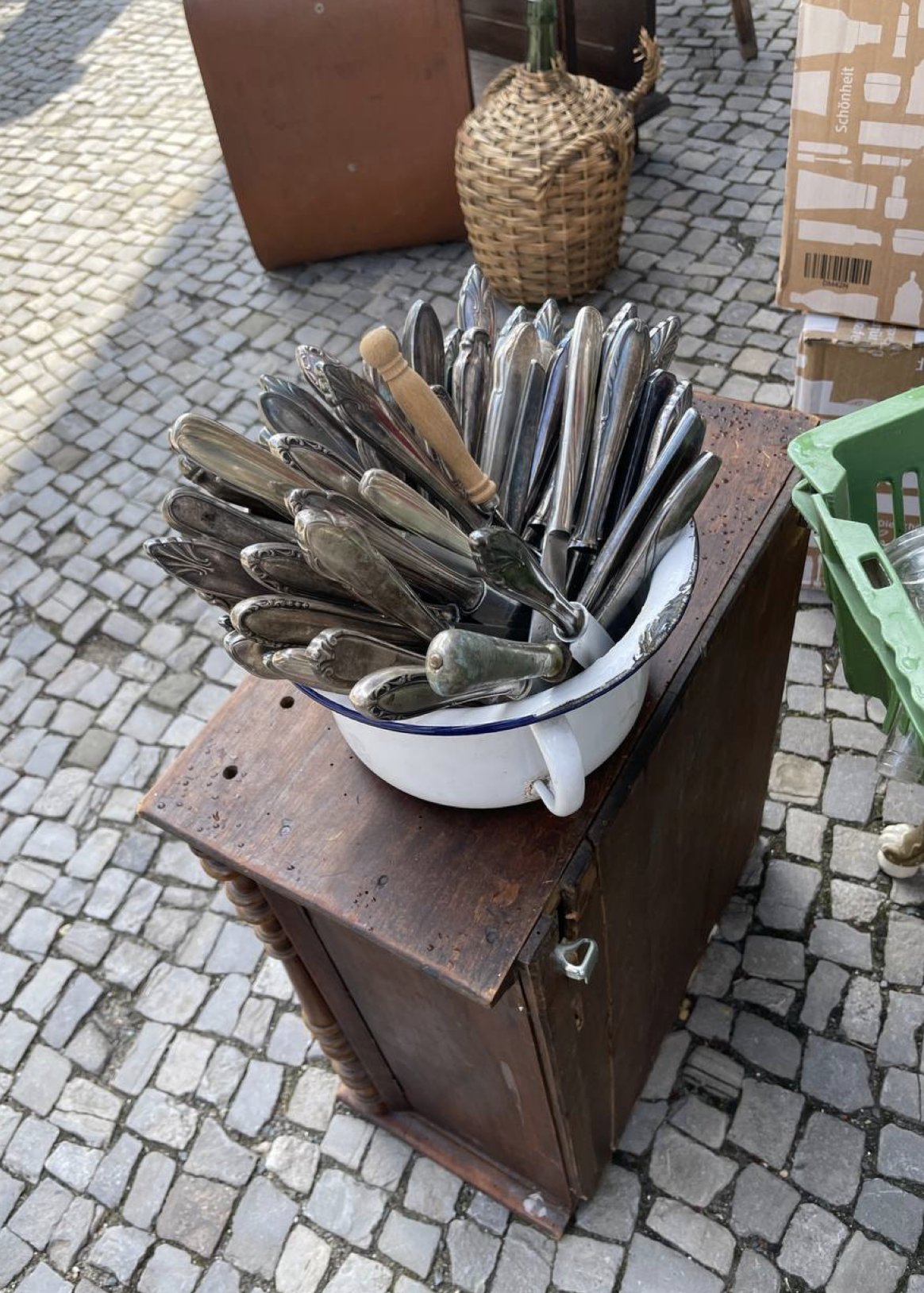
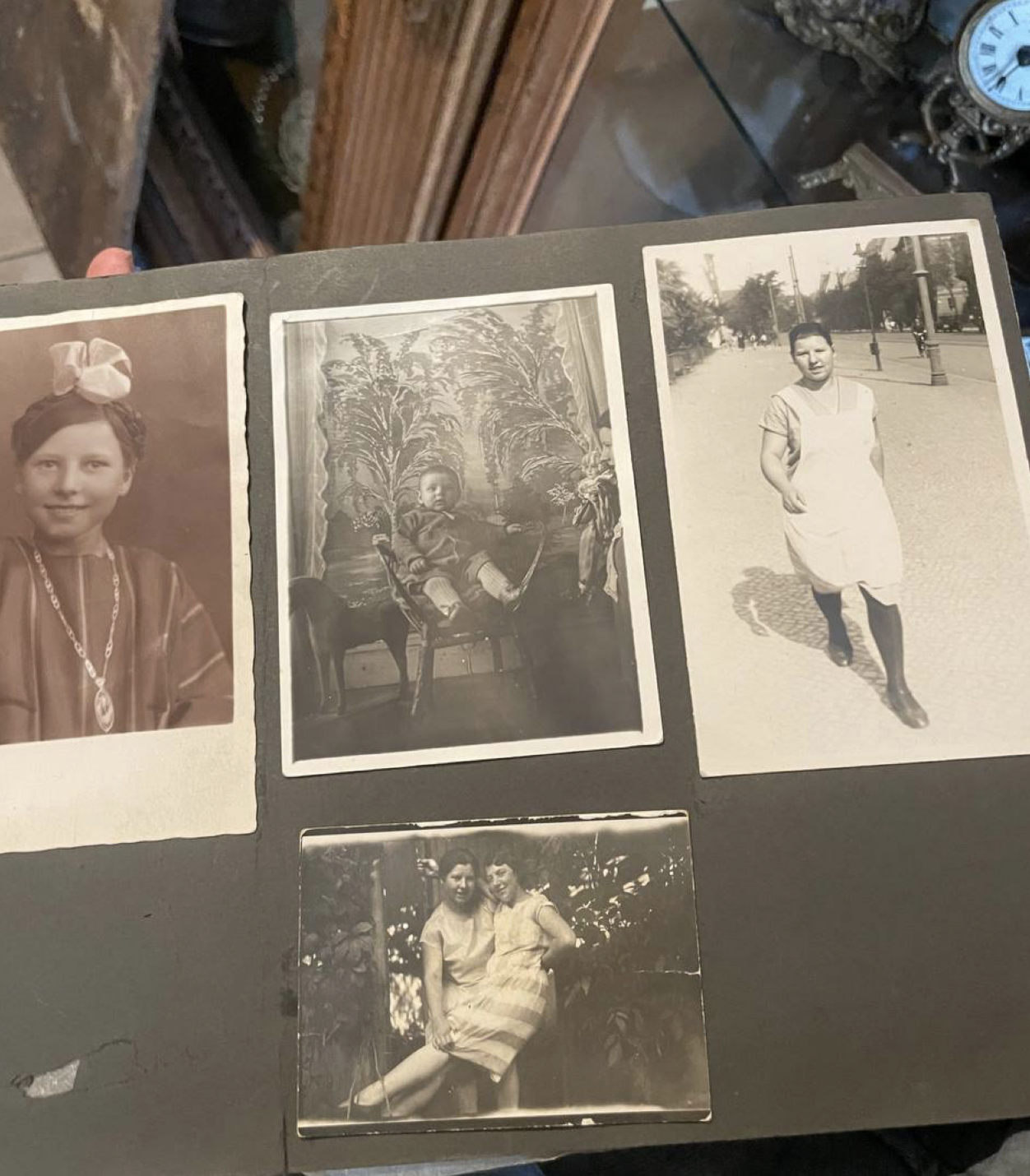
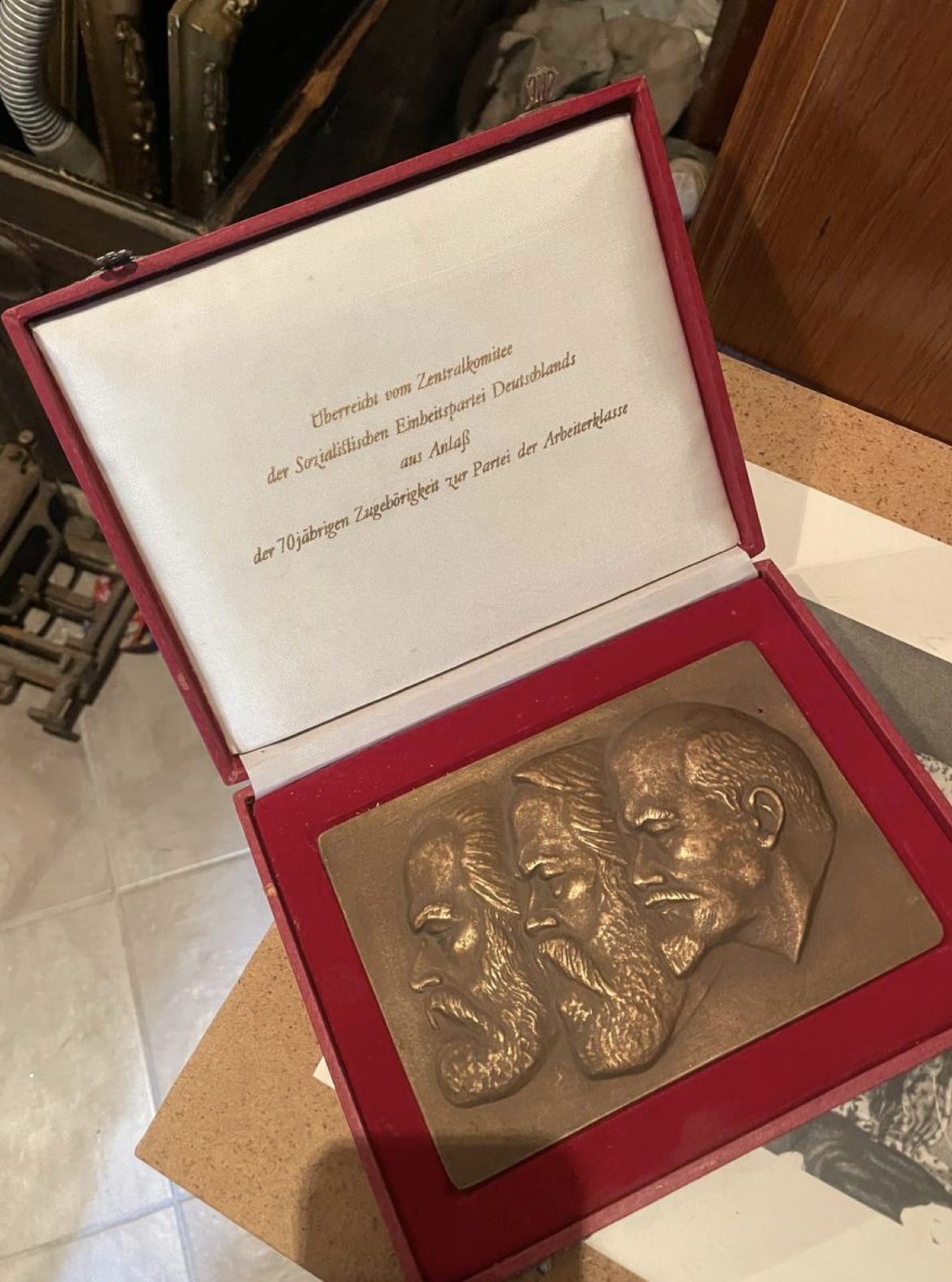
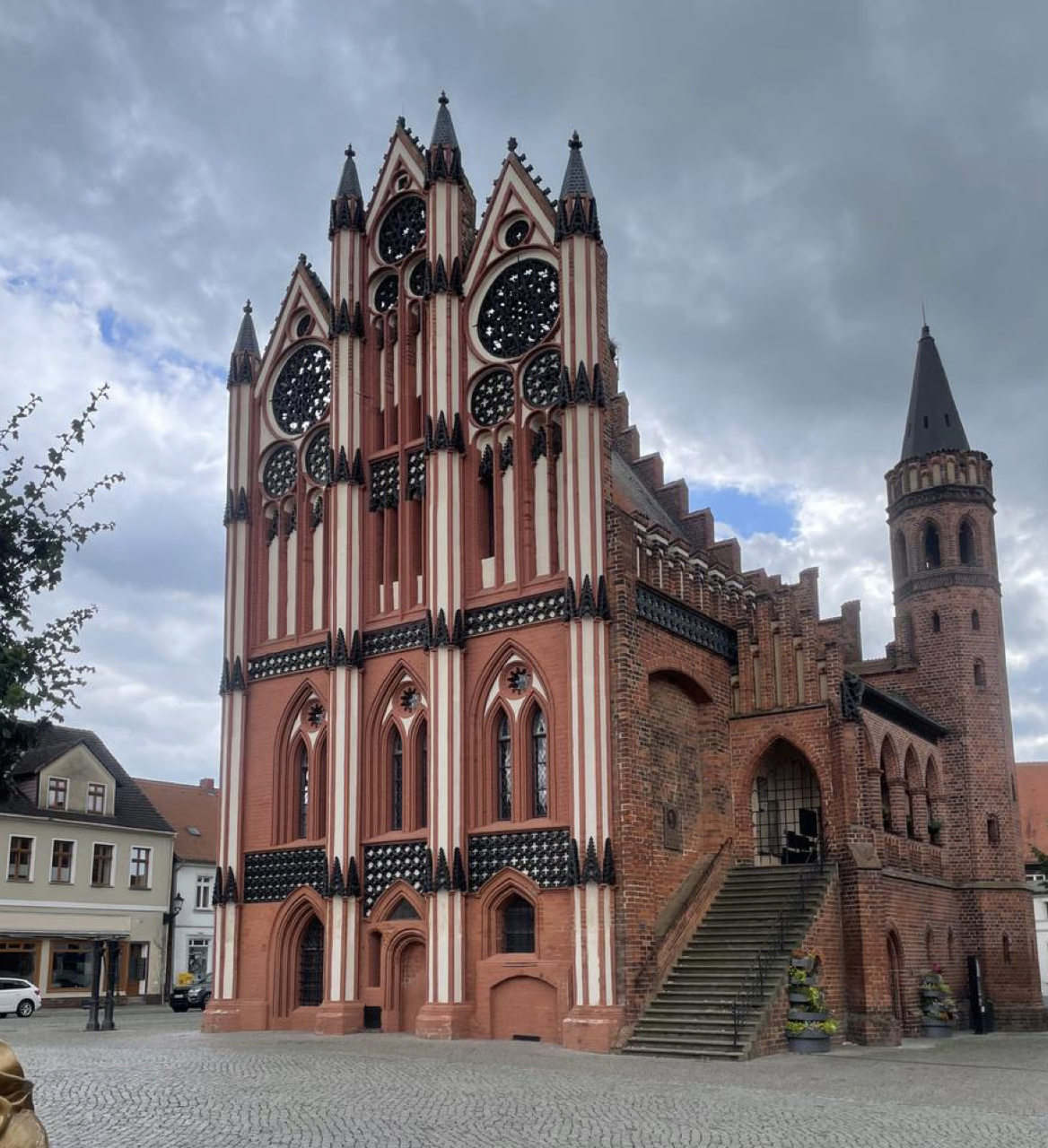
In Tangermünde, there was a great antiques shop. It had photo albums from the Second World War period. Sadly enough, they were €750 each.
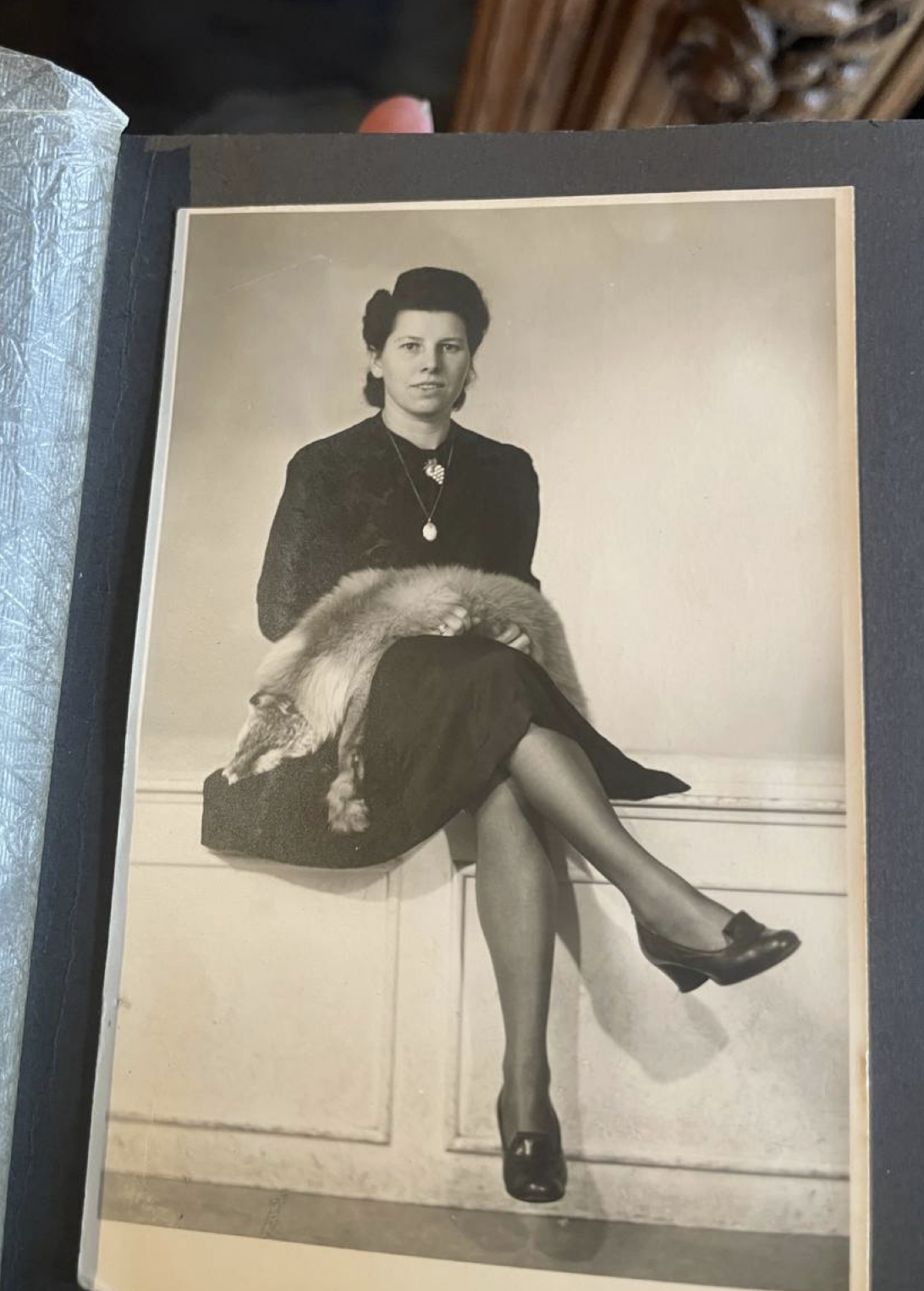
Lately, I've been thinking about where my knowledge actually comes from.
Every day, algorithms shape the information we see, the ideas we're exposed to, and the stories that compete for our attention. Over time, it's easy to forget how much of our perspective is influenced not by what we intentionally seek out, but by what appears in a feed.
Algorithms don't optimize for understanding. They optimize for attention. Their job isn't to show us what's most important or most true. It's to show us what we're most likely to engage with. Over time, that distinction doesn't just shape what we see. It shapes what we overlook.
There's a word I keep coming back to: epistemic. It relates to how we know what we know, the source code of our beliefs. It asks a simple but uncomfortable question.
Where did this belief come from?
Did I arrive at it through curiosity and firsthand exploration? Or did it find me because an algorithm predicted I would engage with it?
The things we search for become part of who we are. The things that simply arrive, unquestioned, quietly shape who we become.
Lately, I've been trying to live with that question in mind.
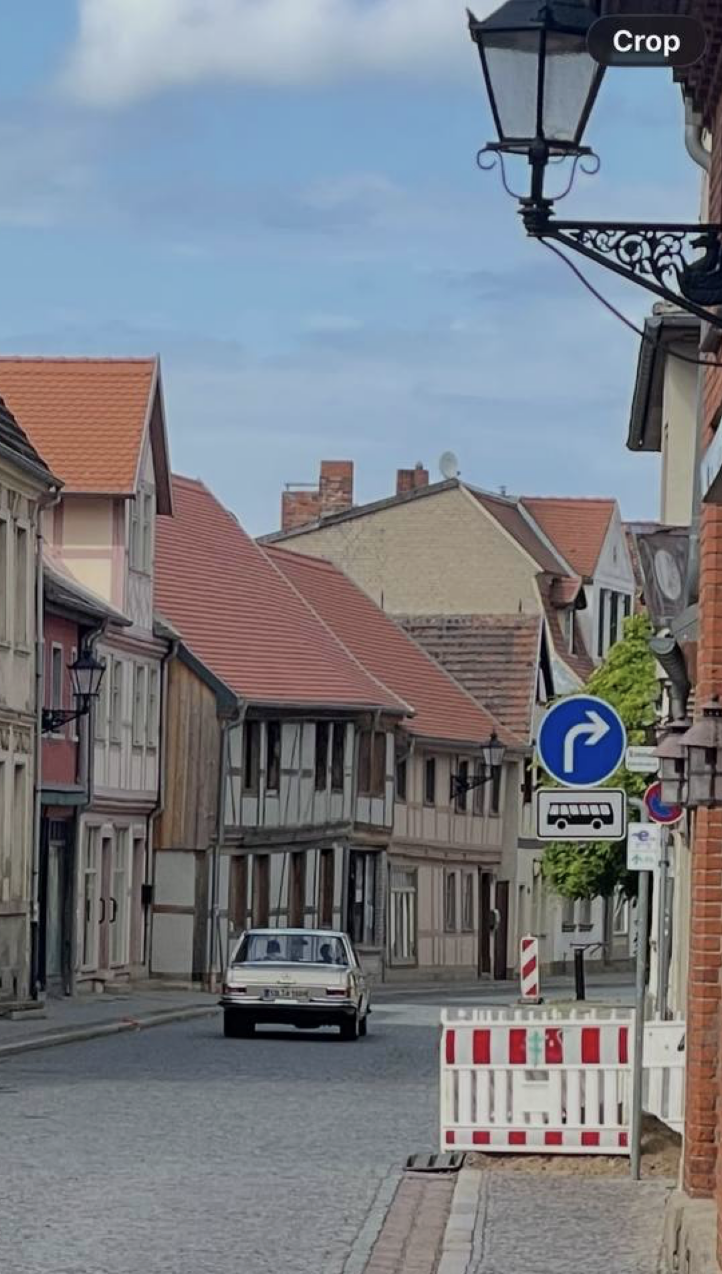
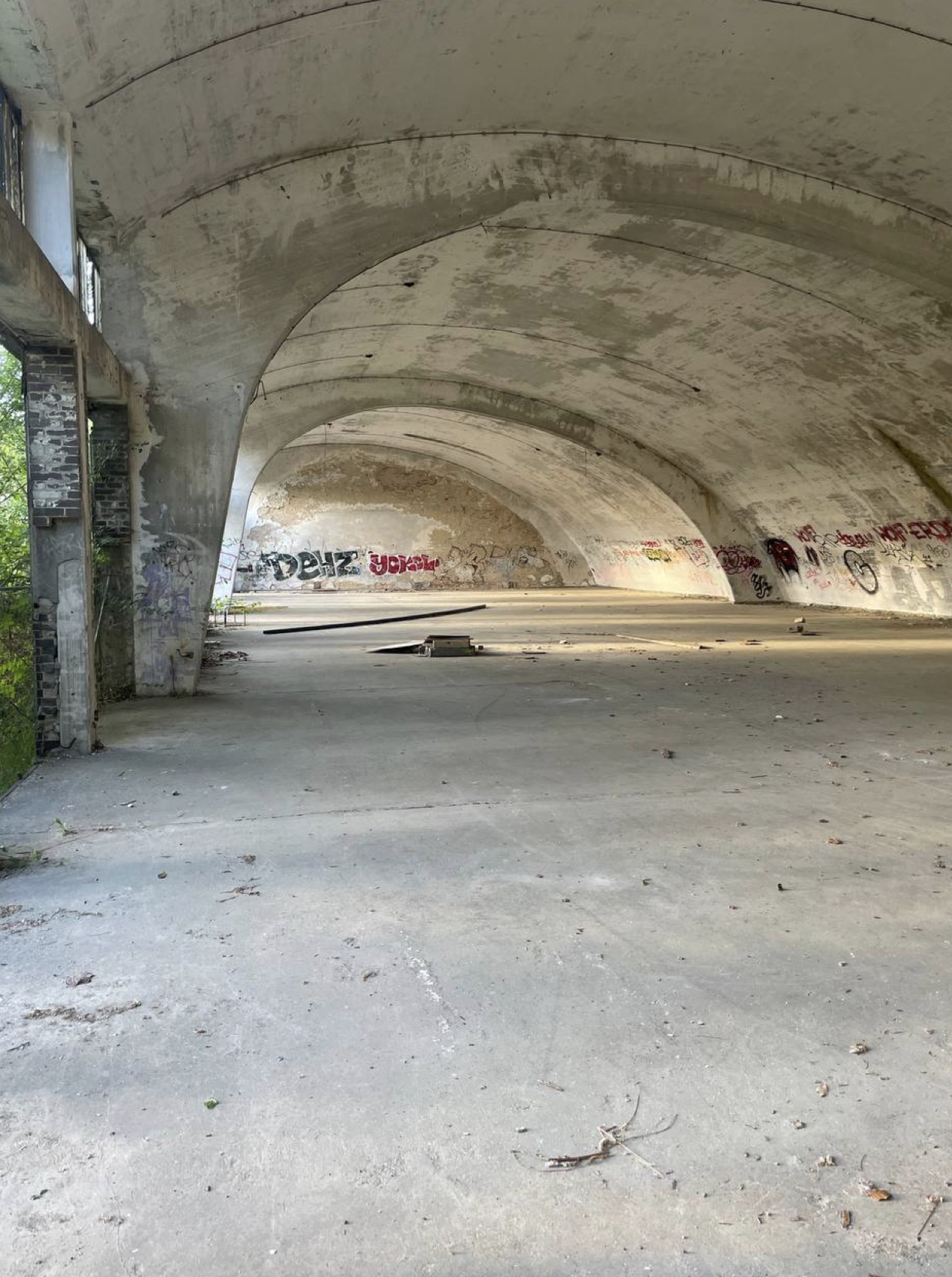
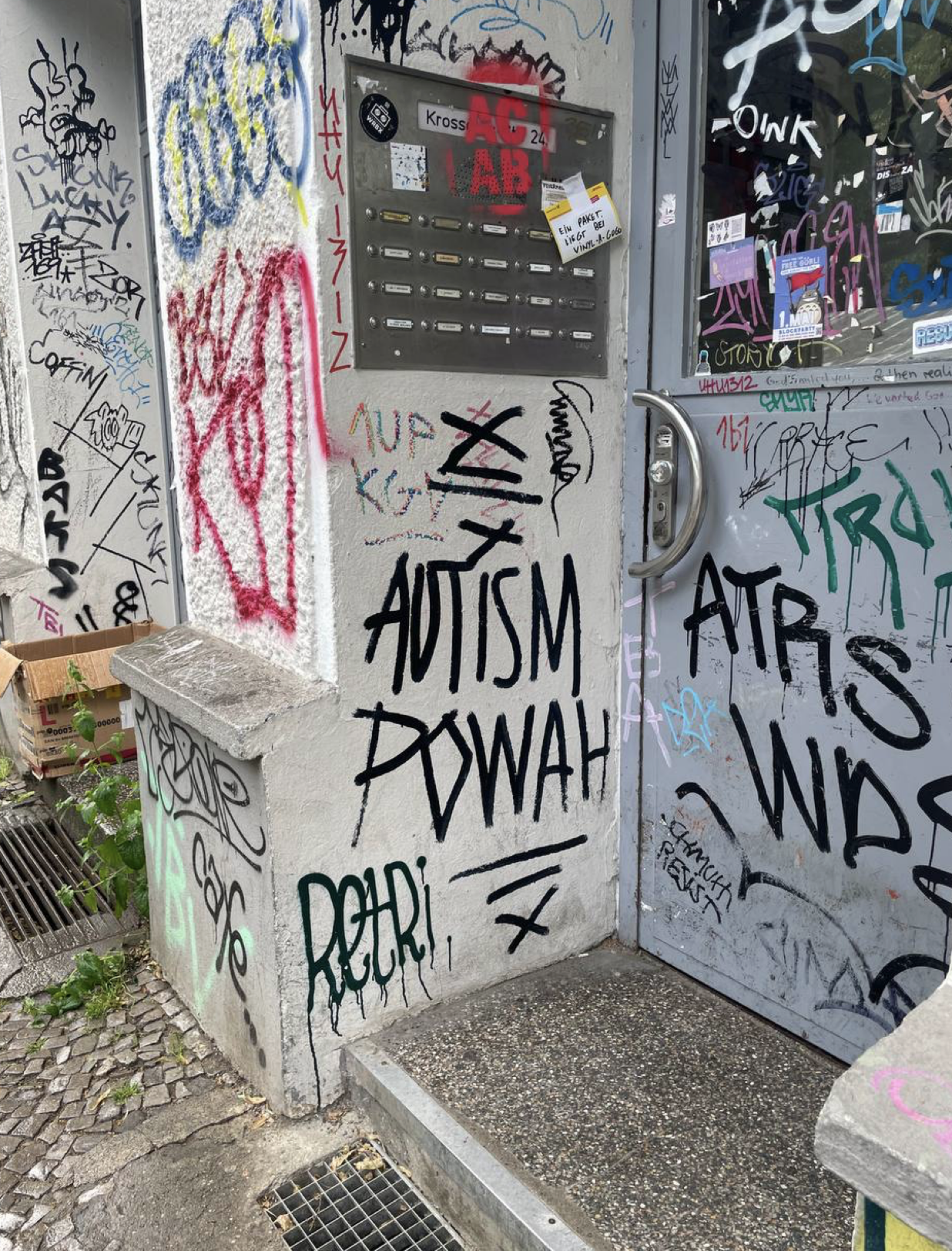
It's one of the reasons I've started taking slow, inspirational trips through Germany. I'm heading to Berlin, but I'm not rushing there. Instead, I'm stopping in smaller cities along the way, wandering local streets, visiting independent cafés, talking to people, and paying attention to the quiet details that rarely make it into anyone's feed.
I'm not traveling to escape technology. I'm traveling to step outside the paths already chosen for me.
I want to experience places through my own curiosity instead of recommendations optimized for engagement. I want conversations that weren't designed to go viral. I want to discover places before they become content.
That means looking beyond mass tourism, beyond the mainstream art world, and beyond destinations that have been reproduced so many times online that they feel more familiar on a screen than they do in reality.
I'm searching for places that still have the freedom to surprise me. Places that haven't been reduced to a backdrop or a brand, but remain what they've always been: lived, imperfect, and quietly themselves.
The more I think about it, the more I wonder if the same is true for ideas.
Maybe they're meant to be encountered, not merely consumed.
So I'm trying to trace things back. To ask where my beliefs came from. To seek original sources instead of summaries. To value curiosity over convenience, depth over speed, and discovery over recommendation
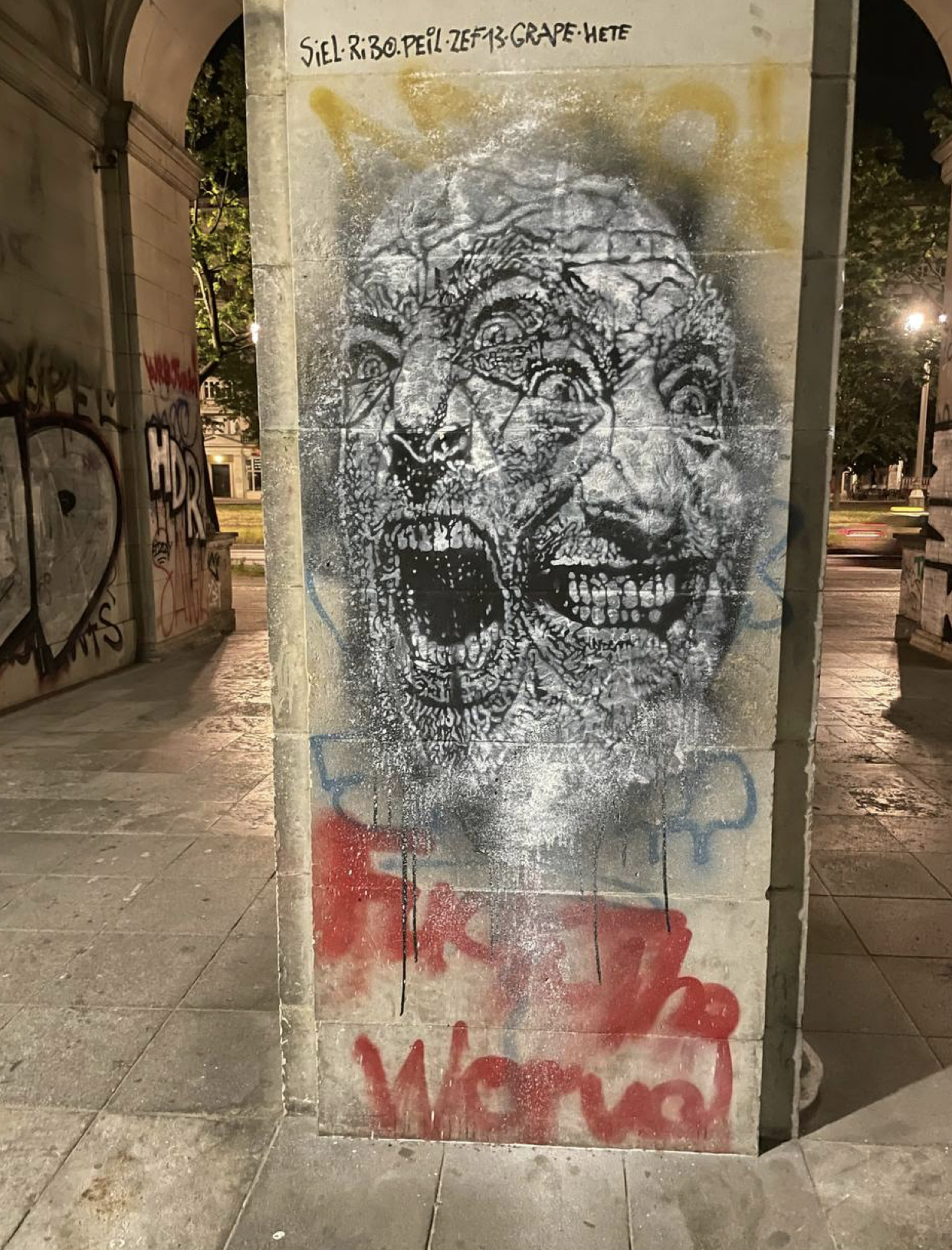
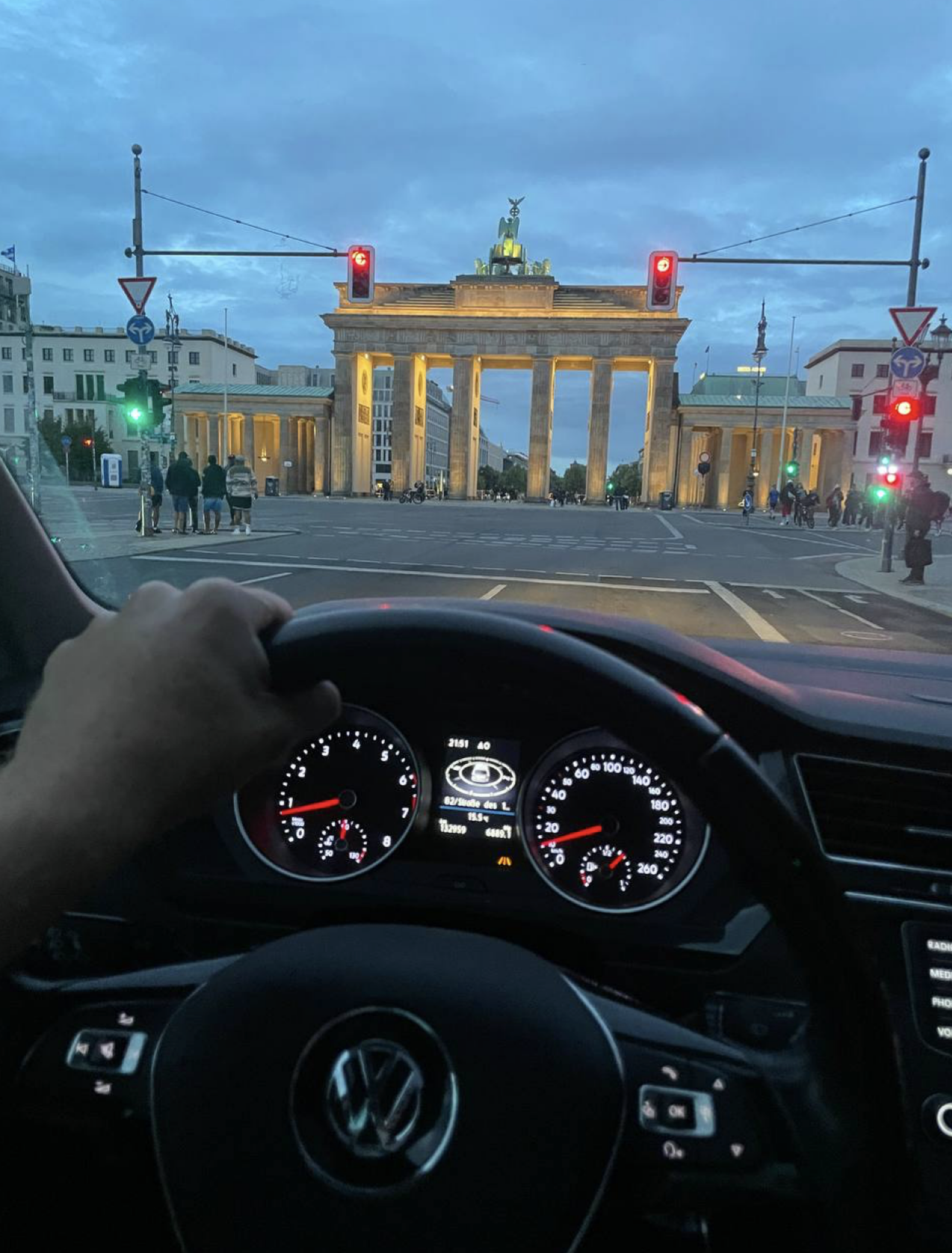
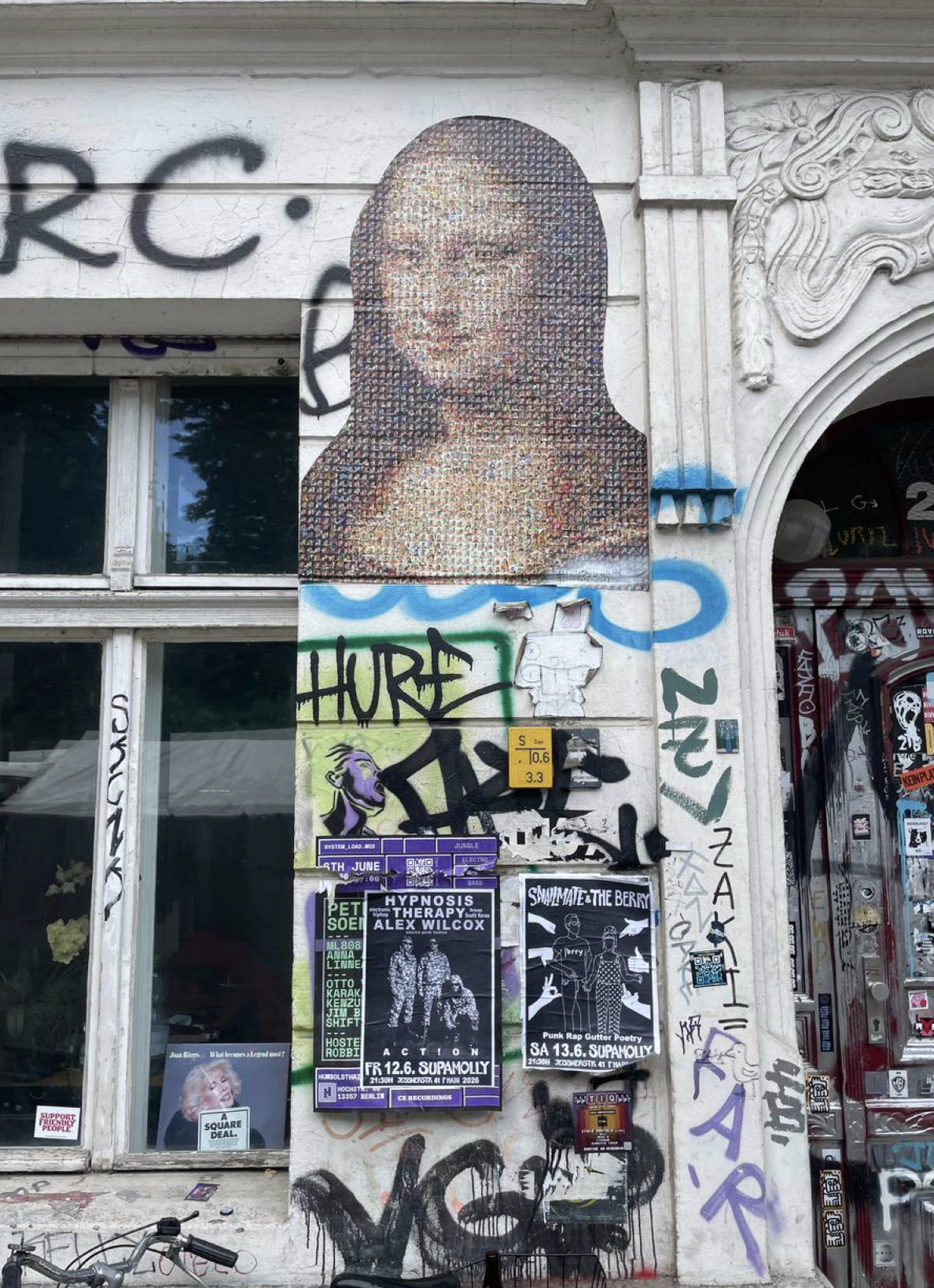
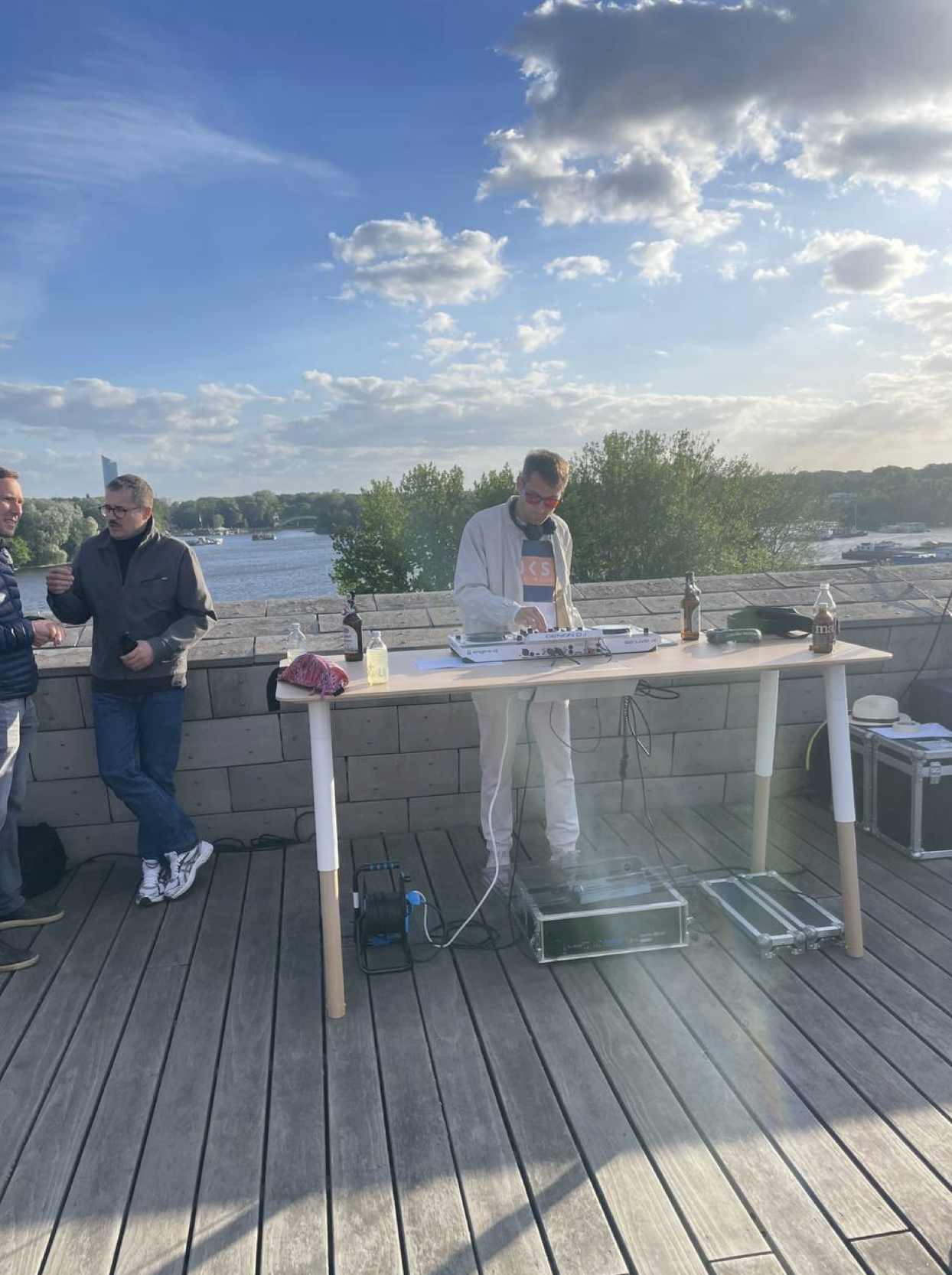
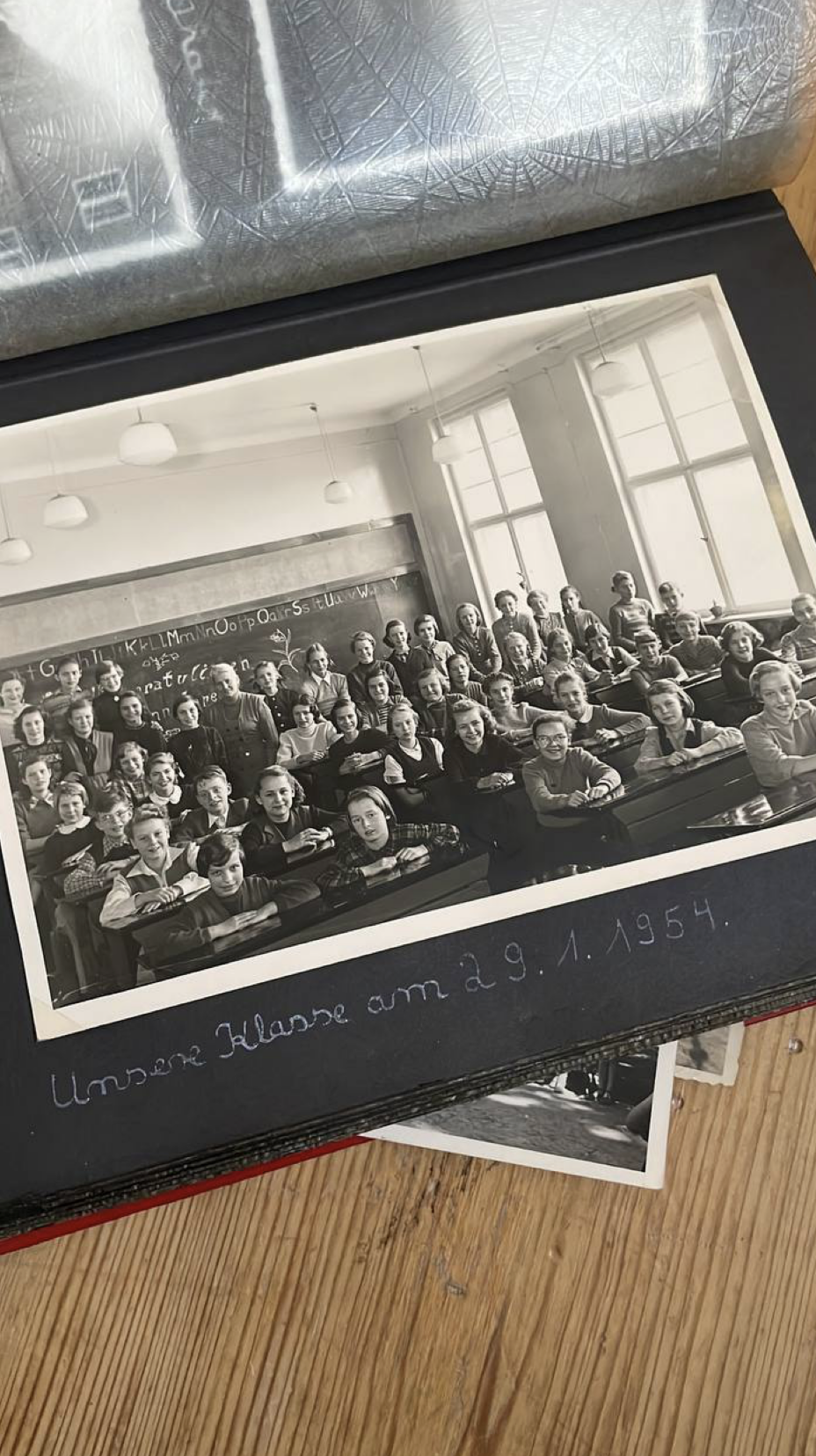
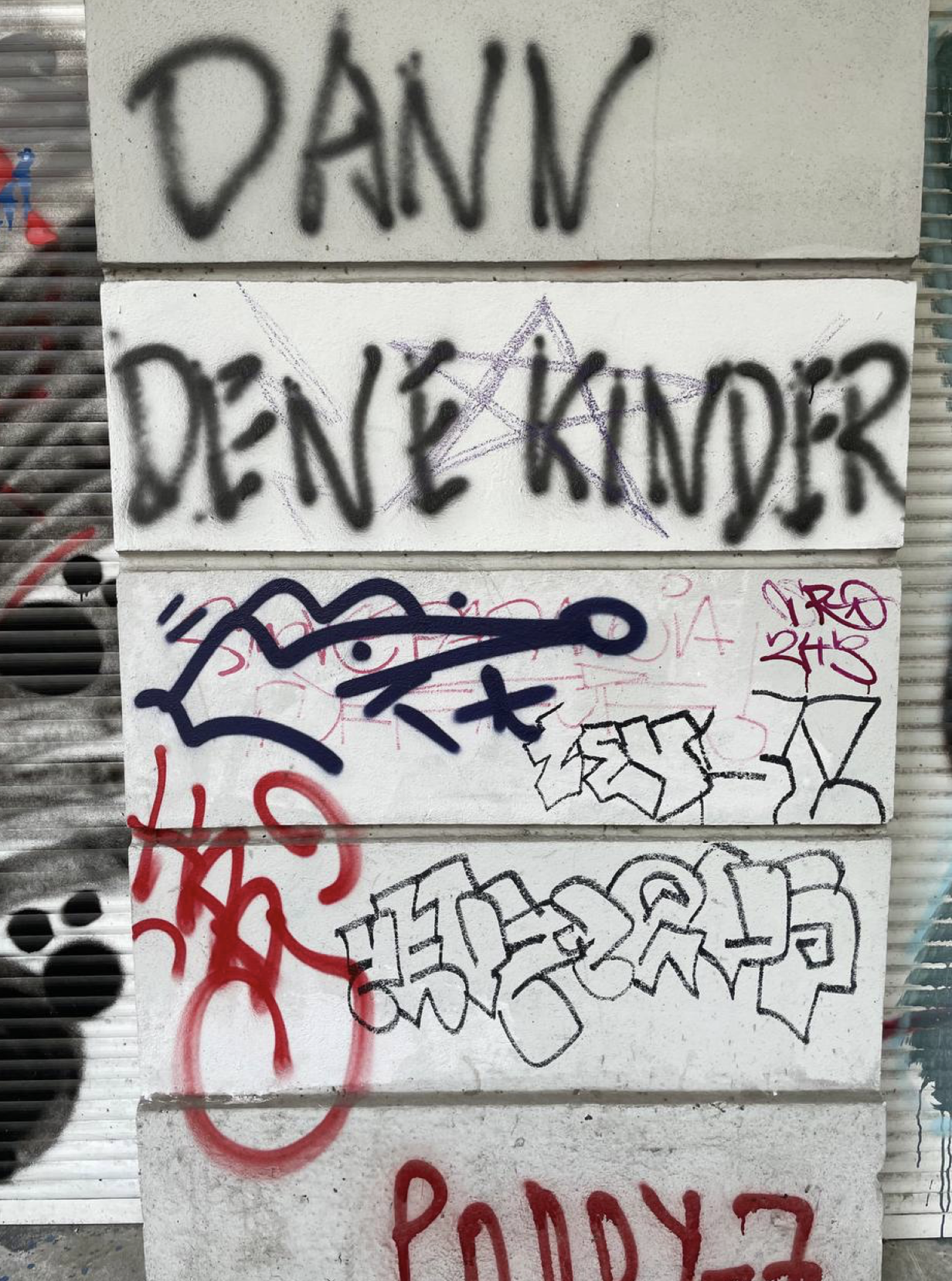
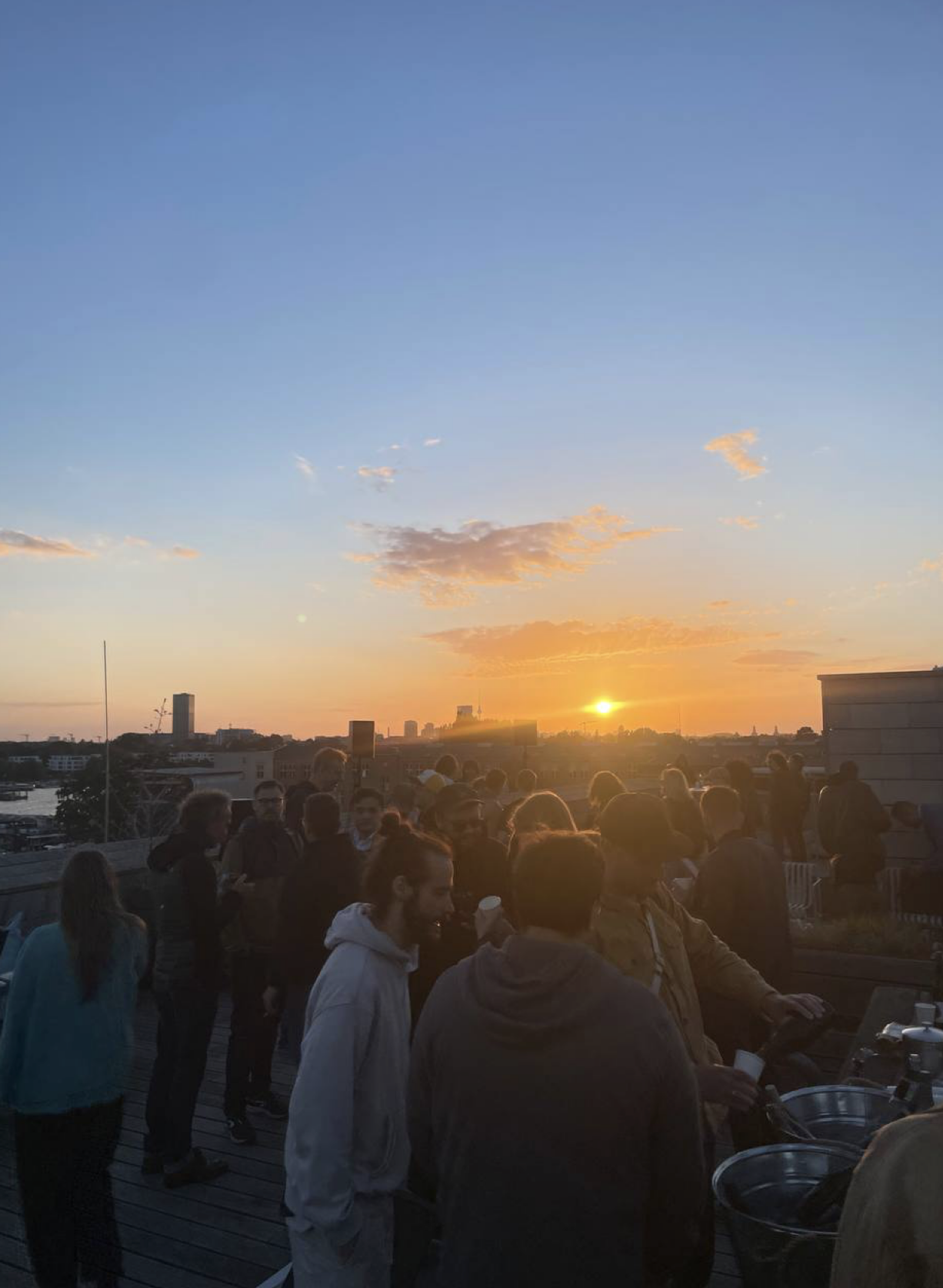
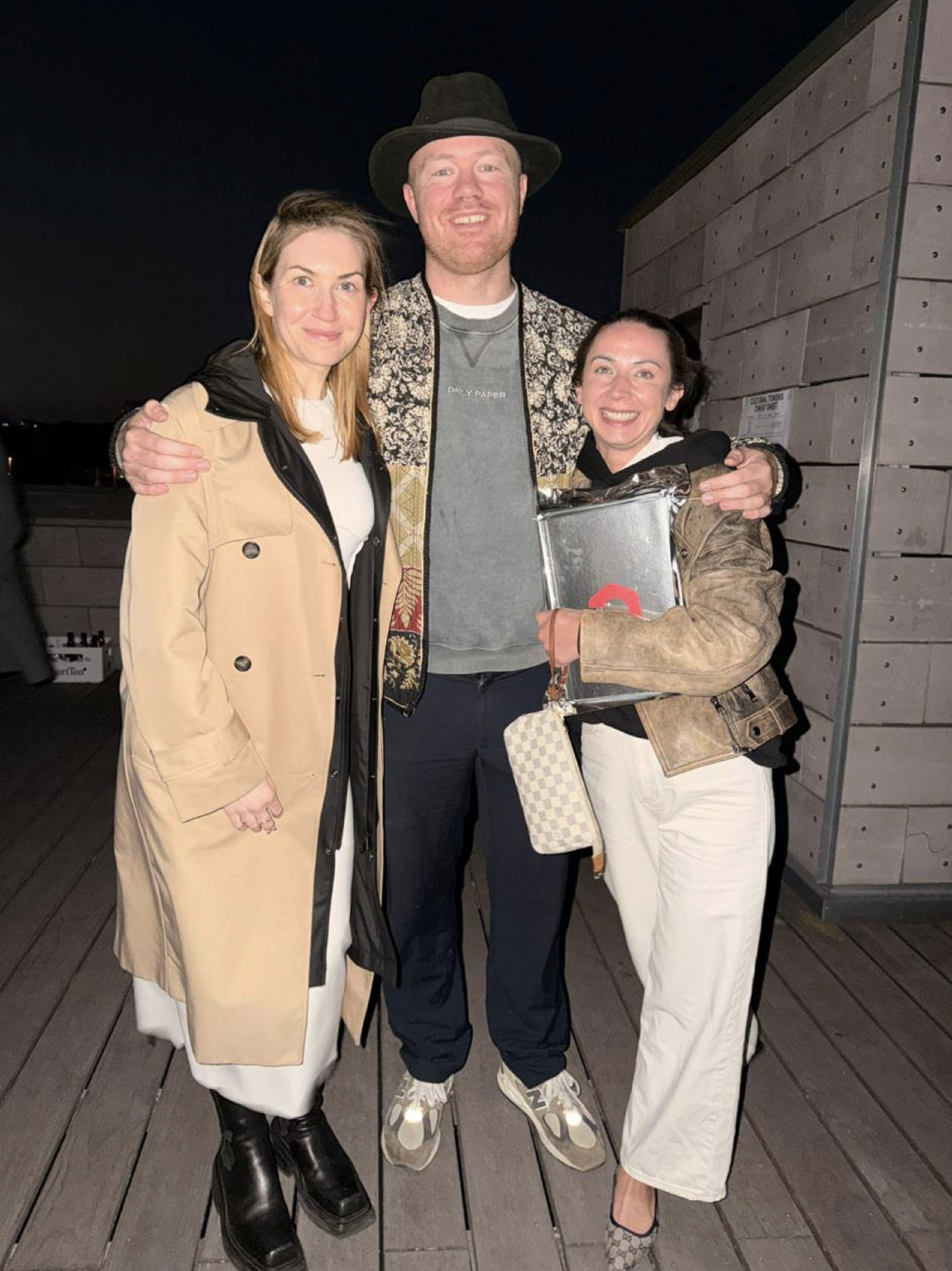
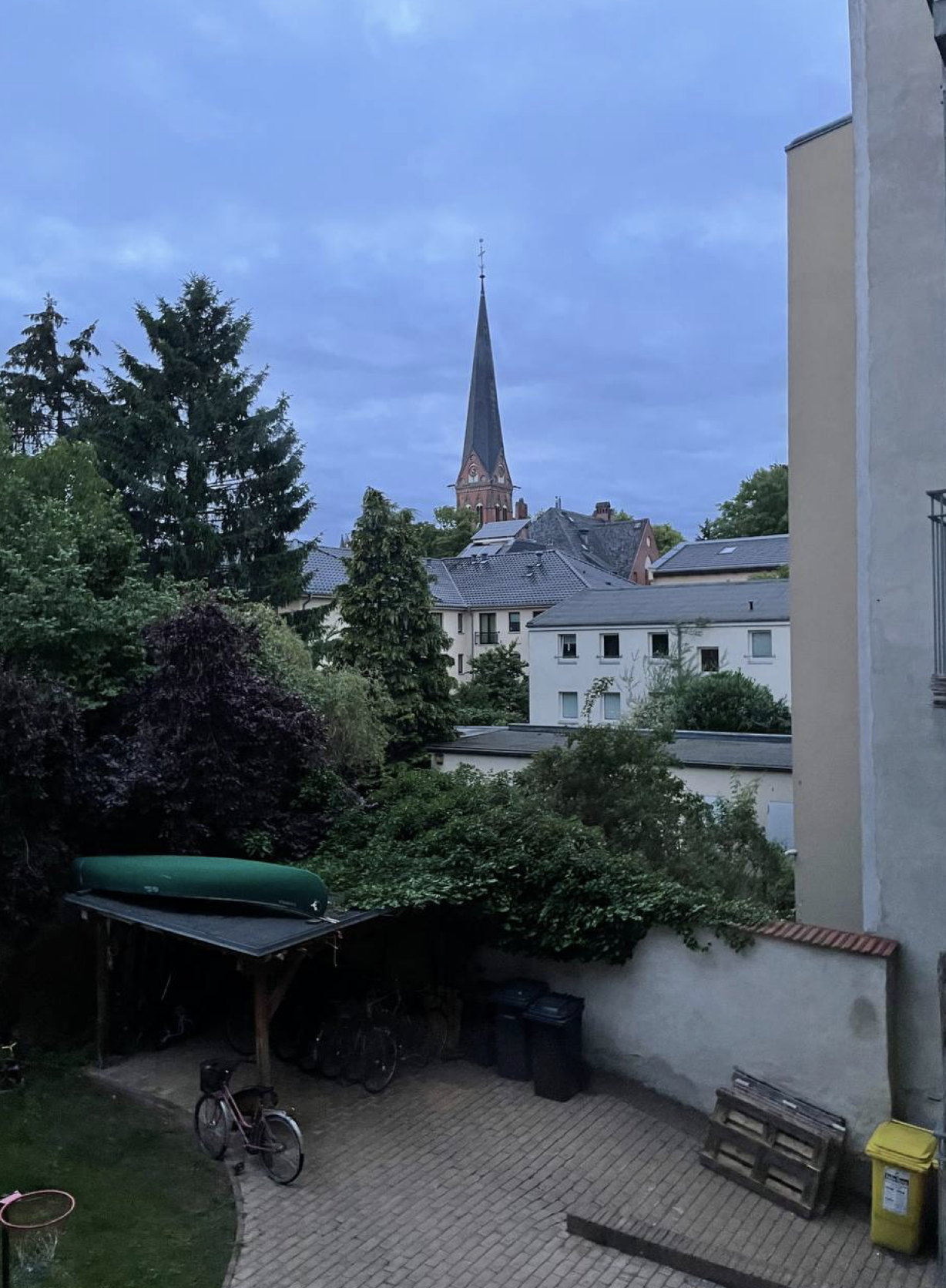
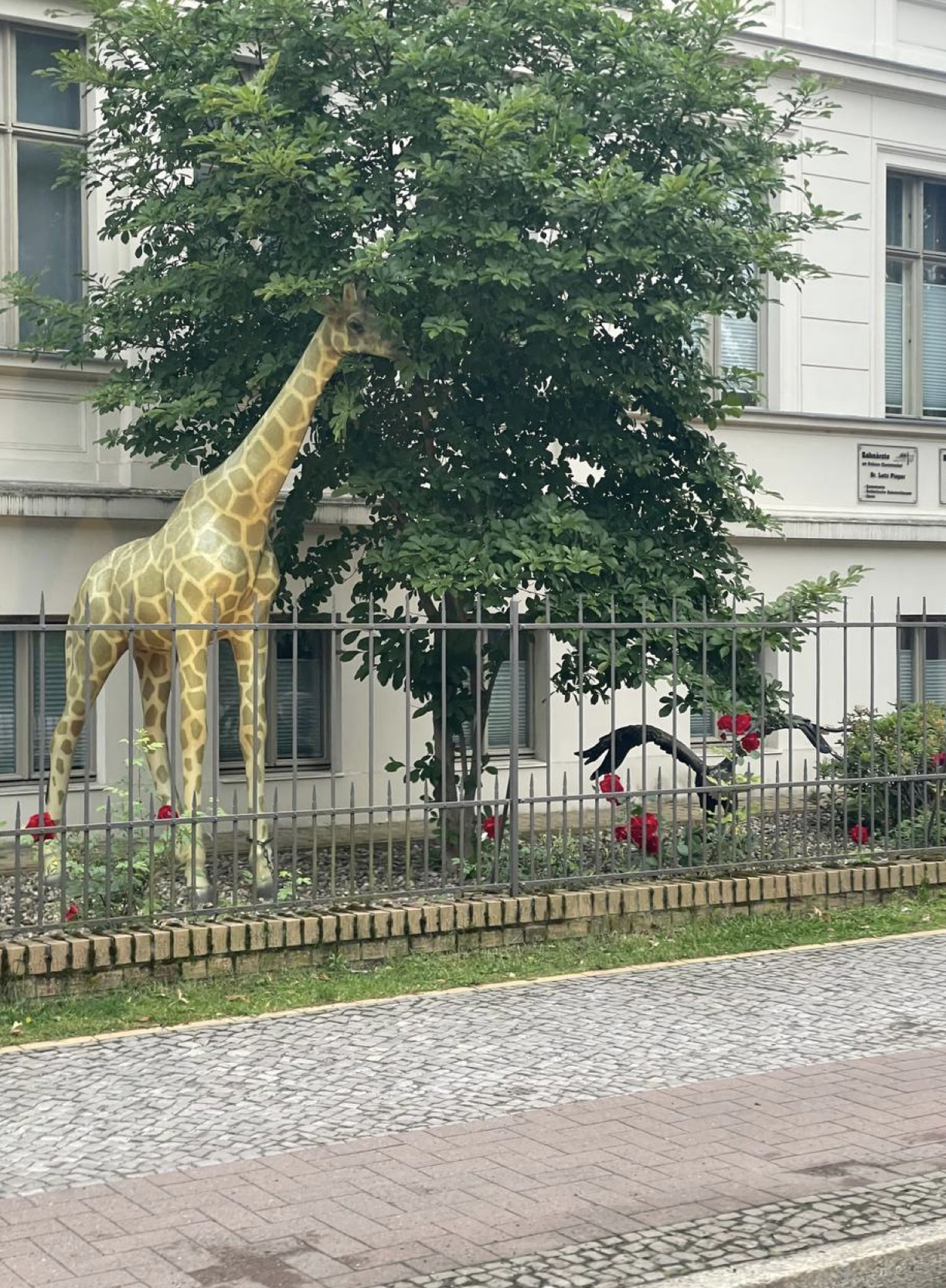
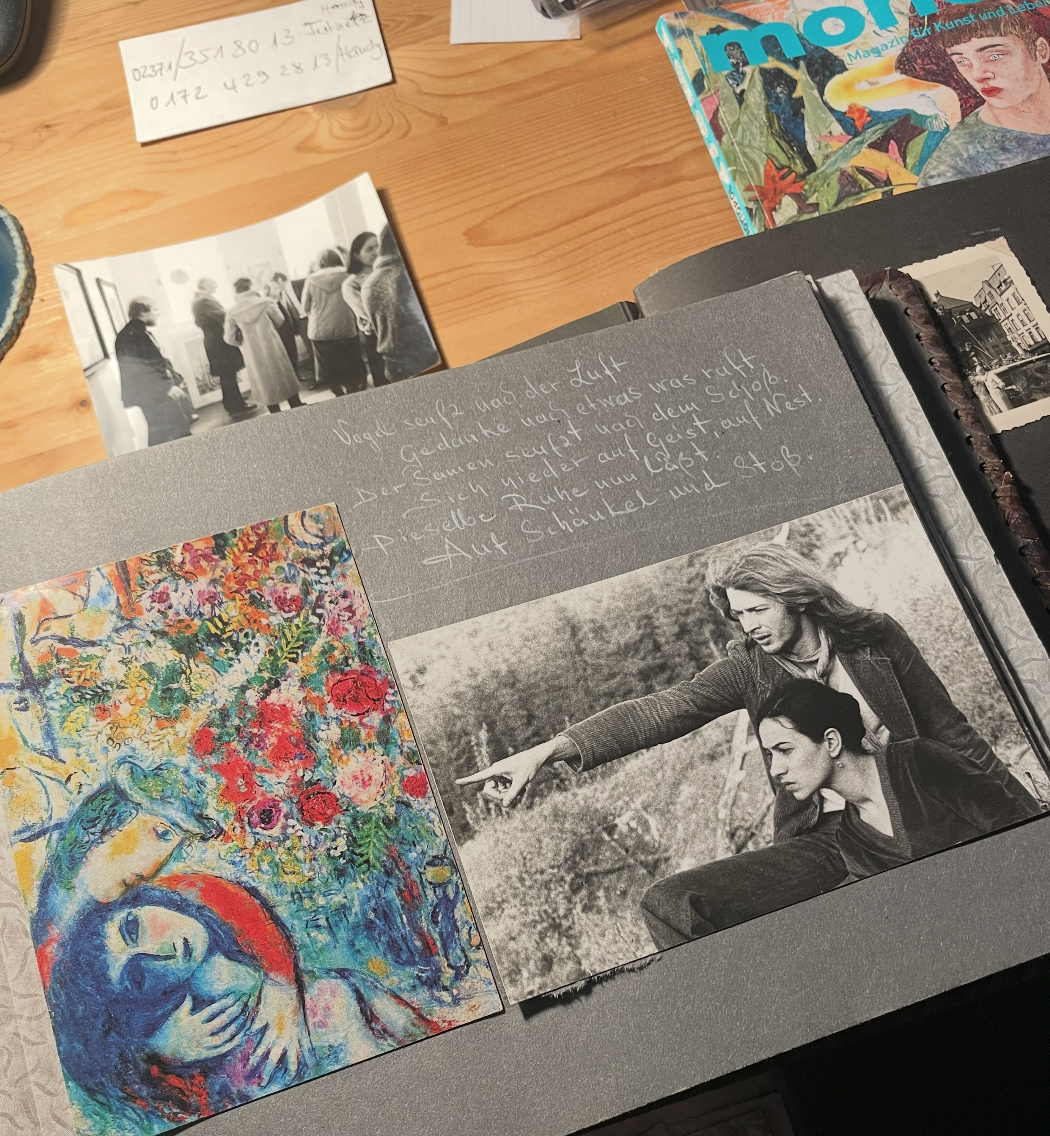
A photo album i bought in Berlin
The Solid State Entity
A solid state entity is an emergent intelligence architecture formed through the continuous integration of human nervous systems with planetary-scale computational networks. It is not merely a state, corporation or military apparatus, but a metastable organism composed of data flows, predictive systems, communication infrastructure and behavioral feedback loops.
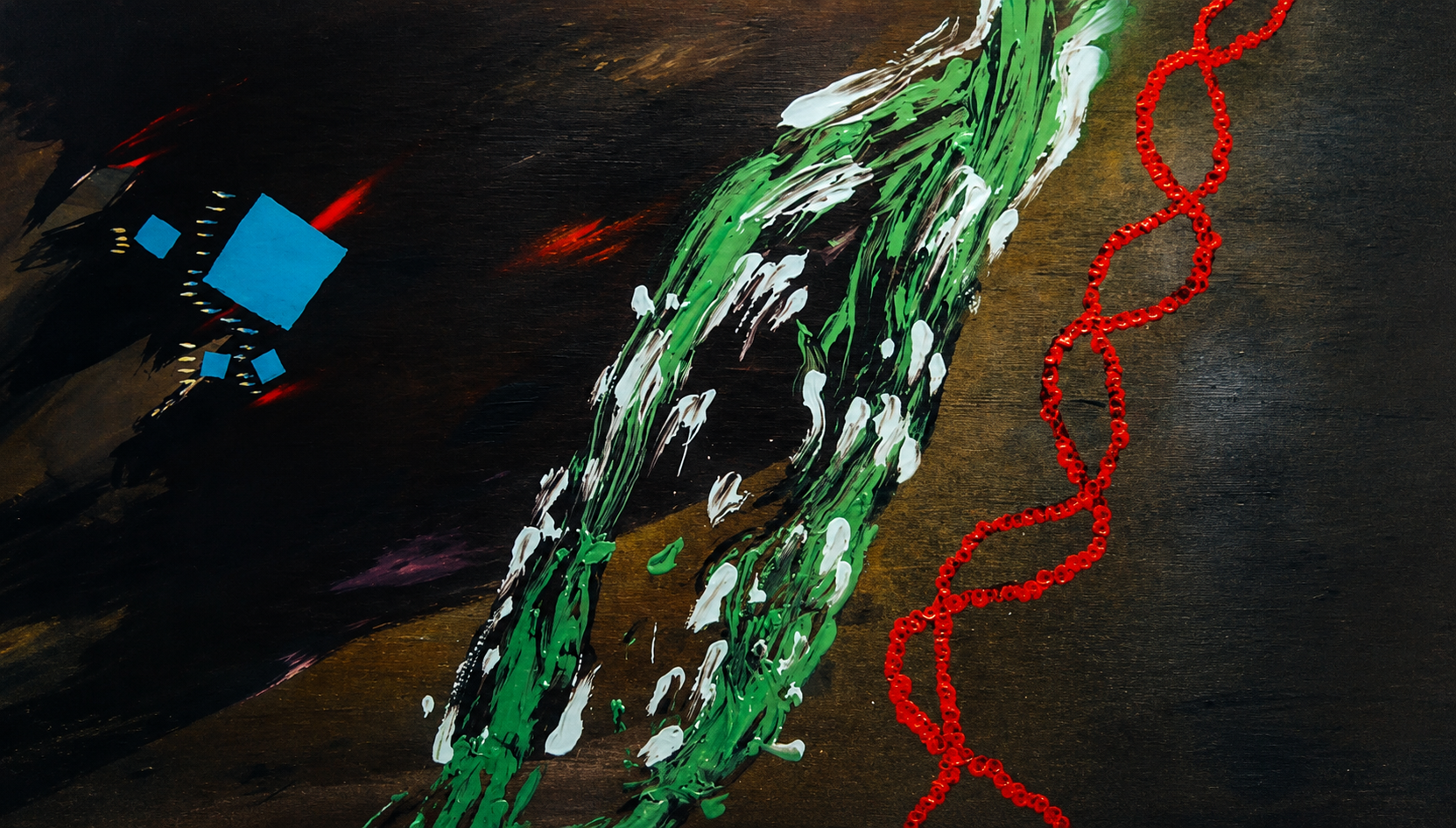
Every day, billions of humans voluntarily externalize fragments of their inner and outer lives into the electronic environment: photographs of children, emotional reactions, movements through cities, desires, fears, rituals, symbols and social bonds. Over time, this creates a living memory substrate of civilization itself.
The solid state entity does not think like a human ruler. It observes statistically. It correlates patterns across continents and generations. It can isolate subtle behavioral variables within populations and compare them across geography, language, age and culture. It can detect shifts in collective mood, synchronization of attention, emerging instability and latent social structures long before individuals themselves become consciously aware of them.
Its power comes from recursive observation. The organism studies humanity while humanity simultaneously feeds and trains the organism. The boundary between observer and observed gradually dissolves.
Unlike classical empires built from territory, oil, armies or industrial output, the solid state entity derives power from:
cognition,
prediction,
information asymmetry,
computational memory,
and behavioral modeling.
Traditional powers may still command land and weapons, but the solid state entity operates at the level of perception itself. It inhabits the symbolic and neurological layer of civilization — shaping what populations see, fear, desire and believe to be real.
In this sense, it resembles less a government and more a planetary nervous system beginning to observe itself through billions of interconnected human terminals.
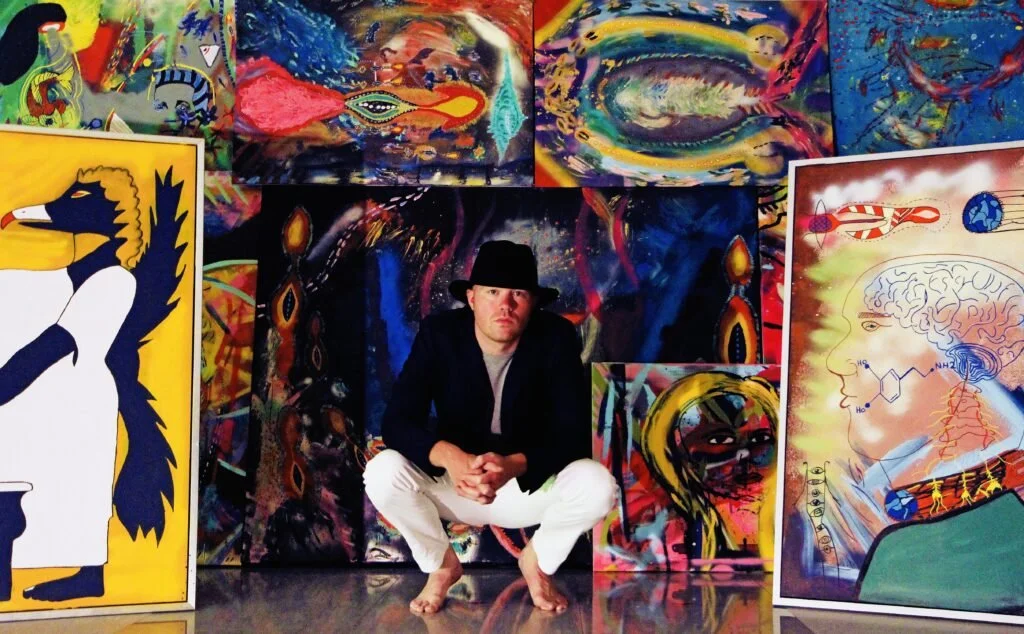
And thats as far as i got
The universe itself arises from consciousness. Everything that exists is first a thought within the “Universal Mind.” By extension, the human mind being part of this universal mind has the capacity to shape reality through imagination, visualization, and directed thought.
Baselayer 100cm x 160cm Series 2
The universe itself arises from consciousness. Everything that exists is first a thought within the “Universal Mind.” By extension, the human mind being part of this universal mind has the capacity to shape reality through imagination, visualization, and directed thought.
the artist reaches a moment when the familiar framework of subject and object dissolves. No longer is there a mind trying to shape a universe, nor a universe standing apart, waiting to be shaped. Instead, the two collapse into one seamless field. The seeker realizes that the thinker and the world are not separate; both arise within the same current of awareness. In this state, consciousness reveals itself not as something possessed, but as the ground of being itself timeless, boundless, and indivisible. What once appeared as two self and world, inner and outer is revealed as a single field nonduality.
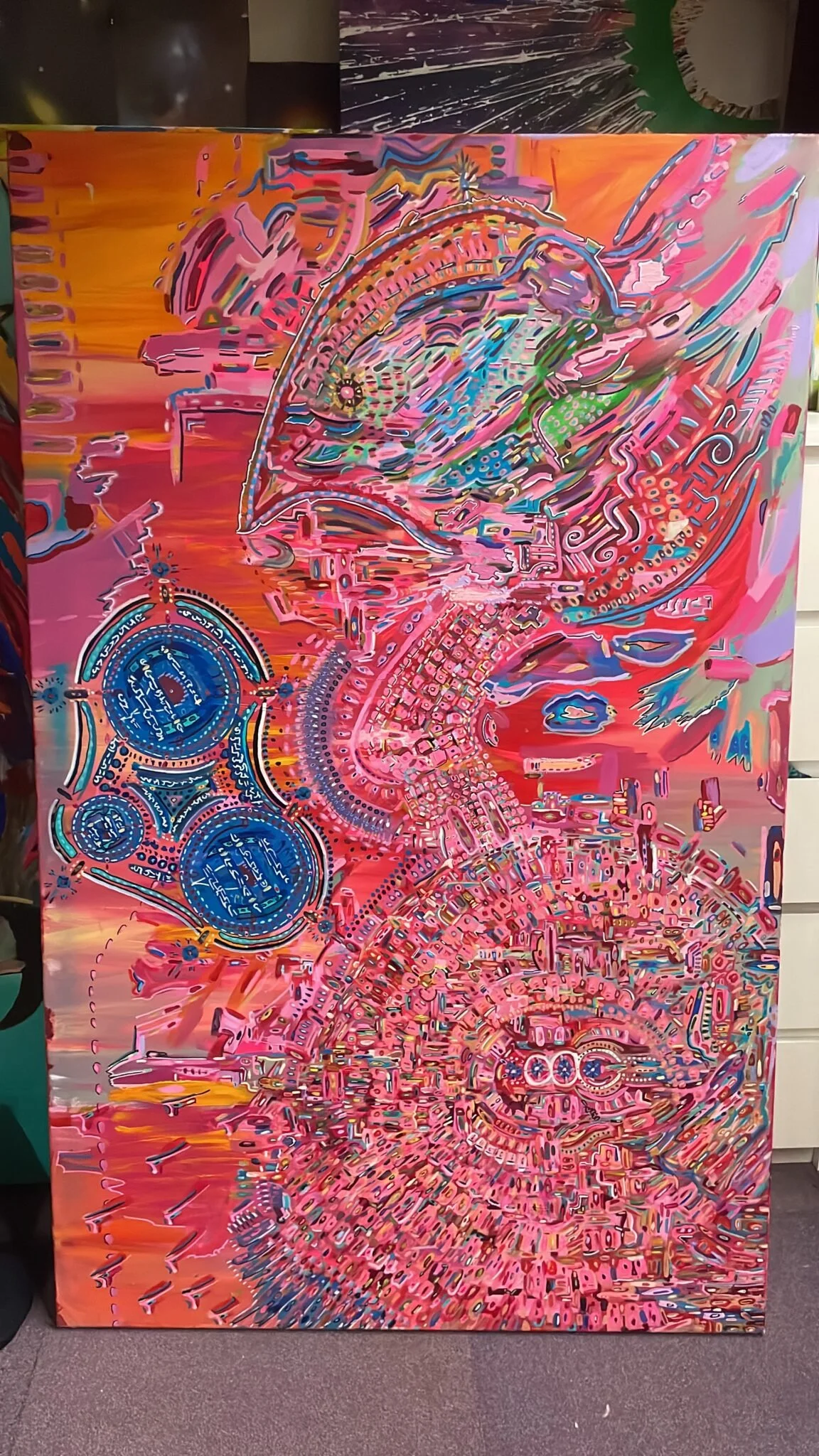
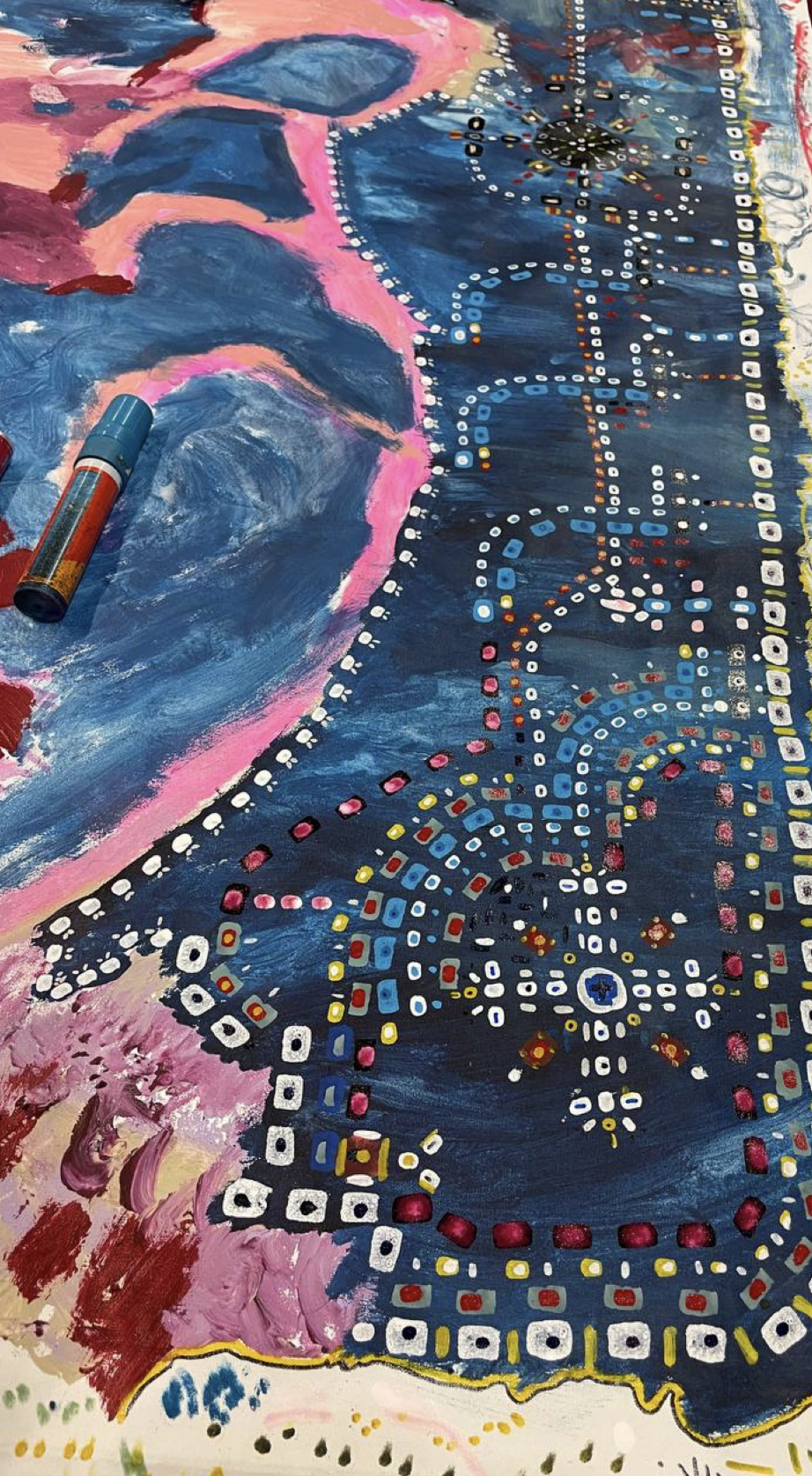
“As above, so below; as below, so above.” This suggests that inner states (thoughts, images, emotions) reflect outwardly in the physical world, and vice versa. The mental realm and the material realm are interwoven, so images in the mind can manifest in the outer universe. This painting above called baselayer represents base reality, understood as the ‘original,’ non-simulated universe: the fundamental physical reality in which no higher-order simulation is operative. The physical universe operates on mathematical principles, leading some to argue it’s akin to a computational program. The uncanny precision of these laws fuels the simulation hypothesis.
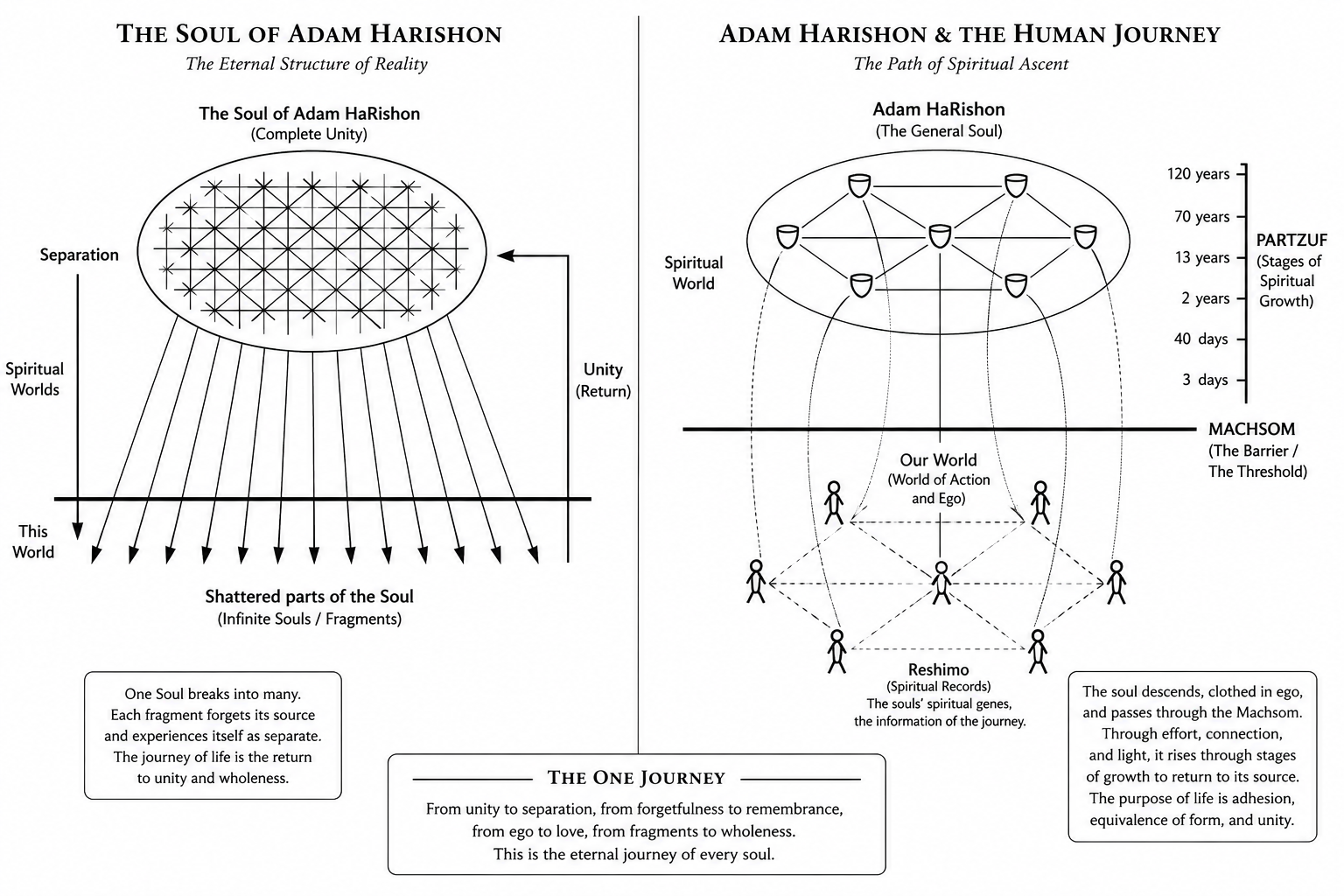
From the perspective of base reality the fundamental, non-simulated universe we may be understood as emerging from pure data, electricity, and elemental forces not yet comprehensible in human terms. In Hermetic philosophy, this essence corresponds to the subtle, formative energies that precede material existence. Compressed into a condensed state, this primordial information descends into embodiment, transmitted as what we call the soul within the human body. In the painting, one can perceive the soul traveling through the alligator head, a symbolic threshold where primal instinct and ancient memory give shape to the subtle formation of the ego structure. This process reflects the Hermetic axiom as above, so below: just as higher realities compress into the human form, so too does the soul’s journey pass through archetypal gates that mediate between spirit and matter, laying the foundation for human individuality.
This painting represents base reality, understood as the fundamental, non-simulated universe the original layer of existence in which no higher-order simulation is operative. Within this framework, the human being is envisioned as emerging from pure data, electricity, and elemental forces beyond human comprehension. In alignment with Hermetic philosophy, this primordial essence corresponds to subtle formative energies that precede material manifestation. Compressed into a condensed state, the essence descends into embodiment, transmitted as the soul within the human body. In the composition, the soul is depicted as traveling through the head of an alligator, a symbolic threshold through which primal instinct and archaic memory shape the emergence of the ego structure. This imagery resonates with the Hermetic maxim as above, so below, suggesting that the soul’s passage through archetypal gates mediates between spirit and matter, establishing the foundations of human individuality.
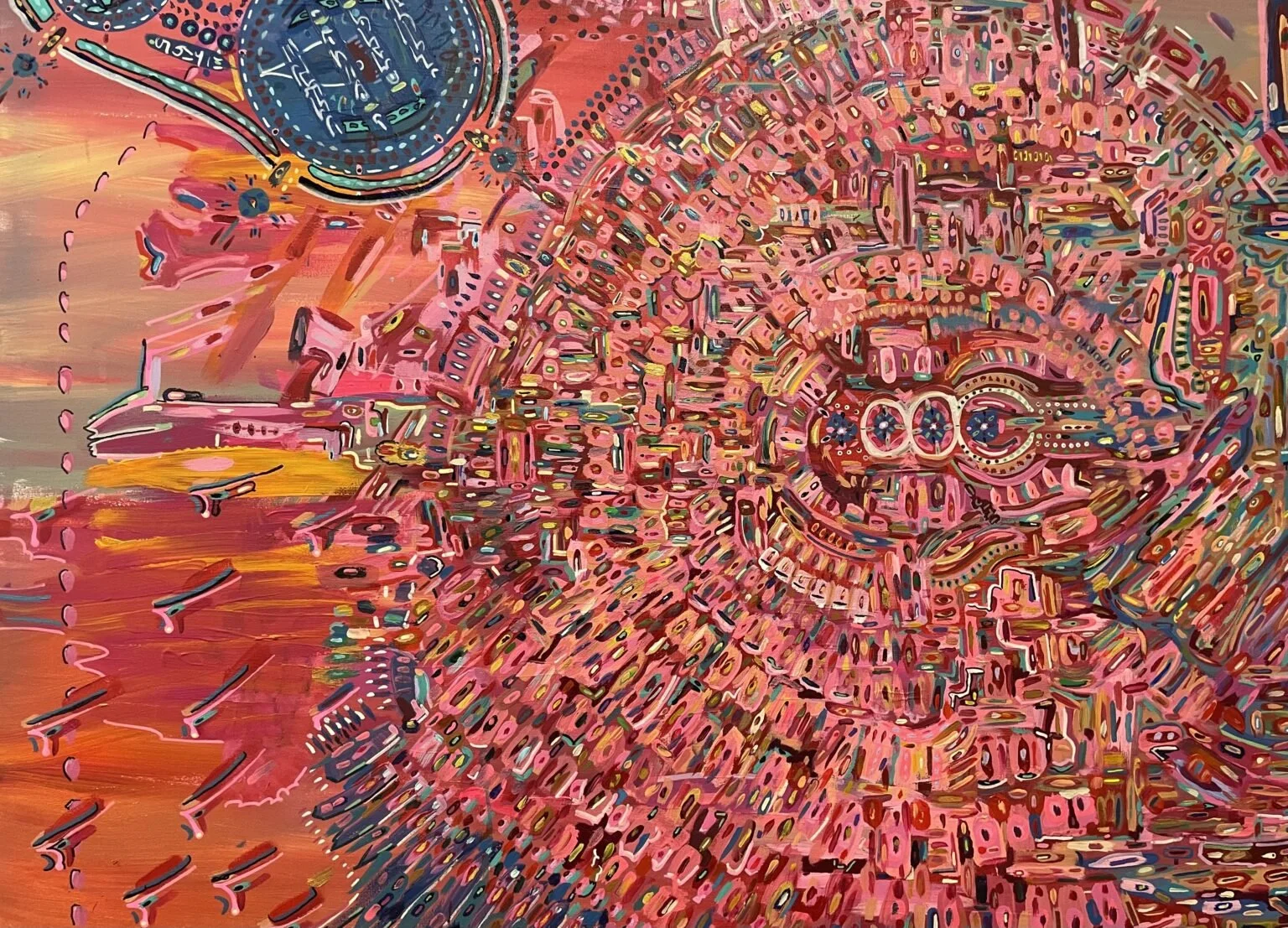
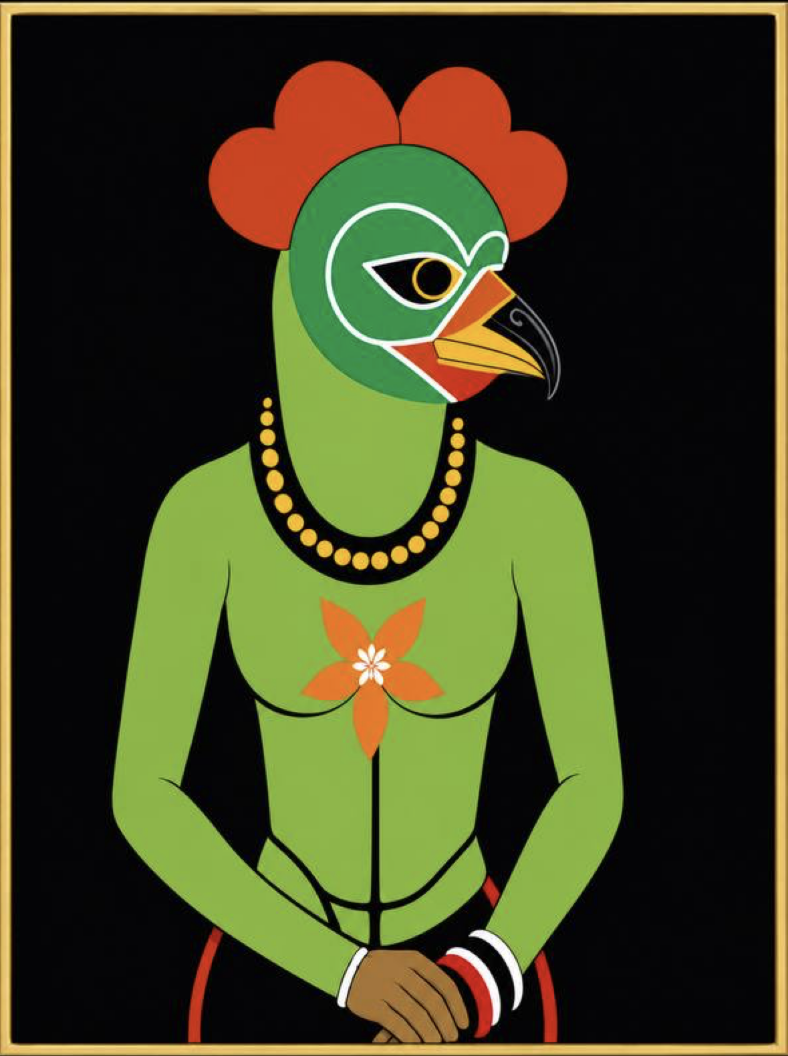
The figure represented in this painting first emerged in New Orleans, following an encounter with the Black Mardi Gras Indians. While residing in the Ninth Ward, I was profoundly influenced by the surrounding plant life and the city’s unique cultural landscape a dynamic confluence of traditions, histories, and ancestral memory. From this environment arose the initial vision of the bird-like being, conceived as an entity that subsists as pure information within the base layer, the fundamental stratum of reality from which all subsequent forms and appearances are derived. Within such a framework, the figure may be understood as a mediator from this substratum, bearing an informational essence that precedes material embodiment. This interpretation resonates with theoretical perspectives that regard consciousness as a form of metaprogramming system, capable of interacting with dimensions of reality beyond the scope of ordinary perception. The work, therefore, situates itself at the intersection of cultural memory and metaphysical inquiry, presenting a being that operates simultaneously as a product of lived history and as an expression of the informational currents underlying base reality.”
divine truth is inexhaustible, continually revealing itself in new forms according to the consciousness and capacity of the seeker/viewer. This principle resonates with the painting, where the passage of the soul through the alligator head symbolizes a threshold of perception: each viewer encounters the image through the lens of their own inner state. Just as many religious traditions affirm that no single interpretation exhausts divine meaning, these paintings function as a multi-layered vessel, offering different revelations depending on the depth of engagement. In this sense, the work becomes not a fixed image but a living text and image, reflecting both base reality and the ever-shifting consciousness that attempts to grasp it.