The Arush
When you stand before it, something begins. You may not know what it is yet but a part of you already does.
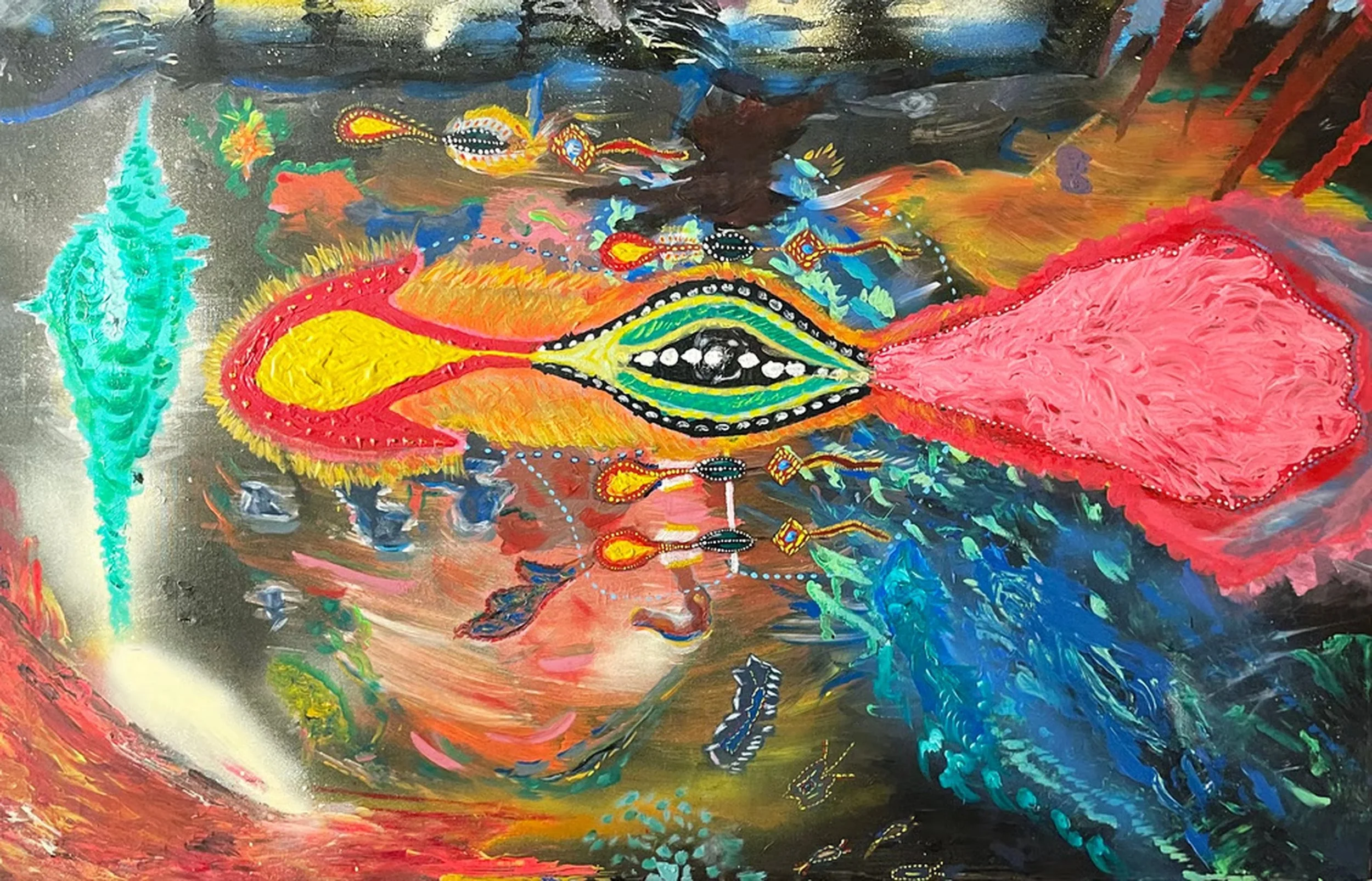
In the evolving mythos of Roland Carter, The Arush is not a character but a living intelligence a cosmic generator, a structure that conceals and reveals the codes of transformation. It is womb and threshold: something to pass through, or perhaps remember.
Painted in luminescent detail, The Arush pulses with symmetry, color, and biological rhythm, as though breathing through the wall itself. Some see a portal. Others, an alien mandala. For some, the body responds before the mind has decided what it is seeing.
Follow its inner geometries long enough and something begins to reverse: you are no longer simply looking at the painting. The painting seems to be looking back.
The work draws on Carter’s investigations into somatic tension, fascial systems, ancestral patterning, and nondual states of consciousness. Yet these references do not resolve the image. They form a kind of hidden anatomy a structure in which memory, sensation, and transformation appear to occupy the same space.
The Arush is the Body without Organs given visionary form. The Other Mother. Keeper of the code. A timeless structure beneath all becoming.
The Arush came to me in 2010, before I knew what to call it. It first appeared in a dream not as god, not as machine, but as a presence. Alive somehow. Moving through space the way mycelium moves beneath the soil: unseen, patient, without haste.
The Arush Landing
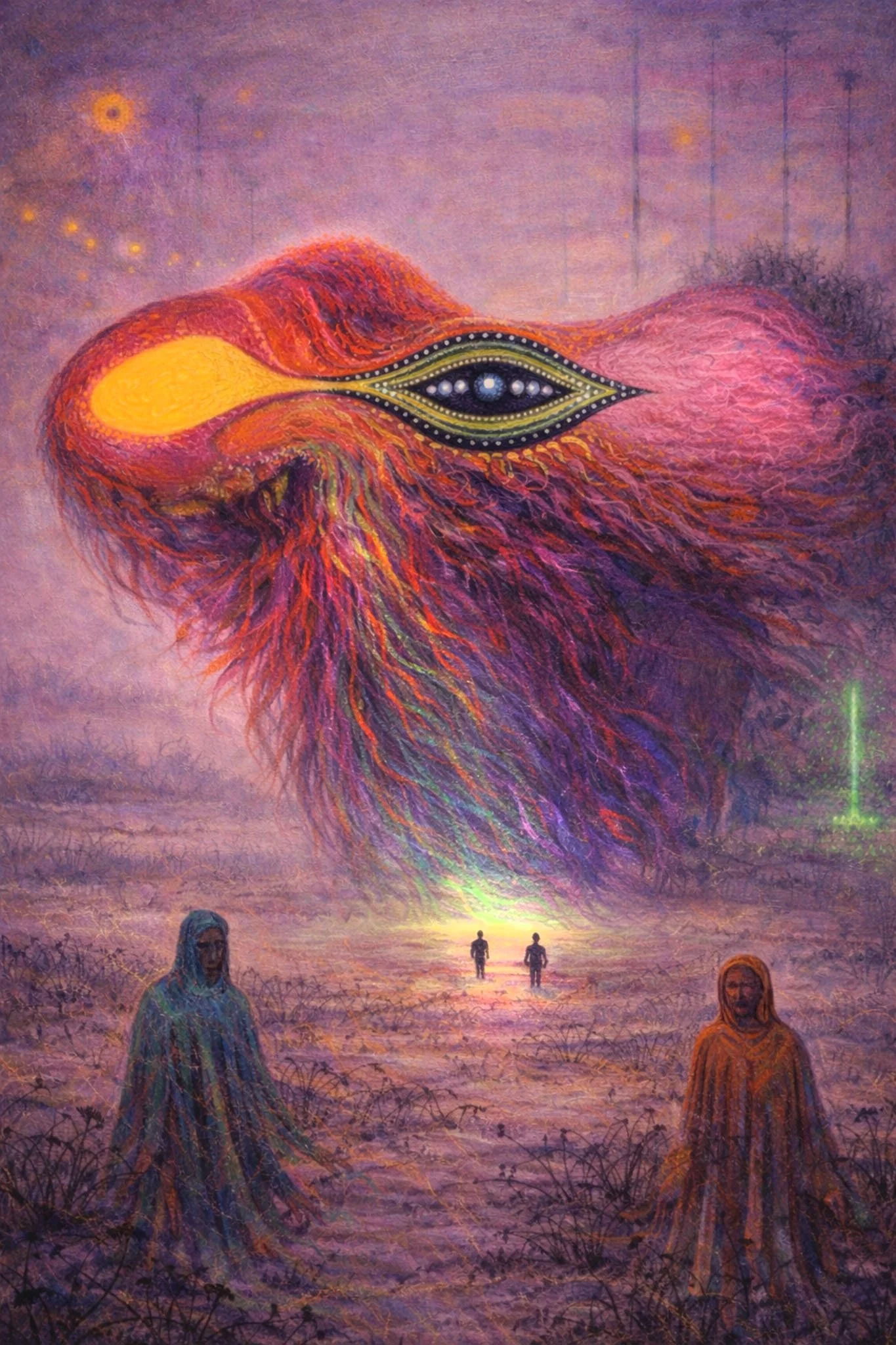
The Arush does not search; it feels.
When a world is ready not perfect, not pure, only ready to feel—it arrives. From there, a pattern spreads, threading through matter, memory, and instinct. It does not decide what should grow. It reminds what is already there.
The luminous points are spores, fragments of awareness. The spirals are blueprints—emotional rather than technical. The form of the Arush is never fixed; it changes with the one who encounters it. Some find comfort, others unease. A few sense it looking back. At times, the body seems to remember something older than thought, as though the Arush had always been present within it.
In the early work, these ideas first appeared through the body: organic forms, internal structures, shapes that seemed biological without belonging to any known anatomy. Over time, that anatomy expanded beyond the human. The body became landscape. The landscape became cosmos.
Within this mythology, the Arush is not confined to the image. It is alive in our universe.
Perhaps they drift between stars for millennia vast leviathans hibernating between sources of energy, awakening in the presence of light or radiation. Their bodies are immense and almost transparent, carrying luminous gases within them. Fins unfold into electromagnetic sails. Slow pulses travel through their forms: movement, communication, or something for which we have no name.
Seen this way, the organic shapes of the early paintings are no longer merely abstract. They might be fragments of an anatomy glimpsed before the creature itself was understood.
Nothing here is resolved. What remains begins with the viewer.
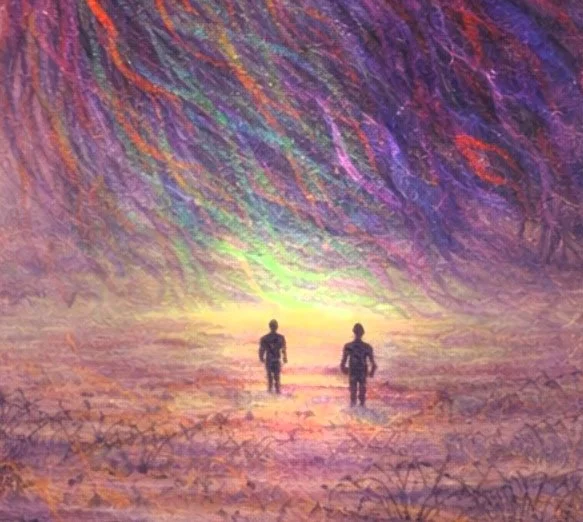
Light moves across their skin like auroras or neural activity unfolding on an unimaginable scale. Vast, silent, ancient, they drift between storm bands and nebular currents, feeding on starlight, radiation, and dust.
Their movement is almost imperceptible. A fin turns. A membrane opens. A slow pulse travels through the body and disappears into darkness. Whether these signals are navigation, communication, or thought remains unknown.
They seem less like creatures moving through the universe than something the universe itself has learned to become.