Roland Carter — The Longbody
100 × 160 cm | Acrylic on Canvas
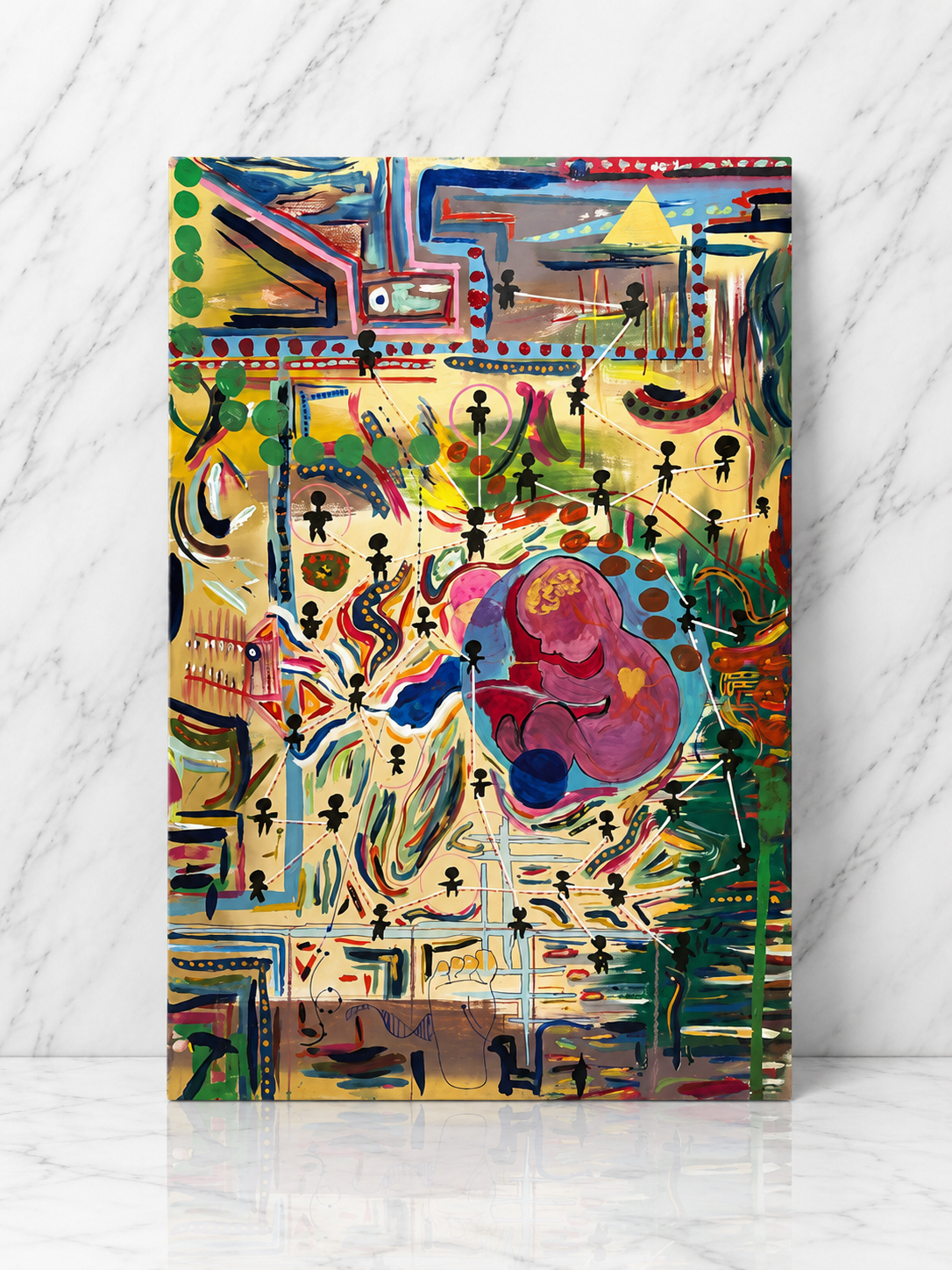
The Longbody explores the human being not as an isolated body, but as part of a much larger biological, emotional, social, and environmental system. It asks where the individual truly begins and ends, and how the experiences, relationships, decisions, and environments encountered throughout a lifetime become embedded within us.
At the beginning of the composition is the baby in the womb — the first environment we inhabit and the first relationship between body and world. Birth marks our passage into another environment, but it is not necessarily a gentle transition. Coming into the world can itself be overwhelming, establishing the painting’s central idea that our nervous system is shaped by experience from the very beginning of life.
Across the work, green and red dots represent the years of a human life. Some years become red — periods marked by pain, fear, loss, or trauma. Yet these colours are not necessarily permanent. Through healing, understanding, and transformation, what was once carried as red can become green. The past cannot be erased, but our relationship to it can change.
The stripes represent the decisions we make, the pathways and directions through which a life develops. Alongside them, small black figures represent the people we encounter — family, friends, strangers, lovers, teachers, adversaries and others whose presence can alter the trajectory of our lives. Together, these elements form a visual network in which identity is produced not by the individual alone, but through continuous interaction with everything surrounding it.
This interconnected system is the Longbody: a conception of the human organism extending beyond the visible boundary of the skin. The individual body exists together with the biological and social systems that sustain, influence, and transform it. Environment, relationships, memory, behaviour, and physiology become parts of one larger living field.
Within this expanded body, social experience is physical experience. We do not encounter one another through the intellect alone. The nervous system continually reads movement, expression, attention, proximity, and intention. We internally simulate aspects of what others are experiencing, allowing another person's emotional or physical state to affect our own.
In the painting, this embodied exchange takes the form of the dragon.
The dragon represents trauma as a force capable of entering the Longbody and moving through an entire life. Trauma does not necessarily remain confined to the moment in which it occurred. When it is unresolved, its effects can continue through memory, behaviour, relationships, perception, and the body's responses to the world. What happened years earlier can remain present in the way the nervous system anticipates danger.
Childhood experiences become particularly significant within this landscape. Fear and helplessness carried forward from early life can influence how safety, intimacy, trust, and connection are experienced in adulthood. The dragon therefore represents not only the traumatic event, but the way its consequences can travel through time.
Yet The Longbody is not a painting about inevitability. Red can become green. Patterns can change. The nervous system can encounter new experiences, new relationships, and new forms of safety. Healing becomes a process of transforming the relationship between past and present rather than pretending that the past never existed.
Through layered mark-making, symbolic figures, recurring patterns, and interconnected pathways, Carter constructs the canvas almost as a map of an extended human organism. Womb, body, environment, other people, memory, choice, trauma, and healing exist within the same visual system.
Ultimately, The Longbody challenges the conventional boundary between self and environment. If our biology is continuously shaped through relationships and surroundings, perhaps the human body cannot be understood simply as something contained by the skin.
The work leaves us with four fundamental questions:
WHY DO WE HAVE NERVOUS SYSTEMS?
ARE WE CURRENTLY LIVING IN AN ALIEN ENVIRONMENT?
WHERE DOES THE HUMAN BODY BEGIN AND END?
WHAT IS TRAUMA, AND HOW CAN WE LET IT GO?
Medium: Acrylic on canvas
Dimensions: 100 × 160 cm
Artist: Roland Carter
Status: Sold
Collection: Private Collection, Groningen, The Netherlands
Order Print
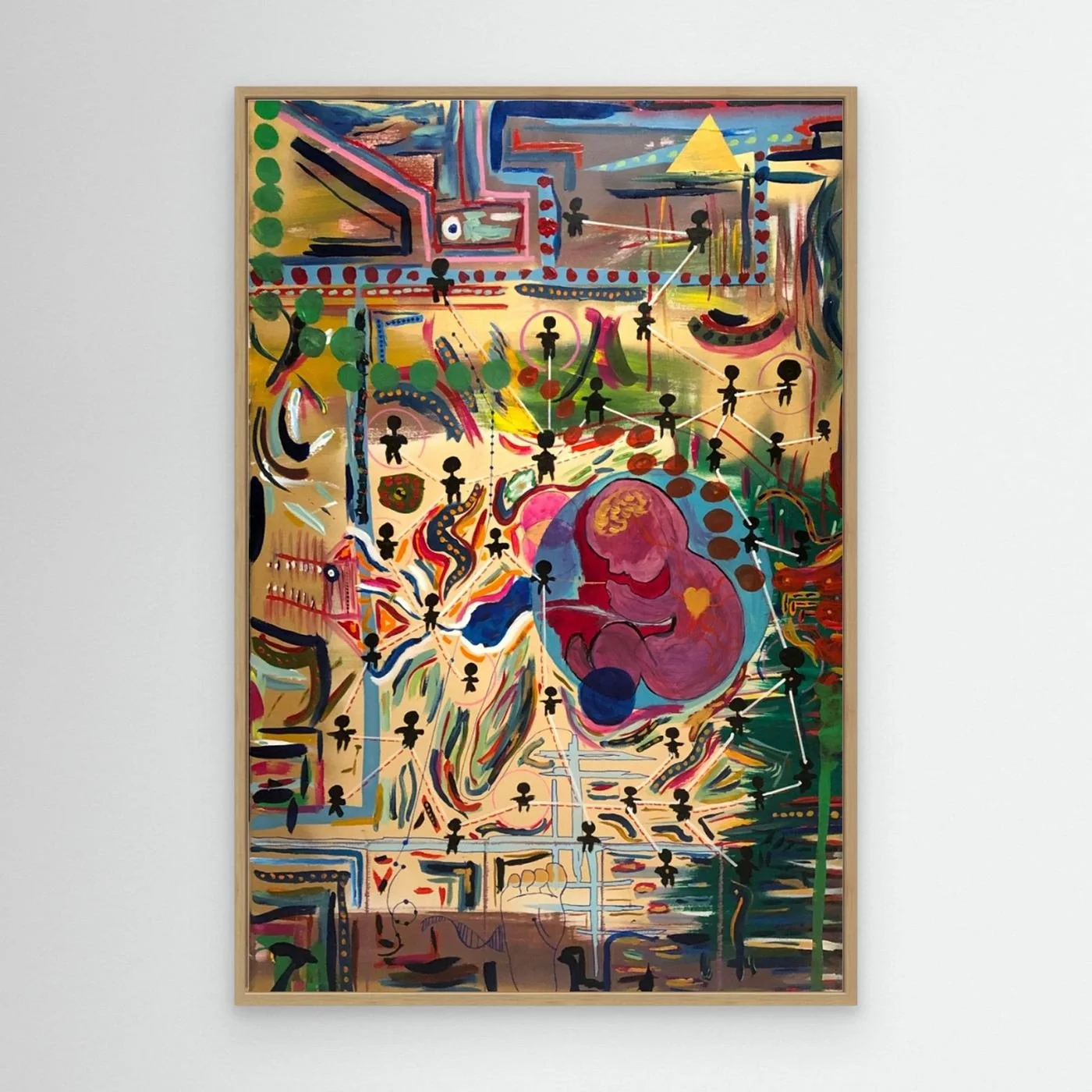
• Poly-cotton blend canvas with a matte/satin finish. Scratch, crack, and warp resistant. • Vibrant, long-lasting colors with water-based HP Latex inks and UV protection. • Solid wooden frame from renewable sources, 4 cm deep. The Longbody The Longbody explores how trauma, relationships, choices, and healing shape us throughout our lives. Beginning with the child in the womb, the painting traces a life through red and green marks representing pain and healing, interconnected figures representing the people we encounter, and pathways representing the decisions we make. Inspired by the idea that the human body extends beyond the individual into our social and biological environment, the work asks: Where does the human body begin and end? What is trauma, and how can we let it go?